
How to Play
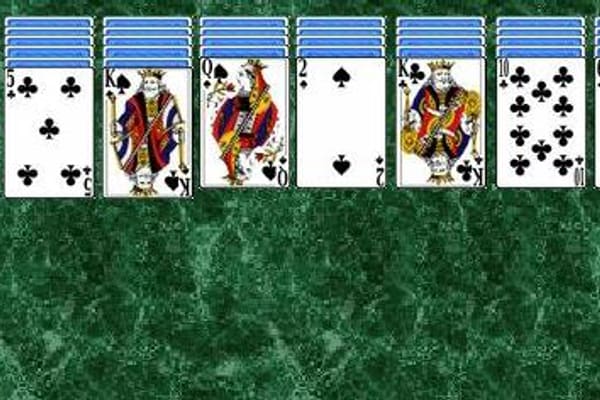
Spider Solitaire is a two-deck one-player patience played across 10 tableau columns. The goal is to assemble eight complete same-suit sequences from King down to Ace; each completed run is sent out of play. Spider has three difficulty modes based on suit count (1, 2, or 4 suits).
Spider Solitaire is a popular two-deck patience game played with 104 cards. The tableau is 10 columns of 5 or 6 cards; the goal is to assemble eight complete same-suit sequences from King down to Ace (each sequence is 13 cards of one suit) and send them out of play. It has three difficulty modes based on how many suits are in use (1, 2, or 4), and a typical deal takes 10 to 25 minutes. Optimal win rates range from nearly always in 1-suit to about 1 in 3 deals in 4-suit.
Quick Reference
- Shuffle two 52-card decks (1-suit uses all spades, 2-suit uses spades and hearts, 4-suit uses all suits).
- Deal 10 columns: first 4 have 6 cards, remaining 6 have 5 cards; only bottom cards face-up.
- Remaining 50 cards form the stock, dealt in 5 groups of 10 during play.
- Single-card move: place the bottom of any column onto a column whose bottom card is one rank higher (any suit).
- Same-suit run: move a contiguous descending same-suit sequence as a unit onto a column one rank higher.
- Completed King-to-Ace same-suit sequence is automatically removed.
- When you want, deal 10 cards from the stock (one per column); every column must be non-empty first.
- Win = all 8 suit sequences removed; loss = stuck with stock empty.
- Success by mode: 1-suit ~100%, 2-suit ~80%, 4-suit ~30%.
Players
1 player. Spider Solitaire is strictly solitary; no partnership or competitive variant exists in the classic rules.
Card Deck
Two standard 52-card decks shuffled together (104 cards). The decks are pre-filtered depending on the difficulty mode: 1-suit uses only spades (each suit's 52 cards are replaced with 52 spades, 4 copies of each rank × 13 ranks; or equivalently 8 full spade suits); 2-suit uses spades and hearts (4 sets of each); 4-suit uses all four suits (2 sets of each, i.e. the full 104-card two-deck pack). Within each suit, cards rank Ace (low) through King (high) for sequence-building.
Objective
Remove all 104 cards by assembling 8 complete same-suit sequences from King down to Ace in the tableau, each of which is immediately sent out of play. When all 8 sequences have been completed and removed, the tableau is empty and the game is won.
Setup and Deal
- Shuffle the 104-card deck thoroughly.
- Deal 10 tableau columns: the first 4 columns receive 6 cards each (24 total) and the remaining 6 columns receive 5 cards each (30 total), for a total of 54 cards in the tableau. Only the top (bottom of the stack) card of each column is face-up; the cards above it in the column are face-down.
- Stack the remaining 50 cards face-down beside the tableau as the stock. The stock is dealt in 5 groups of 10 cards during play.
- No foundation slots are used explicitly; completed 13-card sequences are removed to a discard area out of play.
Gameplay
- Available cards: The bottom card of each tableau column is available to move. Face-down cards become face-up when they become the bottom of their column (because the cards below them have moved away).
- Single-card move (building down by rank): Move the bottom card of any column onto another column whose bottom card is exactly one rank higher, regardless of suit. For example, any 7 may be placed on any 8; a 9 of diamonds may sit on a 10 of clubs. Single-card builds ignore suit entirely.
- Same-suit sequence move: A contiguous run of cards in descending rank, all of the same suit at the bottom of a column (for example ) may be moved as a group onto any column whose bottom card is one rank higher (a 10 of any suit). Multi-card moves require the moving group to be in perfect same-suit descending order; mixed-suit sequences cannot be moved as a unit (they must be moved one card at a time, which is usually impossible in practice).
- Completing a sequence: Whenever a full 13-card same-suit sequence (King, Queen, Jack, 10, 9, 8, 7, 6, 5, 4, 3, 2, Ace, all of one suit) comes together at the bottom of any column, the sequence is automatically removed from the tableau and set aside. The next card above is turned face-up if face-down.
- Dealing from the stock: When you choose, deal 10 cards from the stock: one face-up card onto the bottom of each of the 10 tableau columns. No column may be empty when you deal from the stock; every column must have at least one card before the deal is legal (fill any empty columns first with available cards or sequences).
- Five deals only: The stock is dealt in 5 groups of 10; when it is exhausted, no more deals happen.
- Empty columns: Any single card, or any same-suit sequence, may fill an empty column. Empty columns are extremely valuable because they allow reshuffling of blocks.
- Illegal play: Moving a card onto a tableau column whose bottom card is not one rank higher is illegal. Moving a multi-card group that is not perfect same-suit descending order is illegal. Dealing from the stock while any column is empty is illegal.
- End of game: The game ends when (a) all 8 suit sequences are completed and removed (win), or (b) no legal move remains and the stock is empty (loss / stuck state).
Winning
- Win condition: All 104 cards have been assembled into 8 complete same-suit King-to-Ace sequences and removed. The tableau is empty.
- Loss condition: No legal move remains (cannot build, cannot deal because columns are empty, or the stock is exhausted and no move helps).
- No tie-breakers: Win or loss; no running score within a deal. Some implementations award a time or move-count bonus for tournament play.
- Success rate by difficulty: 1-suit: nearly 100% winnable with correct play. 2-suit: around 80% winnable. 4-suit: around 30% winnable (about 1 in 3 deals).
Common Variations
- 1-suit Spider: Only spades used (effectively every card is the same suit). Multi-card moves are always same-suit; a beginner or teaching mode.
- 2-suit Spider: Spades and hearts; some sequences can cross colours.
- 4-suit Spider: The full two-deck pack; the standard competitive mode.
- Spiderette: Single-deck Spider played in 7 columns (like Klondike); quicker game.
- Simple Simon: Single-deck Spider variant with all cards face-up from the start; pure puzzle.
- Scorpion: Similar two-deck layout but all tableau cards start face-up; different strategy.
- Relaxed Spider: Allow dealing from the stock even when some columns are empty; significantly easier.
- Spider One Suit to Four: A graduated learning mode where you start with 1-suit and build up.
Tips and Strategy
- Build same-suit sequences whenever you have a choice between an in-suit and an out-of-suit target. An in-suit sequence can be moved as a group; an out-of-suit build cannot, and creates a locked column down the line.
- Empty columns are your most valuable resource. An empty column can temporarily hold a long sequence while you reshuffle elsewhere. Never fill an empty column until you are sure the filling card (or sequence) has somewhere useful to return.
- Uncover face-down cards aggressively. Until a face-down card is flipped, you have no information; every turn-up adds a little more data and usually a little more flexibility.
- Be cautious with stock deals. Dealing 10 new cards onto the tableau is nearly always destructive to your current sequences; make every move possible before committing to a deal. You only have 5 deals total.
- Do not let a King sit at the bottom of a column unsupported. A King is a sequence starter, but it locks the column until you can build downward from it; if you cannot build on it and you deal from the stock, the column is stuck.
- In 4-suit, prioritise opening up long same-suit runs even if you must temporarily create short out-of-suit builds as scaffolding. You will almost always need 2+ long in-suit sequences running in parallel to win.
Glossary
- Tableau: The 10-column spread of cards in the play area (54 cards initially).
- Column: One of the 10 tableau stacks; only the bottom card is available to move.
- Stock: The 50-card face-down reserve, dealt in 5 groups of 10 during play.
- Suit / rank build: Moving a card (or same-suit run) onto a higher card of the same or different suit, in strictly descending rank.
- Same-suit sequence (run): A contiguous block of descending-rank same-suit cards at the bottom of a column; can be moved as a unit.
- Completed sequence: A 13-card King-to-Ace run in one suit that forms at the bottom of a column; automatically removed from play.
- Difficulty mode: The number of distinct suits in the 104-card deck (1-suit, 2-suit, or 4-suit).
- Empty column: A tableau column with no cards; can be filled by any card or same-suit sequence.
Tips & Strategy
Always prefer an in-suit build to an out-of-suit one, even at the cost of an extra move. Protect empty columns because they are your only multi-card scratch space for reshuffling blocks.
Mixed-suit builds are tactical costs you pay now to unlock progress; each one limits future group moves, so spend them only when they enable an in-suit sequence to emerge.
Trivia & Fun Facts
Success rates by mode: 1-suit is near 100 percent winnable, 2-suit around 80 percent, and 4-suit around 30 percent with optimal play, making 4-suit one of the harder standard solitaires.
-
01How many complete King-to-Ace sequences must be assembled to win Spider Solitaire?Answer Eight; each 13-card same-suit sequence is automatically removed when completed, and clearing all eight empties the tableau.
History & Culture
Spider patience appeared in Charles Jewell's 19th-century patience books; it became globally recognised through Microsoft Windows XP's inclusion of 1-, 2-, and 4-suit versions.
Alongside Klondike and FreeCell, Spider is one of the three canonical digital solitaires; its 4-suit mode is widely cited as the standard 'hard' solitaire.
Variations & House Rules
Spiderette uses one deck in 7 columns. Simple Simon is a single-deck variant with everything face-up. Scorpion uses a similar layout but all cards face-up from the start. Relaxed Spider allows dealing from the stock while columns are empty.
Begin with 1-suit to learn the mechanic, then progress to 2-suit and 4-suit. For tournament play, track move counts or times across a fixed number of deals.
More Solitaire Variants


