
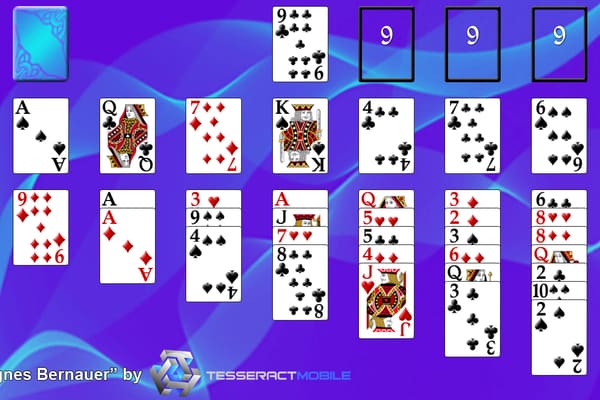
How to Play
Two named single-deck patience games: Agnes Bernauer (staircase tableau + reserve row, alternating colours, restrictive empty-column rule) and Agnes Sorel (staircase tableau, same-colour builds, free empty columns).
Agnes is a single-deck patience (solitaire) game that David Parlett in 1979 split into two distinct named variants: Agnes Bernauer, a Klondike-influenced game with a staircase tableau and a face-down reserve dealt in 7s, and Agnes Sorel, a similar staircase tableau game where builds are in the same colour rather than alternating, and no reserve is dealt. In both versions a single card is turned up at the start to determine the foundation base rank, and all four foundations then build up by suit from that rank, wrapping around from King to Ace as needed. The two remaining cards (in Agnes Sorel) or dealt reserve (in Agnes Bernauer) determine how forgiving the game is. Agnes Bernauer has a low win rate (approximately 1 in 30 games) and is one of the classic 'hard' patience games of the Victorian canon; Agnes Sorel is more generous (approximately 1 in 6). Both are solo games for a single player at a time.
Quick Reference
- 1 player with a 52-card deck.
- Turn up one card to set the foundation base rank.
- Deal 28 cards in a 7-column staircase tableau, all face-up.
- Bernauer: deal 7 more as the reserve row. Sorel: no reserve.
- Build tableau down: alternating colours (Bernauer) or same colour (Sorel).
- Foundations build up by suit from base rank (wrap K→A).
- Bernauer: deal 7 new reserve cards when stuck, 3 deals total.
- Sorel: deal 7 cards across 7 columns when stuck, 3 deals total.
- Win = all 52 cards on foundations.
- Bernauer win rate ≈ 1 in 30; Sorel ≈ 1 in 6.
Players
One player, no opponents. Agnes is a true patience or solitaire game; it can be played on a table, on a screen, or in any layout that fits 28 cards in a staircase plus a reserve row.
Card Deck
A standard 52-card deck; no jokers. Ranks order ace low through King high, but because all foundations wrap (King → Ace → 2) after reaching the top, rank order becomes effectively cyclical. Red suits are Hearts [♥] and Diamonds [♦]; black suits are Spades [♠] and Clubs [♣].
Objective
Move all 52 cards to the four foundations. Each foundation builds up by suit from the randomly determined base rank, wrapping around so that King is followed by Ace. The game is won when all four foundations hold 13 cards each.
Setup and Deal (Agnes Bernauer)
- Shuffle the 52-card deck.
- Turn the top card of the stock face-up and place it as the first foundation. The rank of this card is the base rank for all four foundations; each of the remaining three foundations is started as soon as another card of that rank becomes available.
- Deal 28 cards face-up as the tableau in a right-angled staircase: 1 card in column 1, 2 in column 2, 3 in column 3, 4 in column 4, 5 in column 5, 6 in column 6, 7 in column 7. All cards face-up.
- Deal 7 cards face-up as the first reserve row, one card below each tableau column. Only reserve cards in the current row are available for play; they cover any previous reserve cards.
- The remaining cards (52 - 28 - 1 - 7 = 16) stay in stock.
Gameplay (Agnes Bernauer)
- Foundation build: Play cards up by suit from the base rank, wrapping King → Ace. If the base is a 5 of Hearts, the sequence is 5-6-7-8-9-10-J-Q-K-A-2-3-4.
- Tableau build: Build columns downward in alternating colours (red on black, black on red). Sequences wrap from Ace down to King if needed: on a 2 you may place an Ace, on that Ace you may place a King of the opposite colour, and so on back down the ranks.
- Moving groups: Properly packed sequences may be moved as a unit from one column to another.
- Reserve cards: Only cards in the current reserve row are in play. When no useful moves remain, deal the next 7 cards from stock onto the reserve row, covering the previous row.
- Empty columns: A tableau column that has been fully cleared may be filled only by a card of the rank one below the base rank (i.e. the card that would normally come before the base on a circular rank order). For a 5-base game, empty columns must be filled with a 4; everything else is illegal.
- No redeal: Only three reserve deals are made (7 + 7 + 7 = 21; plus the final 2 leftover cards when the third reserve deal is short). After the final reserve deal, no more cards enter play; you must win with what is on the table.
Agnes Sorel Variant
- Setup: Deal the 28-card staircase and the base card as in Bernauer, then place the three other cards of the base rank face-up as foundations as they appear. No reserve row is dealt. The remaining 23 stock cards are held aside.
- Tableau build: Downward by the same colour (red on red, black on black), not alternating.
- Moving groups: Packed sequences may be moved together only if they are both same suit and same colour.
- Stock mechanic: When stuck, deal 7 cards from stock to the bottom of the 7 tableau columns, one per column. Continue dealing until stock is exhausted. After the third deal of 7 cards, two cards remain; examine them and play both onto the first two columns (from column 1 to column 2).
- Empty columns: May be filled with any available card (unlike Bernauer's restrictive rule).
- Single deal: Agnes Sorel allows only one pass through the stock; no redeal.
Scoring
- Win: All 52 cards on the foundations. Traditional score = 52.
- Loss / stalled game: Count cards successfully placed on foundations as a partial score. Some digital versions award time bonuses.
- Estimated win rates: Agnes Bernauer approximately 1 in 30 games with careful play; Agnes Sorel approximately 1 in 6 games.
Winning
You win when all 52 cards reach the foundations. There is no time limit; the game ends either in a win or in a stall where no legal move remains and the stock is exhausted. Digital versions sometimes offer a 'show all' mode that reveals if the remaining deck can still be resolved.
Common Variations
- Agnes Bernauer (classic): Reserve-based, alternating-colour tableau, restrictive empty-column rule. Named after the 15th-century Bavarian Agnes Bernauer.
- Agnes Sorel: No reserve, same-colour tableau, free empty-column fill. Named after the 15th-century French mistress of Charles VII.
- Agnes with redeal: A forgiving modern variant that allows gathering the remaining reserve or stock and redealing once. Raises the Bernauer win rate to about 1 in 10.
- Face-down reserve: A harder variant where reserve cards are dealt face-down, revealed only when the column above them empties.
- Chosen base rank: A beginner variant where the player selects a convenient base rank (often an Ace) rather than turning the top card. Raises win rates significantly.
Tips and Strategy
- Study the tableau before the first move: Agnes Bernauer is unforgiving of early missteps. Look for the three other base-rank cards and plan how to reach them before shifting cards randomly.
- Find and play the base-rank cards: Each of the four foundations must start with a base-rank card. Uncovering and playing all four is the single most important early goal.
- Preserve empty columns carefully: In Bernauer, an empty column can only be filled with the card one below the base rank. This makes an empty column practically useless until you happen to draw a base-minus-one card, so avoid clearing columns before you have somewhere to park.
- Time your reserve deals: When close to a breakthrough, sometimes it pays to hold off on dealing a reserve row until the current tableau is fully exhausted, since each deal covers existing reserve cards.
- Play each reserve card before the next deal: Once a new reserve row is dealt, covered cards are blocked. Clear the current row before dealing the next.
Glossary
- Base rank: The rank of the first card turned up at setup. All foundations start from this rank and build up by suit, wrapping King → Ace.
- Tableau: The staircase of 28 face-up cards in 7 columns (1, 2, 3, ..., 7 cards tall).
- Reserve row (Bernauer only): A row of 7 face-up cards dealt from stock below the tableau. New reserve rows cover earlier ones.
- Foundation: One of four piles built up by suit from the base rank.
- Packed sequence: A run of cards on a tableau column in alternating colour (Bernauer) or same colour (Sorel).
- Empty column / Space: A cleared tableau column. In Bernauer, may only be filled with a specific rank; in Sorel, free choice.
- Wrap: The King → Ace transition when foundations or tableau sequences reach the top of their rank order.
Tips & Strategy
Focus first on uncovering the three non-base base-rank cards to open all four foundations. Preserve empty columns until you have a base-minus-one card to fill them (Bernauer only). Clear the current reserve row before dealing the next to avoid burying useful cards.
Once the deck is shuffled, the reserve deals are predetermined; truly expert players memorise which cards are scheduled to appear and plan around them. For most players, the practical skill is simpler: always look at the full tableau before moving a card, and never clear a column in Bernauer without a base-minus-one card ready.
Trivia & Fun Facts
Agnes Bernauer has one of the lowest win rates among classic solo patience games (approximately 3%), making a successful completion a genuine achievement. Agnes Sorel, despite its similar layout, is nearly five times more forgiving at about 17% win rate, purely because of its free empty-column fill and same-colour building.
-
01What determines the starting rank for all four foundations in Agnes?Answer The very first card turned up from the stock becomes the base rank, and all four foundations must start from that rank (wrapping King → Ace → 2 as they build up).
History & Culture
Agnes Bernauer is named for the 15th-century Bavarian commoner who was the wife or mistress of Duke Albert III of Bavaria; her father-in-law, Duke Ernest, had her drowned in the Danube in 1435 out of opposition to the marriage. Agnes Sorel is named for the mistress of King Charles VII of France, herself the subject of Renaissance paintings. David Parlett assigned these names in his 1979 patience compendium to distinguish two closely related patience layouts that had previously travelled under confusing shared titles.
Agnes has been in the solo patience canon for over a century, appearing in Lady Adelaide Cadogan's 1870s and Mary Whitmore Jones's 1898 patience compendia. Parlett's 1979 renaming standardised the modern usage, and the two variants now feature in virtually every major digital solitaire collection, from Microsoft Solitaire Collection to Solitaired.com.
Variations & House Rules
Agnes Bernauer uses a reserve row and alternating-colour tableau builds; Agnes Sorel has no reserve and builds by same colour. Redeal variants raise the win rate by allowing one second pass through stock. Face-down-reserve variants make Bernauer even harder. Beginner rules let the player choose the base rank.
Choose the base rank intentionally (often an Ace) instead of turning the top card for a significantly easier game. Allow one redeal of the reserve for a middle-ground difficulty. Switch to Agnes Sorel rules for a game that feels similar but wins much more often.
More Solitaire Variants


