
How to Play
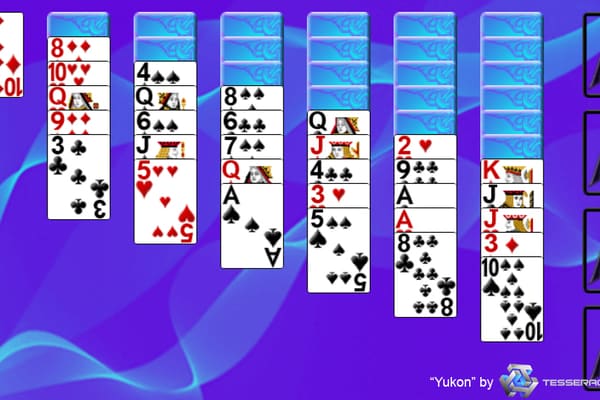
Yukon Solitaire is a Klondike-family one-player patience: all 52 cards deal into a 7-column tableau with no stock or waste. The signature rule lets you grab any face-up card together with every card stacked on top of it and move them as one group, regardless of their internal order.
Yukon Solitaire is a one-player patience game in the Klondike family, dealt entirely into a 7-column tableau with no stock or waste pile. Its signature rule allows you to move any face-up card together with everything sitting on top of it (in or out of sequence), which gives more tactical freedom than Klondike but also more ways to deadlock. A typical game takes 5–15 minutes and is winnable with careful planning.
Quick Reference
- Deal 7 columns of 1/2/3/4/5/6/7 cards, bottom card face-up, rest face-down.
- Deal the remaining 24 cards face-up, four extra per column across columns 2–7.
- No stock: all 52 cards are in the tableau from the start.
- Move any face-up card plus everything on top of it as one group (internal order does not matter).
- Land the group on a card one rank higher and opposite colour.
- Move single cards to foundations in ascending same-suit order.
- Turn a face-down card face-up as soon as it becomes the bottom of its column.
- Empty columns may only be filled by a King or a group led by a King.
- Win = all four foundations complete from Ace to King.
- Any other end state is a loss; no partial credit.
Players
1 player. Yukon is strictly solitary.
Card Deck
One standard 52-card deck. All four suits (clubs, diamonds, hearts, spades) and all thirteen ranks are used. No jokers. All 52 cards are dealt into the tableau at the start; there is no stock or waste pile at any point.
Objective
Build all 52 cards onto the four foundations, each foundation running from Ace up to King in a single suit: →, →, →, →.
Setup and Deal
- Shuffle the 52-card deck.
- Deal 7 columns with 1, 2, 3, 4, 5, 6, and 7 cards respectively (like Klondike). In every column the bottom card is face-up and the rest face-down, using 28 cards.
- Deal the remaining 24 cards face-up across columns 2–7, four extra face-up cards per column. After this, the final column layout holds 1 / 6 / 7 / 8 / 9 / 10 / 11 cards; the top five (bottom-most in the overlapping fan) of each column are face-up, the rest face-down. Column 1 has exactly one face-up card.
- Leave four empty slots above the tableau for the foundations, one per suit. All cards begin in the tableau; foundations start empty and fill during play.
Gameplay
- Group moves: Unlike Klondike, you may grab any face-up card together with every card stacked on top of it and move them as one group, even if those cards are not in rank/colour sequence among themselves. Only the destination rule needs to be satisfied; the internal order of the moving group is irrelevant.
- Tableau building: The bottom card of the moving group must land on a card one rank higher and of the opposite colour (red onto black, black onto red). For example, you can move any group led by a red 7 onto a black 8; the cards above that red 7 in the group can be anything.
- Foundation building: Only a single top card at a time may be moved to a foundation, and only if it is the next rank up in its own suit (Aces start a foundation, then 2, 3, … up to King). Cards on foundations are fixed; you may not move them back into the tableau.
- Turning face-down cards: Whenever a face-down card becomes the new bottom card of a column (because everything above it has been moved), turn it face-up. It is now an ordinary available card.
- Empty columns: An empty column may be filled only by a King, either a single King or a group of cards led by a King. Once a King occupies the slot, normal building resumes on top of it.
- Stuck state: The game ends when no tableau or foundation move remains. If every foundation runs from Ace to King the game is a win; otherwise it is a loss.
Winning
You win when all four foundations are complete from Ace to King. Any other end state is a loss. Because the game is solitary, there are no tie-breakers and no partial-credit scoring.
Tips and Strategy
- Uncovering face-down cards is almost always the top priority: hidden cards are the only unknown in the game, so every face-down card flipped reduces uncertainty.
- The group-move freedom is a digging tool: shuffling a large group onto a valid base can expose the face-down cards underneath, even when the group itself is disorderly.
- Be selective about emptying a column. Empty columns are only useful for dropping a King (or a group headed by one), so save them for when you actually have a King that needs a home.
- Avoid locking Aces underneath long disorderly groups you cannot safely move. Once the deal is done, your main risk is deadlock around the Aces.
Variations
- Russian Solitaire: Build tableau columns by same suit instead of alternating colour. The most common variant and substantially harder.
- Alaska: Build tableau columns by same suit, but allow building up or down.
- Australian Patience: Yukon-style layout with slightly different building rules, often treated as a distinct game.
- Double Yukon: Use two decks (104 cards) with proportionally larger columns. Longer game, higher win rate because of the extra face-up cards.
Glossary
- Tableau: The seven columns of playing cards in front of the player.
- Foundation: One of four target piles, one per suit, built upward from Ace to King.
- Face-up / face-down card: A card whose face is visible / hidden. Face-down cards cannot be moved until the card above them leaves and they are turned face-up.
- Group (move): A block of cards taken together: any face-up card plus everything sitting on top of it.
- Alternating colour: Placing a red card on a black one or vice versa; the rule for building tableau columns.
- Stock / waste: Reserve piles used in Klondike; Yukon has neither.
Tips & Strategy
Uncovering face-down cards is almost always the top priority; every card turned face-up reduces hidden uncertainty. Use the group-move freedom as a digging tool, not a tidying tool.
Empty columns should be reserved for Kings or King-led groups. Emptying a column without a King to fill it wastes manoeuvring room you rarely recover.
Trivia & Fun Facts
Despite having no stock pile, Yukon's effective win rate is similar to Klondike (around 80 percent with good play) because the group-move rule offsets the lack of a redraw.
-
01What movement rule makes Yukon Solitaire unique compared to standard Klondike?Answer You can move any face-up card together with every card stacked on top of it as a single group, regardless of whether the group is in sequence.
History & Culture
Yukon originated in Canada in the 20th century, sharing Klondike's Gold Rush-themed naming. It became widely known through computer solitaire collections in the late 1990s.
Yukon is a staple of solitaire software collections and a favourite of players who find Klondike too shallow; it rewards planning over luck.
Variations & House Rules
Russian Solitaire builds by same suit instead of alternating colour and is substantially harder. Alaska allows building up or down. Double Yukon uses two decks for a longer game.
Play Russian Solitaire rules (same-suit building) when Yukon feels too easy; for an easier game deal extra cards face-up or allow one undo per deal.
More Solitaire Variants


