
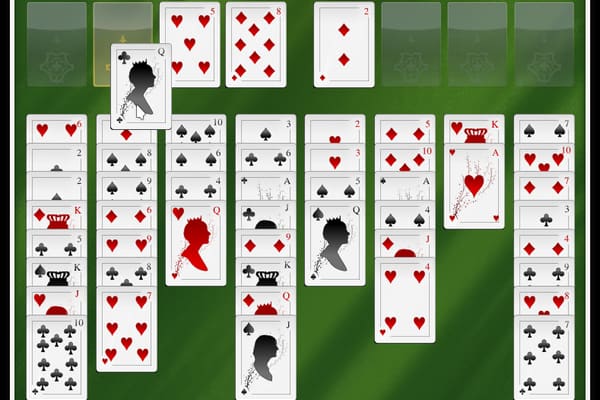
How to Play
FreeCell is an open-information one-player patience where all 52 cards deal face-up into 8 tableau columns plus four single-card 'free cells'. Build down in alternating colour on the tableau and up by suit on four foundations; nearly every deal is solvable with correct play.
FreeCell is an open-information one-player patience game in which the full deck is dealt face-up into an 8-column tableau plus four free cells that can hold one card each. Because every card is visible from the opening deal, FreeCell is a pure puzzle of planning and sequencing; nearly every deal is solvable with correct play (the standard Microsoft 32,000-deal set contains just a single unsolvable deal). Games take 5 to 15 minutes and reward multi-step forward planning.
Quick Reference
- Deal the 52-card deck face-up into 8 tableau columns (4 columns of 7, 4 columns of 6).
- Leave 4 empty free cells for single-card storage and 4 empty foundation slots.
- Move the bottom card of any column onto another column whose bottom is one rank higher and the opposite colour.
- Or move any available card to an empty free cell (one card per cell) or to a foundation (next rank up in its suit).
- Fill empty columns with any single card.
- Supermove: a sequence of (1 + free cells) x 2^(empty columns) cards may move as one action.
- Win = all four foundations built from Ace to King.
- Stuck state with any card not on a foundation is a loss; 99.999% of deals are solvable with correct play.
Players
1 player. FreeCell is strictly solitary; there is no multiplayer version (Double FreeCell variants exist but are uncommon).
Card Deck
One standard 52-card deck, no jokers. All four suits (clubs, diamonds, hearts, spades) and all thirteen ranks are used. Within each suit, cards rank Ace (low for foundations) through King (high). Colours matter: clubs and spades are black; hearts and diamonds are red. Tableau building follows alternating colour.
Objective
Move all 52 cards to the four foundations, each foundation built upward in a single suit from Ace to King: →, →, →, →. The game is won when every card is on a foundation; any end state with cards still in the tableau or free cells is a loss.
Setup and Deal
- Shuffle the 52-card deck thoroughly.
- Deal the entire deck face-up into 8 tableau columns: the first 4 columns receive 7 cards each (28 total), the remaining 4 columns receive 6 cards each (24 total). Cards overlap downward so every card is visible.
- Leave 4 free cells empty in the upper-left (or above the tableau) as single-card reserve slots; each cell can hold exactly one card of any suit and rank at a time.
- Leave 4 foundation slots empty in the upper-right (or above the tableau), one per suit. Foundations start empty; the first play of each suit must be its Ace.
Gameplay
- Available cards: The bottom-most card of each of the 8 tableau columns is available; the single card in any occupied free cell is also available. Only available cards can be moved.
- Tableau building (down, alternating colour): Move the bottom card of any column onto another column whose bottom card is exactly one rank higher and of the opposite colour. Example: a may be placed on any red 8 ( or ), but not on another black 8.
- Free cell (temporary storage): Move any available card to an empty free cell. Each free cell holds one card; you cannot stack cards in a free cell. The card in a free cell is always available for later use.
- Foundation play: An available card may be moved to a foundation if it is the next rank up in its own suit. Aces start a foundation, then 2, 3, ..., up to King. Once a card is on a foundation it is locked there (some houses allow foundation-to-tableau takebacks; the strict rule does not).
- Empty columns: Any single card may fill an empty tableau column. Empty columns are powerful because they double as a staging area.
- Single-card moves (strict rule): Only one card moves at a time. You cannot pick up a run of cards and drop them elsewhere as a group in the strictest rule; each card must be moved individually.
- Supermoves (standard convention): Most FreeCell implementations allow 'supermoves': moving a sequence of alternating-colour rank-descending cards as a single user action, provided you have enough free cells and empty columns to have moved them one at a time. The formula is: max supermove = (1 + empty free cells) × 2^(empty columns). With 3 free cells and 1 empty column, you can supermove up to 4 × 2 = 8 cards.
- Game end: The game ends when every card is on a foundation (win), or when no legal move remains and at least one card is not yet on a foundation (loss / stuck state).
- Illegal play: Moving a card onto a same-colour tableau target, or onto a wrong-rank foundation, is illegal; return the card. Placing two cards in one free cell is illegal.
Winning
- Win condition: All four foundations complete from Ace to King in their suits. The tableau is empty, the free cells are empty, and the deal is a win.
- Loss condition: A stuck state with no legal moves and at least one card still off-foundation.
- No tie-breakers and no score: FreeCell is win-or-loss; most implementations track move count and/or time for personal best, not for game outcome.
Common Variations
- Baker's Game: FreeCell's precursor; tableau columns build by same suit instead of alternating colour. Significantly harder.
- Seahaven Towers: Hand of 10 tableau columns of 5, two free cells, and only Kings may fill empty columns. Harder than FreeCell.
- Eight Off: 8 free cells but only Kings may fill empty columns. Easier than FreeCell.
- Penguin: The card matching the dealt starter acts as a special rule; Kings fill empty columns.
- Stalactites: Tableau deals with a mandatory two-column reserve at top; harder.
- Cells variations: 3, 5, or 6 free cells instead of 4; more or fewer free cells directly changes the game's difficulty.
- Relaxed FreeCell: Allow sequence moves even when not 'legally' possible with available free cells; makes nearly every deal trivial to solve.
Tips and Strategy
- Plan several moves ahead. FreeCell rewards multi-step foresight more than any other common solitaire; the best players think 10 to 15 moves into the future before touching anything.
- Keep free cells empty. Each free cell is a precious resource; using one permanently cripples future supermoves. Fill a free cell only when you have a concrete plan to empty it again.
- Empty columns are worth more than free cells. An empty column doubles your supermove capacity (formula above); protect empty columns fiercely.
- Expose Aces first. Until an Ace is on its foundation, that suit cannot build; dig toward Aces aggressively.
- Build foundations carefully. Pushing every eligible card to the foundation is not always correct: a low card of one suit sitting on the foundation may be needed later for a mid-game tableau sequence. Hold cards that could still help.
- When truly stuck, try a reverse-search: look at what would have to happen for the last few cards to reach the foundation, then work backward to identify which column card must come out now.
Glossary
- Tableau: The 8-column spread of face-up cards at the start of the game.
- Column: One of the 8 tableau stacks; only the bottom card is available to move.
- Free cell: A single-card reserve slot; holds exactly one card at a time and acts as a temporary stash.
- Foundation: One of the 4 suit piles built upward from Ace to King; the win condition is filling every foundation.
- Supermove: A multi-card move permitted by the current number of empty free cells and empty columns; the formula is (1 + free cells) × 2^(empty columns).
- Available card: The bottom card of a tableau column or a card in a free cell; only these can be moved.
- Alternating colour: The tableau building rule, red on black or black on red.
Tips & Strategy
Plan many moves ahead; FreeCell rewards multi-step foresight more than any other common solitaire. Empty columns are more valuable than free cells because they multiply your supermove capacity.
Sending every eligible card to the foundation is not always correct; a low card on the foundation may be needed later as a tableau anchor. Hold cards that might still help.
Trivia & Fun Facts
Of the 32,000 deals in the original Microsoft set, only deal number 11,982 has been proven unsolvable; the solvability rate therefore exceeds 99.999 percent.
-
01How many free cells are available for temporary card storage in FreeCell?Answer Four; each holds exactly one card at a time, and their availability drives the supermove formula (1 + free cells) x 2^(empty columns).
History & Culture
Invented by Paul Alfille in 1978 for the PLATO computer system and later popularised by Microsoft, who included it in Windows from 1995 onwards. The 32,000-deal Microsoft set remains a benchmark.
Microsoft's inclusion of FreeCell in Windows made it one of the most-played computer games ever; it is often taught alongside Solitaire and Hearts to new PC users.
Variations & House Rules
Baker's Game uses same-suit building instead of alternating colour. Eight Off has 8 free cells but allows only Kings into empty columns. Seahaven Towers, Penguin, and Stalactites are related variants.
Start with 5 or 6 free cells for an easier experience, or 2 or 3 for a challenge. Baker's Game offers a harder spin on the same layout.
More Solitaire Variants


