
How to Play
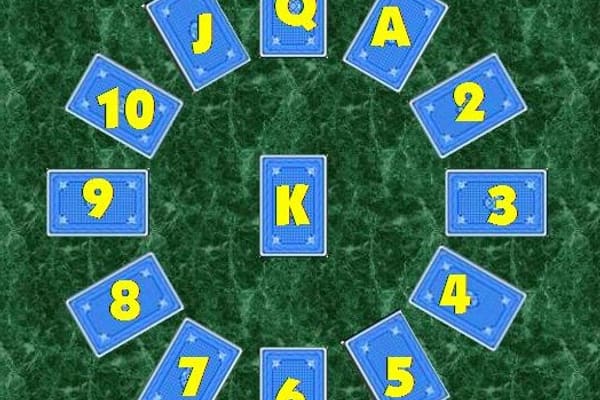
Clock Patience (Clock Solitaire, Travellers) is a one-player patience of pure chance. Deal the 52-card deck face-down into 13 piles arranged as a clock face (12 hour piles plus a centre pile), then flip cards one at a time and place each onto its rank-matching pile until the fourth King appears.
Clock Patience (also Clock Solitaire, Travellers, Sundial, Hidden Cards, or Four of a Kind) is a one-player patience game of pure chance: the full deck is dealt into 13 piles arranged as a clock face with a central King pile, and the game runs itself by turning a card, placing it at its rank's hour position, and flipping a new card from that pile. The player wins only if every rank pile fills before the fourth King turns up. A deal runs 2 to 5 minutes and wins about once every 13 attempts.
Quick Reference
- Deal the 52-card deck face-down into 13 piles of 4, 12 arranged as a clock and one in the centre.
- Leave all piles face-down; the game runs automatically.
- Turn the top card of the centre pile face-up to start.
- Place each revealed card under the pile matching its rank (Ace=1, 2=2, ..., Jack=11, Queen=12, King=centre).
- Turn the top face-down card from the pile you just placed into, and repeat.
- The deal ends the moment the fourth King is turned face-up.
- Win = fourth King turns up with no face-down cards left anywhere (win rate about 1 in 13).
- Loss = fourth King turns up with any face-down card still on the clock.
Players
1 player. Clock Patience is strictly solitary. The player makes no choices during the deal; once the shuffle is done, the outcome is fixed.
Card Deck
One standard 52-card deck, no jokers. All four suits (clubs, diamonds, hearts, spades) are used, but suits do not affect play; only ranks matter. Ranks are mapped to clock positions: Ace to 1 o'clock, 2 to 2 o'clock, 3 to 3 o'clock, continuing through 10 at the 10 position, Jack at 11, Queen at 12, and Kings to the central pile.
Objective
Reveal every one of the 52 cards by the automatic play rules below, so that each of the 12 hour piles is completed with its four matching-rank cards and the central pile is completed with the four Kings. The game is won when the final card turned is the fourth King (and no face-down cards remain elsewhere); it is lost when the fourth King is turned while any other pile still has a face-down card in it.
Setup and Deal
- Shuffle the 52-card deck thoroughly; the quality of the shuffle is the only factor that influences the outcome.
- Deal all 52 cards face-down into 13 piles of 4 cards each, in a clock-face arrangement: 12 piles around a circle at the positions of 1 through 12 on a clock, with the 13th pile in the centre. The piles are dealt in the cycle 1, 2, 3, … 12, centre, 1, 2, …, continuing through four complete passes so every pile receives four cards.
- Do not look at any card during the deal; all piles stay face-down until the play begins.
Gameplay
- Starting move: Take the top (face-down) card of the centre pile and turn it face-up. This is the only manual decision in the game, and it has no strategic weight.
- Placing a card: Slide the face-up card face-up underneath the clock-position pile that matches its rank: an Ace goes under the 1-o'clock pile, a 5 under the 5-o'clock pile, a Queen under the 12-o'clock pile, and a King under the central pile. Place it visibly beneath the face-down cards of that pile so you can see it later when the pile is checked.
- Drawing the next card: Immediately take the top face-down card from the pile you just placed a card under and turn it face-up. Place that card under its rank pile by the same rule, then turn the new top card of that pile, and so on.
- The fourth King ends the deal: Kings are placed under the centre pile. The game continues automatically as long as at least one face-down card is available to turn on the pile you last placed into. The instant the fourth King is turned face-up, the deal ends.
- Illegal play: There are no illegal plays because the player makes no choices; simply follow the place-then-turn rule in order. If the top card you are about to turn is already face-up (because the game logic placed you on a pile that is already full), the game stops immediately.
- Stuck state handling: The only way the game can stop early is when the fourth King turns up while other piles are incomplete; the deal is over at that moment.
Winning
- Win condition: If the fourth King is turned only after every other pile (1 through 12) already has its four matching-rank cards completed, the deal is a win. Every card has been revealed and is sitting on its correct pile.
- Loss condition: Any deal in which the fourth King is turned while any non-King pile still has at least one face-down card is a loss.
- No scoring and no tie-breakers: Because only one player plays and the outcome is binary (win or loss), there is no scoring system and no tie-breaker.
Common Variations
- Watch (or Peek Watch): When the fourth King is drawn, swap it for any still-face-down card rather than ending the deal. The game ends the second time the fourth King surfaces. Slightly raises the win rate.
- Remove-a-King start: Remove one King before dealing (so 51 cards are dealt into 12 piles of 4 and one pile of 3). The fourth King is now only ever the third King drawn, extending the game; win rate rises noticeably.
- Clock / Four of a Kind alternative layout: Lay the 12 hour piles face-up and only keep the centre pile face-down. Reveals almost all information and turns the game into a near-certain win; used when teaching children.
- Sundial / Open Clock: All 52 cards dealt face-up from the start; the player may choose which face-up card to use as the 'next to place', introducing some limited skill.
Tips and Strategy
- There is no strategy during play; the deal either solves itself or it does not. The only thing a player controls is the quality of the shuffle.
- Shuffle thoroughly (riffle at least seven times, or follow your group's shuffle standard). A weak shuffle that leaves Kings clustered together lowers the already-low win rate further.
- Clock Patience is a common teaching game for counting and basic card identification with young children; leaning into its zero-decision nature is the point of the game.
Glossary
- Clock face: The arrangement of 12 piles in a circle matching positions 1 through 12 on a clock; each pile takes the rank of its position.
- Centre pile: The 13th pile at the middle of the clock, reserved for Kings.
- Hour pile / rank pile: A clock-position pile that accepts cards of a specific rank (for example, the 5-o'clock pile takes 5s).
- Fourth King: The fourth and last King to be turned face-up; its appearance ends the game whether or not the other piles are complete.
- Face-up / face-down card: A card turned visible or hidden; Clock Patience starts all cards face-down and the play flips them one at a time.
Tips & Strategy
There are no in-game decisions; the deal decides the outcome. Shuffle thoroughly (seven riffles minimum) so Kings are distributed across the stock rather than clustered together.
The only lever the player controls is shuffle quality. Against a poorly shuffled deck, wins are even rarer than the theoretical 1-in-13.
Trivia & Fun Facts
Despite requiring zero skill, the win rate has been proved to be exactly 1 in 13; roughly 7.7 percent of deals complete before the fourth King turns up.
-
01Which card rank sits in the centre of the clock face in Clock Patience?Answer Kings; their appearance (the fourth King) ends the deal.
History & Culture
A 19th-century English patience, Clock has travelled worldwide as a teaching game for young children learning rank names and counting.
A staple of children's card teaching and a favourite of meditative players who enjoy a purely deterministic deal-and-reveal rhythm.
Variations & House Rules
Watch (Peek) lets the fourth King be swapped for a face-down card once, extending the game. Sundial deals every card face-up so the player chooses which to flip next.
Remove one King before dealing to guarantee a longer game at the cost of pure randomness. For children, use only two suits or play Sundial for visible cards.
More Solitaire Variants


