
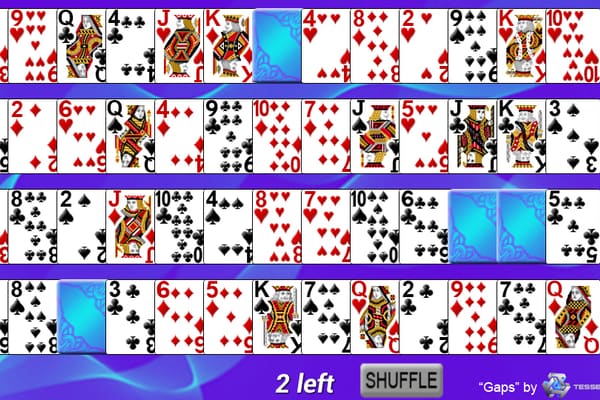
How to Play
A 19th-century single-pack patience: all 52 cards dealt in 4 rows of 13, Aces removed to create 4 gaps, fill each gap with the card one rank higher and same suit as its left neighbour, building each row from 2 to King in suit. Standard play allows 2 redeals.
Gaps (also called Montana or Spaces) is a 19th-century single-pack patience in which all 52 cards are dealt face up into 4 rows of 13 cards, the four Aces are removed to create 4 empty gaps, and the player slides cards into the gaps to build each row into an ordered sequence 2, 3, 4, 5, 6, 7, 8, 9, 10, Jack, Queen, King of the same suit from left to right. A gap may be filled only by the card that is one rank higher and of the same suit as the card immediately to the gap's left; a gap in the leftmost column of a row may be filled by any 2; a gap directly to the right of a King is 'dead' and cannot be filled until the next redeal. When no legal moves remain, the player may perform a redeal: any correctly-placed 2-to-X suit sequence starting from the left end of each row is left in place; all other cards are gathered and reshuffled, and redealt into the remaining spaces with a fresh gap left next to each preserved sequence. Classic rules allow 2 redeals; the game is won when all four rows are built in suit from 2 to King.
Quick Reference
- Deal all 52 cards face up in 4 rows of 13.
- Remove the 4 Aces to create 4 gaps.
- Fill a gap with the card one rank higher and same suit as the card to the gap's left.
- Leftmost-column gap: fill with any 2 to start a suit.
- Gap next to a King is dead until the next redeal.
- Win: all 4 rows complete 2 to King in suit.
- Up to 2 redeals; preserve left-anchored suit sequences between redeals.
Players
Single-player patience. For competition, two or more players can play simultaneously on separate tables or on digital versions using the same starting deal; fastest or most successful wins.
Card Deck
One standard 52-card French-suited pack with jokers removed. The four Aces are removed before play begins (they form the 4 gaps) and are not returned to play during the round. removed.
Objective
Arrange every card so that each of the 4 rows reads from left to right: 2, 3, 4, 5, 6, 7, 8, 9, 10, Jack, Queen, King, all of the same suit. Each row is associated with a specific suit by the 2 placed in its leftmost position. Using at most 2 redeals, the game is won when all four rows are complete.
Setup
- Shuffle a standard 52-card pack thoroughly.
- Deal the entire deck face up in 4 rows of 13 cards each, left to right.
- Remove the 4 Aces from wherever they lie, leaving 4 empty gaps at the positions where they were.
- No further cards are dealt until a redeal is triggered. All 48 non-Ace cards are visible and accessible from the start.
Gameplay
- Legal move (main rule): A gap may be filled by the card that is one rank higher and the same suit as the card immediately to the left of the gap. Example: if the card to the gap's left is the 7 of Clubs, only the 8 of Clubs may be moved into the gap.
- Leftmost-column gaps: A gap at the leftmost position of any row (no card to its left) may be filled by any 2 of any suit. Placing a 2 there anchors the row for its suit.
- Dead gaps: A gap to the right of a King cannot be filled (since no card is one-rank-higher than a King). It remains dead until the next redeal. Similarly, a gap immediately to the right of another gap has nothing playable on its left, so it must wait until the left gap is filled.
- Chain moves: Filling one gap creates a new gap at the card's old position. This new gap in turn becomes playable under the standard rule based on whatever card is now to its left.
- Move freely: Any legal move may be made at any time; there is no enforced order.
- Stuck state (trigger for redeal): When none of the 4 gaps can be filled by any card (all to the right of Kings, or all blocked by other gaps), the player has reached a stuck state and may perform a redeal.
Redeals
- A redeal may be performed whenever the position is stuck. The standard rules allow up to 2 redeals per game (3 total deals including the initial one).
- To redeal: for each of the 4 rows, identify the starting suited sequence from the leftmost 2 (if present) upward. For example, if row 2 starts 2♥, 3♥, 4♥, then pauses, those 3 cards stay in place and a fresh gap is left immediately after the 4♥.
- Gather every card NOT in a preserved leftmost sequence, remove the 4 Aces again (they go back aside), and shuffle the remaining cards.
- Redeal the shuffled cards into the empty spaces of the 4 rows (left to right, top to bottom, skipping over preserved sequences). Leave one gap in each row immediately to the right of the preserved sequence's end (or at the leftmost position if that row had no preserved sequence).
- Play continues from the new layout. If stuck again, a second redeal may be taken (the last of the 2 allowed). After exhausting all 2 redeals and becoming stuck again, the game is lost.
Scoring
- Win: All 4 rows completed 2 to King in suit. Counts as 1 game win.
- Loss: Stuck after all 2 redeals used; count cards correctly placed (in a left-starting suit sequence) as a partial score if playing a scoring variant.
- Partial-score scale (informal): 1 point per correctly placed card. A maximum of 48 points per game (12 cards × 4 rows).
- Redeal penalty (scoring variant): Subtract 5 points for each redeal used; a no-redeal win is worth +10 bonus points.
Winning
The game is won when all 4 rows show a complete 2-to-King sequence in a single suit. The assignment of suit to row is not fixed in advance; it is determined by which 2 each player chooses to place in each row's leftmost position. The game is lost if no legal moves remain and all allowed redeals are exhausted. Historical win rates are low (around 5-10% with random shuffles under standard 2-redeal rules) but can reach 40-50% with 3 redeals.
Common Variations
- Montana: Strictly speaking a distinct variant in which the 2s are pre-placed in the leftmost column before play begins (so each row already has a starting 2 of its associated suit), making the game significantly easier. In many modern references Montana and Gaps are used interchangeably.
- Spaces: Another name for the same game; some variants reshuffle ALL non-Ace cards on redeal (even those in correct position) rather than preserving left-end sequences. Much harder.
- Addiction: A popular digital variant that typically allows 3 redeals (instead of 2) and incorporates the Aces as variable gap-creators during redeals.
- Addiction Solitaire (Microsoft): The Microsoft Store version of Addiction; 3 redeals are standard.
- No-redeal Gaps: A harder variant permitting 0 redeals. Win rate drops to about 1-2%.
- Paganini: A regional variant where 3 redeals are allowed but the entire row must be suited on every redeal (not just the starting sequence).
Tips and Strategy
- Place a 2 in each row's leftmost position as early as possible. A leftmost 2 anchors the row's suit and opens up a meaningful chain of moves.
- Avoid filling a gap next to a King or Queen of a suit you already have anchored elsewhere; the King is a row-terminator and creates a dead gap, while a Queen leaves only the King as a playable option.
- Think 2 to 3 moves ahead. Each fill creates a new gap whose playability depends on the card newly to its left; poor move choice can lock you into a dead-gap cascade.
- When approaching a redeal, preserve as long a left-sequence as possible. Moving the 5 of Diamonds into position next to the 4 of Diamonds is much more valuable than moving a 10 into middle-position if it cannot be anchored.
- Against the urge to fill every gap quickly, sometimes the best move is to wait and plan; letting one gap move first so that the chain uncovers your 2 of Spades at the right spot is often worth 3 subsequent cascading moves.
- In the Addiction 3-redeal variant, use your first redeal aggressively (take moves that partially lock the rows) because 2 redeals remain; in the strict 2-redeal variant, save your redeals for genuinely stuck positions.
Glossary
- Gap: An empty space in the layout. At game start there are exactly 4 gaps (where the 4 Aces were removed).
- Row: One of the 4 horizontal lines of 13 spaces.
- Leftmost column: The first position in each row; a gap there may be filled by any 2 to start a suit sequence.
- Dead gap: A gap that cannot be filled, typically because it lies immediately to the right of a King or to the right of another gap with no playable card to its left.
- Redeal: The act of gathering all out-of-sequence cards, shuffling, and re-laying them into the empty row positions, leaving a gap next to each preserved left-sequence.
- Preserved sequence: A left-anchored run of 2-3-4-5-... in a single suit, starting from the leftmost column of a row, that is kept in place during a redeal.
- Addiction: A common 3-redeal variant of Gaps, particularly popular in digital form.
Tips & Strategy
Anchor a 2 in each row's leftmost position as early as possible; that 2 sets the row's suit and opens the biggest chain of moves. Avoid filling gaps next to Kings or Queens of suits you already have elsewhere; Kings create dead gaps and Queens leave only a single King as a playable option. Preserve long left-sequences before triggering a redeal; moving the 5 of a suit into its anchored spot is worth far more than middle-position moves.
Gaps is a layered planning puzzle rather than a pure arithmetic patience. Each move alters four gaps' playability simultaneously (the gap you just filled plus the new gap you created), so thinking 2 or 3 moves ahead is essential. The game's most decisive tactical lever is choosing which 2 to anchor in each row's leftmost position; this implicit 'suit assignment' commits the row to a specific suit and can be impossible to undo without a redeal. Expert players plan the final suit-to-row assignment early and move toward it deliberately.
Trivia & Fun Facts
The name Montana may reference either the vast open spaces of the US state (reflecting the game's need for 'space to move') or a lost family connection; no definitive etymology is documented. Addiction Solitaire, which is the 3-redeal variant, became famous as the 'just one more try' patience game on early Windows systems, earning its name from users who could not stop attempting to beat the low win rate.
-
01In Gaps, what happens when a gap appears to the right of a King?Answer The gap is 'dead' and cannot be filled during that deal (since no card is one rank higher than a King); it must wait for the next redeal.
-
02In the standard rules of Gaps, how many redeals are allowed, and how is each redeal conducted?Answer 2 redeals are allowed; each one preserves any correctly-placed left-to-right suited sequence starting from a row's 2 and reshuffles only the remaining cards into the empty positions with a fresh gap after each preserved sequence.
History & Culture
Gaps emerged in 19th-century European patience-game collections and was widely published under the names Montana, Spaces, Gaps, and Addiction across English, German, and French card-game books. The Microsoft Windows Addiction Solitaire implementation brought the game to millions of computer users in the 1990s-2000s and remains one of the best-known digital patience games. The game has one of the lower win rates among well-known patiences (around 5-10% with the strict 2-redeal rule), which explains its reputation for being genuinely challenging rather than mechanical.
Gaps has been a staple of patience-game collections for over a century and made the successful transition to digital platforms with the Windows Addiction Solitaire implementation in the 1990s. It is one of the most commonly re-implemented computer patience games and a favourite on mobile app stores. The name Montana has become the Americanised default and Addiction the standard digital name; in Europe the original Gaps name is still preferred.
Variations & House Rules
Montana pre-places the 2s in the leftmost column at setup. Addiction (3 redeals) is the dominant digital variant. Spaces shuffles ALL non-Ace cards on redeal for extreme difficulty. Paganini requires whole-row suitedness on redeal. No-redeal Gaps allows 0 redeals and is the hardest commonly-played form.
For beginners, pre-place the 2s (play the Montana variant) or allow 3 redeals (play the Addiction variant). For experts, allow 0 redeals. Use a physical layout or digital app; the 4-row structure maps well to phone and tablet screens. Keep a scoresheet to track cards correctly placed and redeals used across multiple games for a scoring tournament.
More Solitaire Variants


