
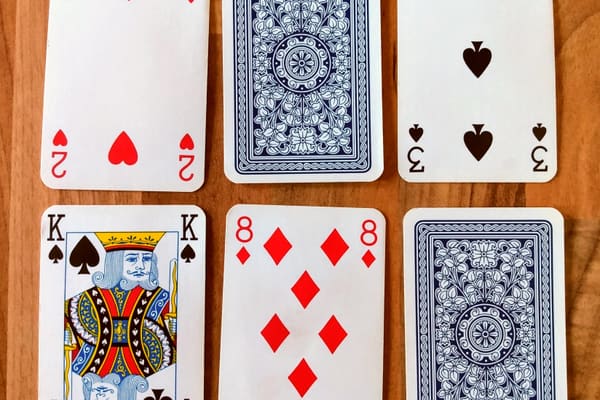
How to Play
Golf Solitaire is a one-player patience named after the sport. Deal 35 cards into a 7-column tableau, turn a card from the 17-card stock to start the waste, then clear the tableau by moving exposed cards onto the waste in either-direction rank sequence.
Golf Solitaire (also Golf Patience) is a one-player patience game named after the sport it imitates: each deal is a 'hole', and your score is the count of cards you could not clear (strokes). 35 cards are dealt face-up into a 7-column tableau, a 17-card stock drives a running waste pile, and you race to clear the tableau by laying its exposed cards onto the waste in either-direction rank sequence. One deal takes 2 to 4 minutes; the classic golf scoring format totals 9 or 18 deals across a 'round'.
Quick Reference
- Deal 7 columns of 5 face-up cards (35) as the tableau.
- Stack the remaining 17 cards face-down as the stock.
- Flip the stock's top card onto the waste pile to start.
- Move any exposed tableau card onto the waste if it is exactly one rank higher or one rank lower than the current waste top (any suit).
- Chain freely; direction may change with every play.
- Strict rule: nothing plays onto a King; Ace is low only. (Wrap-around variant allows A on K and K on A.)
- Draw one stock card when stuck; the deal ends when the stock is empty and no tableau play is legal.
- One stroke per tableau card left uncleared.
- Clearing the tableau with stock left scores negative strokes equal to the cards still in the stock.
- 9- or 18-hole rounds total per-hole strokes; lowest wins.
Players
1 player. Golf Solitaire is strictly solitary. A multi-player 'Golf' shedding game exists separately and is unrelated.
Card Deck
One standard 52-card deck, no jokers. All four suits (clubs, diamonds, hearts, spades) are used but suits are irrelevant to play; only ranks matter. Ranks run Ace, 2, 3, 4, 5, 6, 7, 8, 9, 10, Jack, Queen, King in ascending sequence. In the strict (traditional) rules this sequence does not wrap: Kings are dead ends and cannot be followed by Aces, nor vice versa.
Objective
Clear as many cards as possible from the tableau by sending them onto the waste pile. The 'golf' theme treats each remaining tableau card as one stroke; your aim is to finish with the lowest possible stroke count across one or several 'holes' (deals). Clearing the whole tableau is a hole-in-one and scores negative strokes equal to the number of cards left in the stock at that moment.
Setup and Deal
- Shuffle the 52-card deck thoroughly.
- Deal 7 columns of 5 cards each, face-up and overlapping downward so all 35 cards are visible; this is the tableau. The bottom-most card of each column is the exposed (available) card.
- Stack the remaining 17 cards face-down beside the tableau as the stock (draw pile).
- Turn the top card of the stock face-up next to it; this becomes the first card of the waste pile and sets the starting rank for sequencing.
- Leave room for the waste pile to grow; there is no foundation pile in Golf Solitaire.
Gameplay
- Available cards: Only the bottom (exposed) card of each tableau column is available. As the exposed card is moved, the card above it in the column becomes the new exposed card.
- Play onto the waste: On any turn, move one available tableau card onto the waste pile if that card is exactly one rank higher or one rank lower than the current top card of the waste, regardless of suit. Example: a 7 on the waste accepts any 6 or any 8; a Jack accepts any 10 or any Queen.
- Chaining: After you place a card, the card you just played becomes the new waste top; you may immediately play another tableau card that is one higher or one lower, and continue chaining as long as legal plays exist. Direction may change freely within a chain (for example 7, 8, 7, 6, 7, 8 is all legal).
- Dead-end Kings: In the strict rules, nothing can be played on top of a King. When a King reaches the top of the waste, no tableau card may be played onto it; you must draw from the stock to continue. (See Variations for the popular wrap-around rule that allows Aces on Kings.)
- Ace is low: The Ace is strictly the low end of the sequence; a 2 can be played on an Ace, but (in strict rules) a King cannot. The Ace itself can only be played onto a 2 that is currently on top.
- Drawing from the stock: When you have no legal tableau play, turn the top card of the stock face-up onto the waste pile. That card becomes the new waste top and may enable new plays. Drawing is your only response to a stuck position; you cannot skip a draw or deal multiple cards at once.
- Game end: The deal ends when (a) the tableau is cleared (a win, all 35 cards gone, possibly plus some of the stock you chained onto them), or (b) the stock is exhausted and no further tableau plays are possible.
- No redeal: The stock cannot be reshuffled; each deal is a single attempt.
- Illegal play: A card two or more ranks from the waste top may not be moved there; a card from the interior of a column (not the exposed one) may not be played. If an illegal move is noticed before the next move, return the card; if after, the cards stay where they are (houses vary, but the standard is to correct).
Scoring
- Per-deal (per-hole) score: Count the tableau cards that remain at game end; that number is your stroke count for the hole. 0 strokes (cleared tableau) is the gold standard.
- Hole-in-one bonus: If you clear the tableau before the stock is exhausted, you score negative strokes equal to the number of cards still in the stock at that moment. For example, clearing with 6 stock cards still unturned scores minus 6.
- Round (9 or 18 holes): Play 9 or 18 deals in a row; sum the per-hole strokes for a round total. Par is commonly set at 45 strokes per 9 holes (5 per hole on average), or 4 per hole for expert play. Lower is better.
- Solo or competitive: You may play alone for personal-best scores or pass the deck around a group so each player plays the same deal; lowest total wins the round.
Winning
- Deal winner: Clearing the tableau is the local 'win' for a deal (a hole-in-one when done with stock remaining).
- Round winner: Across a 9- or 18-hole round, the lowest stroke total wins.
- Tie-breakers: If two players tie in a multi-player round, play one additional hole between them; lowest stroke total in that hole wins.
- No luck carry-over: Each deal starts fresh with a full shuffle; prior deals do not affect current card positions.
Common Variations
- Putt-Putt (wrap-around): The sequence is circular; Aces may be played on Kings and Kings on Aces. Raises win rate substantially.
- Queens on Kings: Kings accept one further play only (a Queen), but nothing can go on top of the Queen. A mild easing of the strict rule.
- Black Hole Golf: Clear into a central foundation slot instead of a waste pile; same sequencing, different layout.
- Jokers as wild cards: Add 2 jokers to the deck as any-rank matches; shorter, easier game.
- Empty-start rule: Do not turn a stock card at the beginning; the first play picks any tableau exposed card as the opening waste top. Slight skill boost for openings.
- 9-hole / 18-hole tournament format: Fix the number of deals and publish par scores (commonly 45 for 9 holes, 90 for 18).
Tips and Strategy
- Before touching anything, scan the seven exposed cards and look for long bidirectional chains already possible; playing the right first card often unlocks 8 to 12 moves before you have to draw.
- Prefer plays that expose cards in several different columns over digging one column deep; a flat tableau of shorter columns gives you more available choices per turn.
- Kings are traps in strict rules. If you can avoid playing onto the waste right before a King (leaving yourself needing a Queen next), delay; draw from the stock instead so you hit a useful card.
- Track the stock count. Late in the deal, knowing you have only 4 draws left should change your risk calculus: favour safer short chains that keep options open.
- With the wrap-around variant, play aggressively around Kings and Aces; the usual dead-end trap disappears and you can push long chains through them.
Glossary
- Tableau: The seven-column spread of 35 face-up cards in the centre of the play area.
- Column (of the tableau): One of the seven overlapping stacks of 5 cards; only the exposed (bottom) card is playable.
- Exposed card: The bottom card of a column, the only one currently available to be moved onto the waste.
- Stock: The face-down reserve of undealt cards (17 at the start) used to turn new waste tops when stuck.
- Waste: The face-up pile of cards you build onto in rank sequence; its top card is what you play to.
- Chain: A run of consecutive plays onto the waste without drawing from the stock.
- Par / stroke: Golf-themed scoring terms; a stroke is any card left uncleared, and par is the agreed target for a round.
- Wrap-around: The optional rule that treats the rank sequence as circular (A connects to K as well as 2).
Tips & Strategy
Before drawing from the stock, map the longest legal chain; changing direction mid-chain (for example 7-8-7-6) is usually what clears a deal. In the strict rules, nothing plays onto a King; manage Kings carefully.
Prefer plays that expose cards in several columns over plays that dig one column deep; a flat tableau of shorter columns gives you more available choices per turn.
Trivia & Fun Facts
Every uncleared tableau card is a 'stroke'. Par is commonly 45 strokes per 9 holes (5 per hole); clearing the tableau with cards still in the stock scores negative strokes as a hole-in-one bonus.
-
01Which rank is a dead-end in strict Golf Solitaire, because nothing can be played on top of it?Answer The King; in strict rules the rank sequence does not wrap from King back to Ace.
History & Culture
Golf patience dates to the early 20th century and became globally recognised through its inclusion in Microsoft and Aisleriot solitaire collections in the 1990s.
One of the most popular mobile solitaire games because of its short per-deal run time and the golf-scoring analogy that invites replay.
Variations & House Rules
Putt Putt enables wrap-around (Ace on King and King on Ace). Queens-on-Kings allows one more play onto each King. 9- and 18-hole round formats score across multiple deals.
Use the wrap-around rule for a casual game or the strict no-wrap rule for expert play. Track stroke totals across 9 or 18 deals for a golf-themed tournament.
More Solitaire Variants


