
How to Play
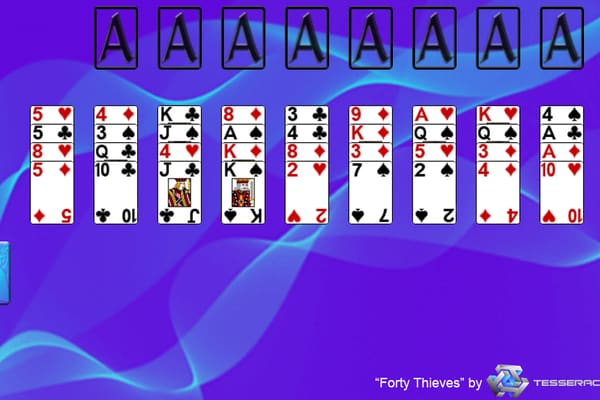
Forty Thieves (Napoleon at St. Helena, Big Forty) is a demanding two-deck one-player patience. Deal 40 cards face-up into 10 columns of 4, and build strict single-card, same-suit sequences while a 64-card stock passes through a waste pile only once.
Forty Thieves (also Napoleon at St. Helena, Big Forty, Le Cadran, or Roosevelt at San Juan) is a demanding one-player patience game played with two full decks. 40 cards are dealt face-up into a 10-column tableau, and the remaining 64 form a stock that passes once through a waste pile. Building is strict: one card at a time, down by suit on the tableau and up by suit on eight foundations. The game is famously hard: typical win rates are 10 to 15%, and a deal can take 15 to 30 minutes of careful play.
Quick Reference
- Shuffle two 52-card decks together; deal 10 columns of 4 face-up cards (40 visible).
- Remaining 64 cards form the face-down stock; leave room for a waste pile and 8 foundations.
- Move one card at a time onto a tableau column one rank lower, same suit.
- Play the available card (tableau top or waste top) to a foundation when it is next rank up in its suit.
- Draw one card from the stock to the waste when you want (single pass only).
- An empty column accepts any single card; sequences cannot be moved as a unit.
- Win = all 8 foundations complete (Ace to King per suit).
- Any other state at stock-exhaustion is a loss; no partial credit.
Players
1 player. Forty Thieves is strictly solitary.
Card Deck
Two standard 52-card decks shuffled together (104 cards total), no jokers. All four suits and all thirteen ranks are used; each card exists in two copies. Within each suit, ranks run Ace (low for foundations) through 2, 3, ..., 10, Jack, Queen, King (high). Suits have no priority relative to each other, but suit matching is strict for all building rules.
Objective
Build all 104 cards onto eight foundations, two per suit, each foundation running from Ace up through King. The game is won only when every foundation is complete (... on two spade foundations, and similarly for clubs, diamonds, and hearts).
Setup and Deal
- Shuffle both 52-card decks together thoroughly to create a 104-card pack.
- Deal 10 columns of 4 cards each, all face-up and overlapping downward so every card is readable. These 40 cards make the tableau.
- Stack the remaining 64 cards face-down beside the tableau as the stock (draw pile).
- Leave empty slots for the waste pile (grows as you draw from the stock) and eight foundations (one per suit per deck) above the tableau. Nothing starts on the foundations; Aces get there during play.
Gameplay
- Available cards: Only the bottom-most card of each tableau column is 'on top' and available to move. The top card of the waste pile is also always available for play.
- Tableau building (down by suit): Move one card at a time onto another tableau column if the destination's bottom card is exactly one rank higher and of the same suit. Example: may be placed on , but not on or after a 6 has already been placed there. You cannot move a multi-card sequence as a unit; each card must be moved individually, one at a time.
- Foundation building (up by suit): An available card may be moved to a foundation if it is the next rank up in the same suit. Aces start new foundations, then 2, 3, ..., up to King. Each suit has two foundation piles because each card exists in duplicate; both piles must be completed independently. Cards on foundations are locked and may not be taken back to the tableau.
- Stock and waste: When you choose, flip the top card of the stock face-up onto the waste pile. The top card of the waste is always available to play onto a tableau column or a foundation by the same building rules. You may continue to flip one stock card at a time until the stock is empty. The stock passes only once; there is no redeal.
- Empty columns: Any single available card (from a tableau top, or from the waste) may be placed in an empty column. Multi-card sequences cannot be dropped into empty columns as a unit; one card fills the slot.
- No sequence moves: The signature restriction of Forty Thieves is single-card movement. Moving a run of cards from one column to another requires you to have enough manoeuvring room (empty columns or workable waste-top cards) to shuttle each card in turn. Running out of room is the usual way the game ends in a loss.
- Stuck state: The game ends when no play is legal (no tableau card, no waste-top card, and no foundation advance is available) and the stock is empty. Until the stock is empty, drawing is always allowed as a fallback; only the last phase of the deal can true-stall you.
- Illegal play: Moving a card onto an off-suit tableau or moving more than one card at a time is illegal; if noticed before the next action, return the card. A card sent to a foundation in the wrong suit or out of sequence is returned.
Winning
- Win condition: Every card is on one of the eight foundations, each running Ace to King in its own suit; nothing remains in the tableau, waste, or stock.
- Loss condition: The stock is exhausted, no tableau or waste move is legal, and foundations are still incomplete.
- No tie-breakers and no score: A deal is a clean win or loss. Many players track a running tally of wins and losses over many deals (the 'scorecard'), but there is no point scoring within a deal.
Common Variations
- Josephine: Allow sequences of cards in correct suit-and-sequence to be moved as a unit; dramatic boost to the win rate while preserving the strict suit rule.
- Limited: Deal three rows of 12 cards instead of four rows of 10; fewer initial tableau positions but each starts shorter. Easier than the classic.
- Indian (Forty Thieves): Build tableau columns down by any suit except the card's own suit. Much easier.
- Streets: Build tableau columns down by alternating colour (red on black and vice versa) instead of same suit. Substantially easier.
- Sixty Thieves: Use three decks (156 cards) and 12 columns of 5 cards; a longer, even harder relative.
- Empty-column restriction variant: Only Kings (or sequences led by Kings) may fill empty columns, Klondike-style. Makes the classic harder.
- Redeal variant: Allow one or two passes through the stock by gathering the waste, flipping it face-down, and continuing. Raises the win rate at the cost of tradition.
Tips and Strategy
- Empty columns are the single most valuable resource in the game; they let you shuttle cards between columns one step at a time. Create them early and guard them unless you are certain of a payoff for filling them.
- Play cards from the waste as aggressively as possible before flipping another stock card; once a waste card is buried by the next draw, it is much harder to retrieve.
- Track duplicates: because each card has a second copy somewhere in the stock or tableau, you can sometimes afford to 'waste' one copy early to progress an important foundation.
- Plan the order of foundation pushes carefully. Sending an Ace and then a 2 to a foundation frees tableau space; sending a higher card there locks it out of the tableau, which can block a future rescue.
- Be cautious about committing a sole remaining King to the tableau. With single-card movement, once a King is down, every card placed on it is harder to retrieve than the preceding one.
Glossary
- Tableau: The 10-column spread of face-up cards dealt at the start of the game.
- Foundation: One of the eight suit piles (two per suit) built upward from Ace to King; the win condition is filling every foundation.
- Stock: The face-down reserve of undealt cards (64 at the start) that you turn onto the waste one at a time.
- Waste pile: The face-up pile fed by the stock; its top card is always available to be played.
- Available card: A card that can currently be moved, namely the bottom card of each tableau column and the top card of the waste.
- Building down / up by suit: 'Down' on the tableau means each card placed is one rank lower than the one below it; 'up' on a foundation means each card placed is one rank higher; both require identical suits in Forty Thieves.
- Redeal: An optional second (or third) pass through the stock used in some variants; the classic does not allow one.
Tips & Strategy
Empty columns are the most valuable resource; protect them ruthlessly because single-card movement makes them your only flexible manoeuvring space. Play from the waste aggressively before each new stock flip buries its top card.
Duplicates matter: each card exists in two copies, so 'wasting' one early to break a blockage is often correct if the second copy is likely to surface.
Trivia & Fun Facts
With strict rules (single-card moves, same-suit tableau, single stock pass) about 10 to 15 percent of deals are winnable; relaxed group-move variants raise that substantially.
-
01How many face-up cards are dealt to the initial tableau of Forty Thieves?Answer 40 cards (10 columns of 4 face-up cards), which is how the game got its name.
History & Culture
Legend attributes Forty Thieves to Napoleon during his exile at St. Helena, though the name is probably 20th-century romanticism. It has been a fixture of solitaire compendiums since the mid-19th century.
Considered the elite classical patience game; an old-school benchmark for serious solitaire players and a regular subject of computer analysis.
Variations & House Rules
Josephine allows sequences in suit to move as a unit. Limited deals 3 rows of 12 instead of 4 rows of 10. Streets builds by alternating colour; Indian builds by any non-same suit. Sixty Thieves uses three decks.
Allow sequence moves (Josephine) for a gentler game, or use Streets' alternating-colour rule for a middle-ground variant. Purists play the strict single-card same-suit rule.
More Solitaire Variants


