
How to Play
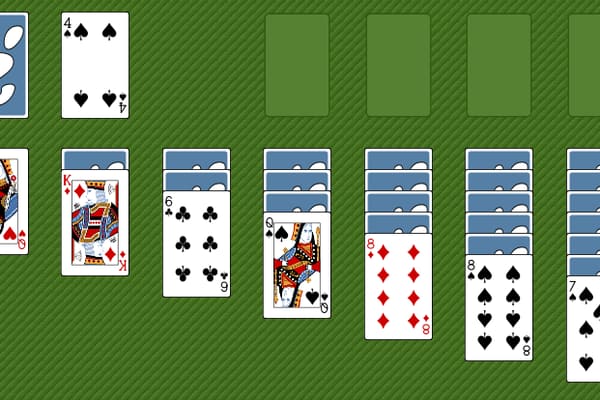
The world's most famous solitaire. Build four suit-sorted foundations from Ace to King by managing a cascading 7-column tableau and drawing from the stock.
Klondike is the single most played card game in human history. When someone says 'Solitaire' they almost always mean Klondike. It is a one-player patience game in which 28 cards are dealt into a cascading tableau of seven columns and the remaining 24 cards form a stock. The player moves cards between columns in descending alternating-colour sequences, flips face-down cards as they are uncovered, and ultimately builds four foundation piles from Ace to King by suit. Microsoft's inclusion of Klondike in Windows 3.0 in 1990 introduced it to hundreds of millions of computer users and helped teach the world to use a computer mouse.
Quick Reference
- Deal 7 tableau columns (1, 2, 3, 4, 5, 6, 7 cards).
- Top card of each column face-up; rest face-down.
- Remaining 24 cards form the stock.
- Move tableau cards in descending rank, alternating colours.
- Flip face-down cards when exposed.
- Build foundations up by suit from Ace to King.
- Draw 1 or 3 from the stock to the waste.
- Win = all foundations complete. Loss = no legal moves.
- Perfect-play win rates: ~80% (Draw-1), ~33% (Draw-3).
- Vegas scoring: earn 5 per foundation card, buy deck for 52.
Players
Klondike is a strictly solitaire game for exactly 1 player. Double Solitaire variants exist for 2 players (see Common Variations), but the classic Klondike is solo.
Card Deck
Use a standard 52-card French-suited deck. No Jokers. Ranks are Ace low through King high for building foundations, and King high through Ace low for building tableau sequences. Cards come in two colours: red (Hearts, Diamonds) and black (Spades, Clubs).
Objective
Move all 52 cards to four foundation piles, one per suit, each built upward from Ace to King. You win by completing all four foundations. You lose when no legal moves remain and the foundations are incomplete.
Setup and Deal
- Tableau: Deal 7 columns left to right. The first column gets 1 card, the second gets 2, the third gets 3, and so on up to 7 cards in the seventh column. Deal each card face-down except the top card of each column, which is face-up.
- Stock: Place the remaining 24 cards face-down beside the tableau as the stock (draw pile).
- Foundations: Reserve space for four foundation piles (one per suit), initially empty, above the tableau.
- Waste: Reserve space for the waste pile next to the stock; it will hold stock cards you flip that are not immediately played.
Gameplay
- Tableau building: Move a face-up card or a valid sequence from one tableau column to another if it starts one rank lower than the destination's top card and is of the opposite colour. For example, a red 6 can move onto a black 7.
- Sequence moves: Move a complete sequence (a correctly alternating-colour descending run) as a single unit to any column where the top card of the sequence fits.
- Flipping face-downs: Whenever a face-down card is exposed at the bottom of a column by a move, turn it face-up.
- Empty columns: An empty tableau column may only be filled by a King, or by a sequence that starts with a King.
- Foundations: Play any Ace to its foundation as soon as possible. Build each foundation upward in suit: Ace, 2, 3, ..., Queen, King.
- Stock and waste: When you cannot or do not want to make a tableau move, flip cards from the stock. In Draw-1 rules, flip one card at a time to the waste. In Draw-3 rules, flip three cards at a time, but only the top card is playable.
- Recycling the stock: When the stock is exhausted, flip the waste pile over (without shuffling) to become the new stock. Some variants limit passes through the stock to 1 or 3 before declaring loss.
- Recovering from foundations: You may move a card back from a foundation to the tableau if it fits a descending-alternating-colour sequence. This is occasionally the key to winning a blocked game.
Scoring
- Win/Loss mode: A won game scores 1; a loss scores 0. This is the default home-play mode.
- Traditional (Klondike) scoring: 10 points per card moved to foundations; 5 points per card moved from waste to tableau; 5 points per face-down tableau card turned up; 3 points per waste-to-foundation direct move. Subtract 20 for each extra pass through the stock after the first. The highest possible score in a perfect game is around 520 points.
- Vegas scoring: The player 'buys' the deck for 52 dollars and earns 5 dollars per card played to the foundation. A full win returns 260 dollars, a profit of 208. Many digital implementations use Vegas scoring to add stakes.
Winning
You win when all four foundation piles have been built up from Ace to King in their respective suits; 52 cards moved to the foundations. You lose when you cannot make any legal move and the foundations are incomplete. Estimated win rates under perfect play: Draw-1 (unlimited passes) ~80%, Draw-3 ~33%, Draw-1 (3 passes only) ~43%.
Common Variations
- Draw-1 (Turn-1): Flip one stock card at a time; the most solvable version.
- Draw-3 (Turn-3): Flip three stock cards at a time; only the top card is playable. Much harder.
- Vegas Klondike: Three passes through the stock maximum, and dollar-scoring applied.
- Thoughtful Klondike: All tableau cards are face-up from the start, making it a pure solvable-or-not puzzle.
- Spider-Klondike: Start with 10 columns and two decks; an intermediate between Klondike and Spider Solitaire.
- Double Solitaire: Two players play Klondike side by side with separate tableaux but share foundation piles in the middle; the first to get all their cards to foundations wins.
- Double-Klondike mini: A casual race where two players each play Klondike and finish fastest.
Tips and Strategy
- Play every Ace and 2 to the foundation as soon as it appears. They can never be useful in the tableau.
- Uncovering face-down cards is the highest-value move. Prefer any sequence of moves that flips a face-down card over moves that don't.
- Do not rush foundation plays of 3s, 4s, and 5s. A red 4 on the foundation cannot help you move a black 5 in the tableau, and you may need it.
- Empty columns are powerful; they give you somewhere to park a King and restructure your tableau. Do not fill an empty column with a King unless you have a strong reason.
- In Draw-3, keep a mental map of which cards are in the waste stack. You often need to know exactly when a specific card will cycle back to the top.
- If you have two options for which King to place in an empty column, choose the one that exposes the longest descending sequence in the tableau.
- Avoid foundation 'locking'; once a suit's foundation outpaces its opposite-colour peers by too much, tableau moves become hard to find.
Glossary
- Tableau: The seven columns laid out at the start of the game.
- Foundation: The four piles built up by suit from Ace to King to win the game.
- Stock: The face-down draw pile of unplayed cards.
- Waste: The face-up pile of stock cards turned over but not yet played.
- Sequence: A run of cards in descending rank, alternating colours.
- Face-down card: A tableau card whose value is hidden; flipped face-up when exposed.
- Empty column: A tableau slot with no cards; fillable only by a King.
- Pass: One traversal of the stock into the waste; variants may limit the number of passes allowed.
Tips & Strategy
Prioritise uncovering face-down cards above everything else. Delay moving mid-rank cards to the foundation; they are often essential for tableau sequences.
Experienced players maintain an invisible 'reserve'; a small number of face-up cards near the top of each column that are ready to be moved. Making moves that increase your reserve of flexible cards is almost always better than moves that feel immediately productive but lock in position.
Trivia & Fun Facts
Microsoft Klondike is widely cited as the most-played computer game in history. Internal Microsoft stories claim the game was kept off the Task Manager in some builds because managers were worried employees were playing it on company time.
-
01Which rank is the only one that may be placed in an empty tableau column in Klondike?Answer A King (or a valid descending-alternating-colour sequence that starts with a King).
History & Culture
Klondike takes its name from the Yukon's Klondike Gold Rush of the 1890s, and the game's exact origin is debated; it was popularised in print during that era. It shot to global dominance in 1990 when Microsoft included it in Windows 3.0, where it was used in part to teach users how to use a mouse for drag-and-drop.
Klondike is the de facto face of solitaire worldwide. Its inclusion in every version of Windows since 1990 turned it into a near-universal shared experience; it is used to teach computer literacy, relieve boredom in waiting rooms, and sharpen concentration and patience.
Variations & House Rules
Draw-1 and Draw-3 change difficulty. Vegas scoring adds stakes. Thoughtful Klondike reveals all cards. Spider-Klondike uses two decks. Double Solitaire turns it into a race for two players.
Play Draw-1 for a more solvable game and Draw-3 for a tournament-grade challenge. Agree on a pass limit (often 3) to force efficient play, or allow unlimited passes for a more relaxed session.
More Solitaire Variants


