
How to Play
Devil's Grip is a two-deck patience (Aces removed) played on a 3x8 grid where each row builds a suited four-card sequence ascending by threes (top 2-5-8-J, middle 3-6-9-Q, bottom 4-7-10-K).
Devil's Grip is a two-deck solitaire played on a 3-by-8 grid of 24 face-up cards. The deck is two standard 52-card packs with all eight Aces stripped out (96 cards in total). Each row of the grid follows a specific build sequence ascending by threes in suit: top row 2-5-8-Jack, middle row 3-6-9-Queen, bottom row 4-7-10-King. Aces are unused; that is why they are stripped from the deck. You move cards already on the grid onto matching grid positions (same suit and next rank by 3) to free spaces, then refill the empty positions from the 72-card stock. When no moves remain and no spaces are open, deal a fresh layer of three cards (one per row) to a talon, and uncovered cards on the talon become available. Only roughly 1 in 10 deals are winnable with optimal play; the name is well earned.
Quick Reference
- 1 player with two 52-card decks; remove all 8 Aces (96 cards remain).
- Deal 24 cards face up in a 3x8 grid.
- Remaining 72 cards form the stock.
- Move grid cards to matching piles (same suit, next rank by 3).
- Fill empty spaces from the stock.
- When stuck, deal cards to a face-up talon and play its top card if it fits.
- Win by completing all 24 suited sequences.
- No redeals of the stock or talon in standard rules.
Players
Single-player patience. Two players may race the same shuffle as a head-to-head puzzle.
Card Deck
Two standard 52-card decks shuffled together with all eight Aces removed, leaving 96 cards. Cards build by threes within the same suit: 2-5-8-J in the top row, 3-6-9-Q in the middle row, 4-7-10-K in the bottom row. Suits matter (each grid pile must be one suit); Aces are not used at all (they have been removed from the deck).
Objective
Place all 96 cards on the 24 grid positions in their correct suited four-card sequences. Each grid position must hold either a 2/3/4-base card and the three cards above it in the row's by-3 sequence, all of the same suit.
Setup and Deal
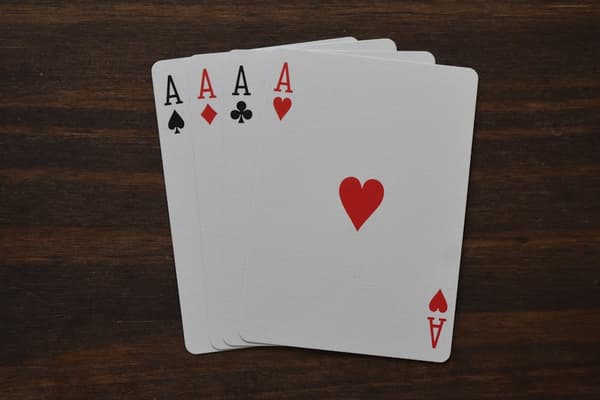
- Combine two standard 52-card decks. Remove the 8 Aces (4 from each deck) and set them aside; they are not used.
- Shuffle the remaining 96 cards thoroughly.
- Deal 24 cards face up into a 3-row, 8-column grid in front of you. The remaining 72 cards form the stock.
- Set aside a small space below the grid for the talon (face-up discard pile) that builds up during play.
Gameplay
- Grid build sequences: Top row pile = 2 (base), then 5, 8, J in same suit. Middle row pile = 3 (base), then 6, 9, Q in same suit. Bottom row pile = 4 (base), then 7, 10, K in same suit.
- Move on grid: If a card on the grid is the next card needed (same suit, next rank by 3) for any other grid pile, move it onto that pile. The space it leaves becomes empty.
- Refill empty spaces from stock: When a space opens, fill it immediately from the top of the stock. This may bring a new playable card into the grid.
- Talon (when stuck): If no grid moves are possible and no spaces are open, deal three cards from the stock face up onto the talon (one for each row, or one consolidated talon depending on house rule). The top card of the talon is now available; play it onto a matching grid pile if possible, otherwise it stays on the talon.
- Talon top card: Always available for play onto any matching grid pile until it is covered by the next talon deal.
- Stock exhaustion: Once the stock is empty, you may continue playing the current talon top card while moves remain. There is no redeal in standard rules.
- End: Game ends when either all 24 grid piles are complete (win) or no legal move remains and the stock and talon are both unplayable.
Scoring
- Win: All 24 grid positions hold their complete four-card suited sequence (top row 2-5-8-J, middle 3-6-9-Q, bottom 4-7-10-K).
- Loss: No legal moves remain and at least one card sits on the talon or in the stock.
- Win rate: Approximately 8-12 percent of random deals are winnable with optimal play.
- Partial score: Count completed grid piles (0 to 24) or correctly placed cards (0 to 96) for comparison play.
Winning
- Win: All 24 piles complete; all 96 cards are on the grid.
- Loss: Stuck after stock and talon are both unplayable.
- Streak measure: Players sometimes track win rate across 50-100 deals; 1 in 8-12 is the typical strong-player rate.
Common Variations
- Relaxed Devil's Grip: Allow one redeal of the talon back into the stock; raises the win rate to roughly 25 percent.
- Single-deck variant: Use one deck with Aces removed (48 cards) on a 3x4 grid; quicker but the same build sequence.
- Open-information variant: Deal the entire stock face up in front of you for a pure visualisation puzzle.
- Three-talon variant: Maintain three separate talon piles (one per row) instead of a single shared talon.
- No-suit Devil's Grip: Build piles by rank only (any suit); much easier and recommended for learners.
Tips and Strategy
- Free spaces aggressively. Each empty grid position pulls a fresh card from the stock, increasing the chance of finding a needed move.
- Prioritise the row with the most base cards already showing. If three 2s are on the top row at the start, build top-row stacks first.
- Track suit distribution. Each pile must be one suit, so a 2 of clubs on the top row blocks any 2 of spades that arrives later from the stock.
- Avoid filling a space with a card that is unlikely to become a base (e.g., a Jack). If you are forced to take a Jack into a space, treat it as a permanent dead spot until its 8 arrives.
- Plan the move sequence carefully. Moving a 5 onto a 2 might free a space for a needed 6, but only if the 6 is in the stock or on the talon top.
- In the relaxed redeal variant, save your redeal for the late game; redealing too early gives the same problem layout back almost unchanged.
Glossary
- Grid: The 3-row by 8-column array of 24 face-up cards where the puzzle is solved.
- Base card: The bottom card of a grid pile (a 2 in the top row, 3 in the middle, 4 in the bottom).
- Build sequence: The set of four cards each grid pile must hold in suit (top: 2-5-8-J; middle: 3-6-9-Q; bottom: 4-7-10-K).
- Stock: The 72 face-down cards remaining after the initial 24-card grid deal.
- Talon: The face-up discard pile of cards dealt when no grid moves are available; only the top card of the talon is in play.
- Empty space: A grid position whose card has just been moved; refilled immediately from the top of the stock.
- Aces removed: The 8 Aces from the two decks are stripped before shuffling and are not used in the game.
Tips & Strategy
Create empty spaces aggressively to cycle through the stock. Each rank belongs to exactly one row (top: 2/5/8/J; middle: 3/6/9/Q; bottom: 4/7/10/K), so track suit distribution carefully across rows.
The key insight is that each rank belongs to exactly one row. Quickly moving misplaced cards to their correct row (or using them to build sequences) is the primary strategic challenge alongside cycling the stock through the grid.
Trivia & Fun Facts
The name reflects the fiendish difficulty: the interlocking sequences create dead-ends with no escape. All eight Aces are stripped before play because no sequence needs them, leaving a 96-card deck for the 24-pile grid.
-
01In Devil's Grip, what four-step suited sequence does the top row of the grid build?Answer 2-5-8-Jack in the same suit (each step adding 3 to the rank, starting from a 2 base).
History & Culture
Devil's Grip is a 20th-century two-deck patience that gained popularity through inclusion in mid-century patience compilations. Its unusual ascending-by-threes building pattern sets it apart from the standard up-by-one Klondike family.
Devil's Grip occupies a niche in the solitaire world for its unconventional ascending-by-threes pattern, appealing to players who have tired of standard build-up-by-one games like Klondike and FreeCell.
Variations & House Rules
Relaxed Devil's Grip allows one redeal of the talon, lifting the win rate. A single-deck variant uses 48 cards on a 3x4 grid for a quicker game. The no-suit variant builds by rank only and is recommended for learners.
Allow 1-2 redeals for a more forgiving experience. Remove the in-suit requirement for beginners and build by rank only. Use a single deck (48 cards) on a smaller 3x4 grid for a quick session.
More Solitaire Variants


