
How to Play
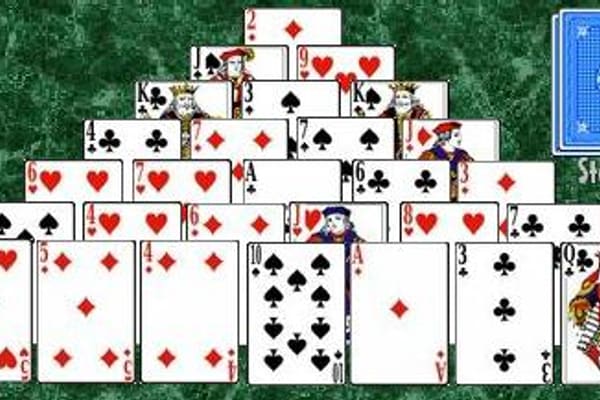
Pyramid Solitaire is a one-player patience where 28 cards form a 7-row pyramid. Remove pairs of exposed cards whose ranks total 13 (Kings come off alone); a 24-card stock supplies further pairings until the pyramid is cleared.
Pyramid Solitaire is a one-player patience game in which the 52-card deck is dealt as a 28-card pyramid plus a 24-card stock, and the player removes the pyramid in pairs whose ranks sum to 13 (Kings come off alone). It is notoriously hard: strict-rule win rates hover around 1 in 50 deals, and a single deal takes 3 to 6 minutes. The goal is to demolish the entire pyramid; any card left in the pyramid at the end is a loss.
Quick Reference
- Deal a 28-card pyramid in 7 rows (1, 2, 3, 4, 5, 6, 7 cards per row) face-up and overlapping.
- Remaining 24 cards form the face-down stock; leave room for a waste pile and a foundation.
- Remove any two exposed cards whose ranks total 13 (A+Q, 2+J, 3+10, 4+9, 5+8, 6+7).
- Remove Kings alone on sight.
- Flip stock cards one at a time; pair with an exposed pyramid or waste top, else place on the waste.
- Only one pass through the stock in strict rules; relaxed rules allow redeals.
- Strict win: pyramid, stock, and waste all empty (about 1 in 50 deals).
- Relaxed win: pyramid empty, leftover stock/waste allowed.
Players
1 player. Pyramid is strictly solitary; there is no partnership or competitive variant in the classic rules.
Card Deck
One standard 52-card deck, no jokers. All four suits (clubs, diamonds, hearts, spades) and all thirteen ranks are used, but suits are irrelevant; only rank values matter for pairing. Card values: Ace = 1, 2 = 2, 3 = 3, ..., 10 = 10, Jack = 11, Queen = 12, King = 13.
Objective
Remove every card from the pyramid by pairing cards whose values total 13. In the strictest scoring, a perfect win means every card from both the pyramid and the stock is cleared; in the common 'relaxed' version, clearing just the pyramid counts as a win even if some stock or waste remains.
Setup and Deal
- Shuffle the 52-card deck thoroughly.
- Deal 28 cards face-up into a pyramid of 7 overlapping rows: 1 card in row 1, 2 cards in row 2, 3 in row 3, and so on down to 7 cards in row 7. Each card in every row except the bottom is half-covered by two cards from the row below.
- Stack the remaining 24 cards face-down beside the pyramid as the stock (draw pile).
- Leave room for a waste pile: face-up stock cards that you chose not to pair immediately go here. Only the top card of the waste is available for pairing.
- Leave one more slot as the foundation (removed-cards pile), where paired cards go out of play. The foundation is purely a resting place; you never draw from it.
Gameplay
- Exposed cards: A pyramid card is exposed (and therefore available to be paired) only when no cards from the row below overlap it. At the start, all 7 base-row cards are exposed; others become exposed as the cards covering them are removed.
- Pairing to 13: Remove any two exposed cards whose values total 13. Legal pairings are Ace + Queen (1 + 12), 2 + Jack (2 + 11), 3 + 10, 4 + 9, 5 + 8, 6 + 7. Suit does not matter. Both cards go to the foundation, face-down and out of play.
- Kings come off alone: A King counts as 13 by itself and is removed without a partner whenever exposed. Send it to the foundation on sight; there is no reason to delay.
- Pairing across zones: You may pair any two available cards, where 'available' means an exposed pyramid card or the top of the waste. For example, an exposed 8 in the pyramid may be paired with the top of the waste if that card is a 5. A stock card you just flipped may be paired with an exposed pyramid card or with the current top of the waste; otherwise it becomes the new top of the waste.
- Drawing from the stock: When no pyramid-to-pyramid or pyramid-to-waste pairing is available (or you choose not to take one), flip the top card of the stock face-up. If it pairs with any available card, remove the pair to the foundation. If not, place it face-up on the waste pile; it becomes the new waste top.
- Single pass through the stock: In the strict rules, the stock is turned face-up just once; when the stock is empty and no further pairings exist, the game ends. Some common relaxed rules allow one or two additional passes (see Variations).
- Game end: The game ends when the pyramid is empty (a win in relaxed scoring; a clean win in strict if the stock and waste are also clear), or when no legal pairing remains and the stock is exhausted.
- Illegal play: Pairing two cards whose values do not total 13, pairing a covered pyramid card, or pairing an interior waste card (anything other than the top) is illegal and must be returned.
Winning
- Strict win: The pyramid, stock, and waste are all empty with every card on the foundation. Rare: estimated about 1 in 50 deals.
- Relaxed win: The pyramid alone is empty even if some stock or waste cards remain unpaired. Several-fold easier than the strict win.
- Loss: The stock is exhausted, no legal pair exists, and at least one card still sits in the pyramid.
- No tie-breakers, no scoring: Because the game is solitary, outcomes are win or loss. A common scoring convention counts the number of cards removed to the foundation (max 52) as the deal's score when played as a multi-deal session.
Common Variations
- Relaxed Pyramid (most common rule): The pyramid alone determines the win; leftover stock and waste cards do not disqualify the game.
- Par Pyramid (one or two redeals): Allow the waste pile to be turned back face-down once or twice to form a new stock; dramatically raises the win rate.
- Apophis: Three waste piles side by side; cards from the stock can be placed on any of the three waste piles, and any waste top may be paired.
- Tut's Tomb / King Tut: Draw three cards at a time from the stock instead of one; stack sums-of-13 as they form.
- Pharaoh / Triangle: Deals a larger triangular layout (often 10 rows) for a longer harder game.
- Spanish Pyramid: Uses a 48-card Spanish deck (no 8s, 9s, or 10s); pair values total 12 instead of 13 and Kings still come off alone.
Tips and Strategy
- Send Kings to the foundation the moment they become exposed; holding on to them serves no purpose and wastes future opportunities to clear cards above them.
- Before committing to a pair, scan to see whether either card has a second partner elsewhere. The card whose only partner is the one you are about to pair with should be used; the flexible card can wait.
- Base-row cards often block several upper-row cards. Aim to clear the base rows systematically from the outside in, so the cards above them become exposed early.
- If the stock is about to produce a card you need to pair with a buried pyramid card, consider whether flipping more stock first will expose the buried card through cascading removals.
- Under relaxed rules, do not hesitate to 'waste' stock cards on the waste pile; they can be revisited whenever their partner surfaces. Under strict rules, every waste is a potential final-score hit.
Glossary
- Pyramid: The 28-card triangular layout dealt at the start (1 card in row 1, 2 in row 2, ..., 7 in row 7).
- Exposed card: A pyramid card not covered by any card from the row below; only exposed cards are available for pairing.
- Stock: The 24-card face-down reserve that you turn one at a time during play.
- Waste pile: The face-up pile that catches stock cards not immediately paired; only the top card is available.
- Foundation: The face-down out-of-play pile of removed pairs (and Kings); purely a resting place.
- Pair of 13: Two cards whose rank values total 13 (A+Q, 2+J, 3+10, 4+9, 5+8, 6+7); Kings count 13 on their own and are removed alone.
- Single pass: A convention that the stock is turned face-up only once during a deal (the strict rule); relaxed play allows redeals.
Tips & Strategy
Send Kings to the foundation the moment they are exposed. Before committing to a pair, check whether either card has a second partner elsewhere; use the flexible card last.
Bottom-row cards block multiple upper-row cards; clear the base systematically from the outside in, so the row above becomes available early.
Trivia & Fun Facts
The strict-rules win rate is about 1 in 50 deals; 'relaxed Pyramid' (which counts the pyramid alone as a win, or allows redeals) is several-fold easier.
-
01Which card rank can be removed to the foundation alone in Pyramid Solitaire, without needing a partner?Answer Kings; they count as 13 by themselves and are removed on sight.
History & Culture
Pyramid patience appeared in the mid-19th century and has long been a teaching game for the rank-to-13 arithmetic. It rose to global recognition through 1990s computer solitaire collections.
One of the most popular themed solitaires on mobile devices; its Egyptian pyramid imagery and quick pairing arithmetic make it approachable for all ages.
Variations & House Rules
Relaxed Pyramid wins on clearing only the pyramid. Par Pyramid allows one or two redeals of the waste. Apophis uses three waste piles. Tut's Tomb draws three cards at a time. Spanish Pyramid uses a 48-card deck where pairs total 12.
Casual players allow redeals and treat the pyramid alone as the win; purists use the strict single-pass rule; children practise arithmetic with the full face-up Spanish Pyramid.
More Solitaire Variants


