
How to Play
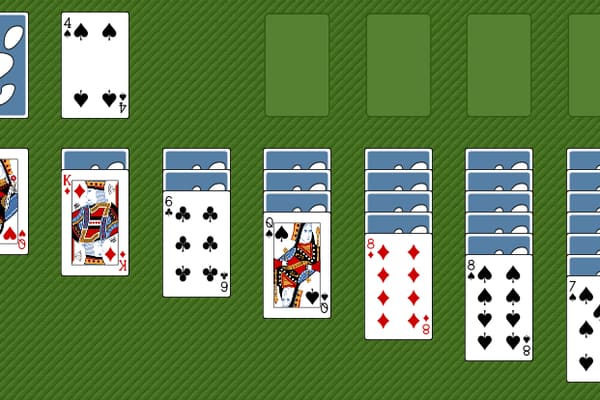
Solitaire (Klondike) is the iconic single-player patience game. Build four foundation piles Ace-to-King by suit using a 28-card seven-pile tableau and a 24-card stock.
Solitaire, known worldwide as Klondike or simply Patience, is the single-player card game that defined the genre for an entire generation of personal-computer users. It is played with one standard 52-card deck dealt into a specific tableau of seven columns, and the goal is to build all 52 cards up to four foundation piles, one per suit, from Ace to King. The game is played entirely against the deal: there are no opponents, no scoring system to maximise, only the binary result of whether every card reaches its foundation or not. An estimated 80% of Klondike deals are winnable with perfect play, but only about 43% of deals are winnable without seeing the face-down cards before committing to moves. It is the benchmark against which every other patience is compared.
Quick Reference
- Shuffle a 52-card deck; remove Jokers.
- Deal 28 cards to 7 tableau piles (1 to 7 cards); only top card face-up.
- Remaining 24 cards form the face-down stock.
- Play tableau top cards or waste top card to another tableau pile (build down alternating colours).
- Move Aces and 2s up to foundations; build up by suit from Ace to King.
- Draw from stock (one card or three) when no tableau moves remain.
- Empty columns accept only Kings.
- Standard Klondike: win if all foundations complete, loss otherwise.
- Microsoft scoring: 10 pts/foundation card, 5 pts/waste-to-tableau, time bonus.
- Vegas scoring: stake $52, earn $5 per foundation card.
Players
Solitaire is strictly a 1-player game. Two-player adaptations exist as Double Solitaire (two players race to build shared foundations), but the classic Klondike form is solitary.
Card Deck
Use one standard 52-card deck; remove Jokers. Suits are equally ranked. Card ranks for the foundation and tableau piles: Ace (low), 2, 3, 4, 5, 6, 7, 8, 9, 10, Jack, Queen, King (high). Foundations are built up in suit starting with Ace; tableau piles are built down in alternating colours.
Objective
Move all 52 cards into the four foundation piles, one per suit, built up in suit from Ace at the bottom to King at the top. A game is won only when every card reaches its foundation; any other end state (stuck with no more moves, no cards left in stock) is a loss.
Setup and Deal
- Shuffle the deck thoroughly.
- Deal the tableau: place 7 piles in a row from left to right. Pile 1 has 1 card, pile 2 has 2 cards, pile 3 has 3, pile 4 has 4, pile 5 has 5, pile 6 has 6, pile 7 has 7 cards. Total tableau: 28 cards.
- Within each pile, only the TOP card (the last one dealt) is face-up; all cards below it are face-down.
- The remaining 24 cards form the stock (also called 'deck' or 'talon'); place them face-down in the upper left.
- Leave 4 empty spaces above the tableau for the foundation piles; they will fill with Aces first and build up to Kings.
- Leave a space next to the stock for the waste pile (also called the stock reserve); cards turned up from the stock that cannot immediately be played sit here.
Gameplay
- Turning the stock: When you have no immediate tableau or foundation move, turn cards from the stock to the waste pile. Two common styles: draw-one (turn one card at a time from stock to waste; unlimited passes through the stock) OR draw-three (turn three cards at a time; only the top card is playable, and passes through the stock are often limited to 3).
- Playing from the waste: The top card of the waste pile is always playable and may go to any valid tableau column or foundation.
- Tableau building: Place a card face-up onto another tableau pile only if it is of the OPPOSITE COLOUR and one rank LOWER than the target pile's current top card. Red cards (Hearts, Diamonds) go on Black cards (Spades, Clubs) and vice versa. Example: the 6 of Hearts (red) plays on the 7 of Spades (black).
- Multi-card moves: You may move any face-up run of correctly-ordered alternating-colour cards from one tableau pile to another, as long as the bottom card of the run fits on top of the destination pile. The whole run moves as a unit.
- Exposing face-down cards: When you move the last face-up card off a pile, flip the next face-down card face-up. This is the primary way to gain new playable cards.
- Empty columns: An empty tableau column (all cards removed) may be filled by a King from any source (tableau, waste, or foundation). Only Kings (or sequences starting with a King at the bottom) may fill empty columns.
- Foundations: Start with Aces. Move an Ace to any empty foundation space. Then build up from Ace by suit: Ace, 2, 3, 4, 5, 6, 7, 8, 9, 10, Jack, Queen, King. Foundation cards may come from the tableau tops or the waste top. Foundation cards can normally be moved back to the tableau if it helps (in some strict rules, once played to a foundation they may not return).
- End of game: The game ends when you successfully build all four foundation piles up to Kings (a win), or when no more legal moves are available (a loss). If you have exhausted your stock passes and cannot move any card, the game is over.
Scoring
- Standard Klondike has no point scoring; the game is a win or loss.
- Microsoft Solitaire scoring: Many digital versions track score: 10 points per card moved to a foundation, 5 points per card moved from waste to tableau, 5 points per face-down card flipped face-up, minus 2 points per pass through the stock after the first. Time bonuses apply to completed games.
- Las Vegas scoring: Stake $52 at the start; earn $5 per foundation card you successfully move. Win if you complete all foundations (net +$208); lose up to $52 otherwise. Only one pass through the stock is allowed.
- Cumulative run: Many digital clients track your win rate across deals and your longest win streak.
Winning
A single game is won by building all four foundation piles from Ace to King. A session or match has no formal structure in classic Klondike, though many players track a cumulative win rate as a personal stat. Digital clients often offer 'best time,' 'best score,' and 'longest winning streak' achievements.
Common Variations
- Draw-three Klondike: Turn three cards at a time from stock to waste, only the top playable. Three-pass limit on the stock. More challenging than draw-one.
- Draw-one Klondike with limited passes: Turn one card at a time but only three passes through the stock allowed; a middle ground in difficulty.
- Klondike with no stock recycle: One pass through the stock only; when exhausted, no more draws.
- Thoughtful Klondike: All face-down tableau cards are turned face-up before play begins. Easier and more puzzle-like.
- Double Solitaire: Two players use two decks and share foundations; first to empty their tableau or the highest foundation contribution wins.
- Vegas Klondike: One pass through stock, Las Vegas scoring; a gambler's version.
- Spider, FreeCell, Yukon: Related solitaires with different tableau structures; each tracked separately in this index.
Tips and Strategy
- Always move Aces and 2s to the foundations as soon as possible; they can never harm you in the foundations.
- Do not rush higher cards (especially 10s, Jacks, Queens) to the foundations. They are useful in the tableau for accepting alternating-colour cards.
- Prioritise uncovering face-down cards in the longest piles. Pile 7 has six face-down cards and is the biggest source of unlocked moves.
- Empty columns are precious. Only fill them with a King that has a Queen or lower cards waiting to stack beneath.
- Before drawing from the stock, check every possible tableau move. Stock cards come up in a fixed order and new draws do not help if no tableau move is available.
- In draw-three mode, remember that the cards below the top of the waste are only accessible in order. Plan two or three moves ahead to sequence waste-pile plays.
- Never move a card to the foundation if its absence would prevent you from placing a different-coloured card in the tableau. Foundation cards can be returned in standard rules, but some digital versions forbid this.
Glossary
- Klondike: The specific solitaire variant described here; the most common form of 'Solitaire' globally.
- Patience: The general British term for single-player card games; synonymous with 'Solitaire' in North America.
- Tableau: The seven-column layout of face-up and face-down cards at the start.
- Foundation: The four piles built up by suit from Ace to King; the win condition.
- Stock: The 24-card face-down reserve to be turned during play.
- Waste: The face-up pile of cards turned from the stock; top card is always playable.
- Build down: The tableau rule; cards placed on a tableau pile must be one rank lower and the opposite colour of the target's top card.
- Build up: The foundation rule; cards placed on a foundation must be one rank higher and the same suit as the target's top card.
- Pass through the stock: Cycling all cards in the stock to the waste and back, one full traversal of the 24 cards.
- Alternating colour: Red (Hearts, Diamonds) and Black (Spades, Clubs) alternated on tableau stacks.
Tips & Strategy
Move Aces and 2s to the foundation immediately. Prioritise uncovering face-down cards in the largest tableau piles. Empty columns are precious; only fill them with a King that has follow-up cards ready.
The deep play of Klondike is balancing foundation-building against tableau mobility. Moving cards to foundations is irreversible; keeping them in the tableau preserves options. Expert players often DELAY sending 6s, 7s, and 8s to the foundation because they are needed as landing spots for 5s, 6s and 7s of opposite colour; sending them up prematurely can deadlock the game.
Trivia & Fun Facts
Not every Klondike deal is winnable. Research by computer scientists estimates that about 79% of deals are theoretically winnable with perfect play and full knowledge of the face-down cards, but only about 43% are winnable in the standard deal-one-unlimited-passes mode where players cannot see hidden cards before deciding moves. In draw-three mode, the winnable percentage drops to roughly 11%.
-
01What is the most well-known version of Solitaire, often referred to as the 'default' or 'standard' version?Answer Klondike, the seven-pile tableau version bundled with Microsoft Windows since 1990.
-
02Approximately what percentage of Klondike deals are winnable with perfect play and full information?Answer Around 79% theoretically, but only about 43% in the practical no-peek mode.
History & Culture
Klondike Solitaire was first documented in the 1890s during the Canadian gold rush from which it takes its name. It became the single most-played digital game in history when Microsoft bundled it with Windows 3.0 in 1990, and it has been pre-installed on every Windows release since. By 2022, Microsoft estimated 35 million people worldwide play Klondike daily on Windows alone.
Solitaire is arguably the most widely played card game in human history by total-games-played count, thanks entirely to Windows bundling. It is synonymous with computer-era productivity loss (the term 'Solitaire break' became 1990s office slang) and is the game every grandparent knows by the same physical card layout. Cultural scholars consider it the most widespread single application of the French-suited deck in modern history.
Variations & House Rules
Draw-three Klondike turns three cards at a time for extra challenge. Vegas Klondike adds cash stakes. Double Solitaire is a 2-player race. Thoughtful Klondike reveals all hidden cards at setup. Related solitaires Spider, FreeCell and Yukon use different tableau structures.
For beginners, start with Thoughtful Klondike (all cards face-up) to learn move planning without hidden-card surprises. For a challenge, switch to one-pass-only Klondike or Vegas-style scoring. Practice the draw-three variant to develop the specific pattern-recognition skills digital Solitaire uses by default.
Variants of Solitaire


