
How to Play
Calculation is the uniquely skill-dependent solitaire where four foundations build from A, 2, 3, and 4 in arithmetic intervals of 1, 2, 3, and 4 respectively; suit is irrelevant and waste-pile organisation decides the game.
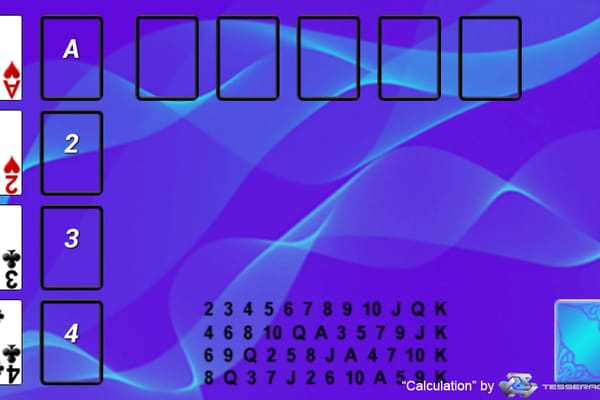
Calculation (also called Broken Intervals or The Fairest) is a one-deck patience game famous among solitaire scholars for its unusually high skill-to-luck ratio: expert players win over 80 percent of deals through nothing but good decisions about where to place a stock card. The four foundations start from an Ace, a 2, a 3, and a 4 (any suits); each builds upward in a different arithmetic interval, wrapping past King back around. The Ace foundation builds by ones (A-2-3-4-...K), the 2 foundation by twos (2-4-6-8-10-Q-A-3-5-7-9-J-K), the 3 foundation by threes (3-6-9-Q-2-5-8-J-A-4-7-10-K), and the 4 foundation by fours (4-8-Q-3-7-J-2-6-10-A-5-9-K). Suits are ignored. The player turns cards one at a time from the stock and either plays each card directly to its correct foundation or places it face up on one of four waste piles (the 'reserve'). Only waste-pile tops can later move to foundations; cards buried in waste piles are often effectively lost. Careful waste-pile organisation is the entire game.
Quick Reference
- Pull A, 2, 3, 4 as foundation starters; rest is stock.
- Four empty waste piles below the foundations.
- Suits are irrelevant; only rank matters.
- Flip the top stock card.
- Play it to the matching foundation's next-needed rank, or place on one of 4 waste piles.
- After every flip, move any waste-pile tops up to foundations if possible.
- Win by placing all 52 cards on foundations.
- Loss when stock is empty and no waste-top moves remain.
Players
Single-player patience. Can be played as a head-to-head race between two players using identically shuffled decks: the first to win wins the round, or whoever has placed more foundation cards when both are stuck.
Card Deck
One standard 52-card deck, no jokers. Suits are completely irrelevant for this game; only rank matters. The deck divides into 4 foundation starters (Ace, 2, 3, and 4 of any suits) and a 48-card stock. Four waste piles initially empty. No trump, no partnerships, no card-point values.
Objective
Play all 52 cards to the four foundations. Each foundation starts with its starter card (A, 2, 3, or 4) and builds upward in its fixed interval, ending with a King on top. The game is won when all four foundations are complete (13 cards each, 52 total); it is lost when the stock is exhausted and no waste-pile top card can move to any foundation.
Setup and Deal
- Shuffle the 52-card deck thoroughly.
- Pull the Ace, 2, 3, and 4 (any four cards of those ranks, any suits) from the deck and place them face up in a row at the top of the play area. These are the four foundation starters. Order matters: the Ace on the left (builds by 1s), then 2 (by 2s), 3 (by 3s), 4 (by 4s).
- Below the four foundations, designate four empty spaces for the four waste piles (the 'reserve').
- The remaining 48 cards form the face-down stock pile.
Foundation Sequences (Memorise these)
- Foundation 1 (Ace, by 1s): A, 2, 3, 4, 5, 6, 7, 8, 9, 10, J, Q, K.
- Foundation 2 (Two, by 2s): 2, 4, 6, 8, 10, Q, A, 3, 5, 7, 9, J, K.
- Foundation 3 (Three, by 3s): 3, 6, 9, Q, 2, 5, 8, J, A, 4, 7, 10, K.
- Foundation 4 (Four, by 4s): 4, 8, Q, 3, 7, J, 2, 6, 10, A, 5, 9, K.
- Each foundation ends with a King, so all four Kings are placed last.
- Note: At any point in play, only four cards from the stock can go 'next' on foundations (one per pile). Every other turned card goes to a waste pile or is impossible to place.
Gameplay
- Turn a card: Flip the top card of the stock face up.
- Foundation play: If the card is the next rank needed on any of the 4 foundations, you may place it there. For example, if Foundation 2 currently shows 6 on top, the next card needed is 8 (2, 4, 6, 8). Any 8 may be placed on Foundation 2.
- Waste pile placement: If the card cannot (or should not) go on a foundation, place it face up on any one of the 4 waste piles. You choose which.
- Waste pile top-card rule: Only the top card of each waste pile is available to move. A card placed into a waste pile is blocked by anything later placed on top of it.
- Move waste to foundation: After each stock turn (and any foundation placement from the stock), check whether any waste-pile top is now the next rank needed on any foundation. If so, move it. You may continue moving waste tops to foundations in chain as long as each move exposes a new viable waste-pile top.
- Cannot move between waste piles: A card on a waste pile may only be moved onto a foundation; waste-to-waste moves are forbidden.
- Repeat: Turn the next stock card and repeat until either (a) all 52 cards are on foundations (win) or (b) the stock is empty and no waste top moves to any foundation (loss).
- No redeal: Once stock cards are played, you cannot reshuffle; the game ends when stock runs out and no moves remain.
Scoring
- Win: All 52 cards placed on foundations; game complete.
- Loss: Stock exhausted and no legal moves from waste to foundation remain.
- Progress metric (for tracking improvement): Count total cards placed on foundations at the moment the game ends; a 'near miss' scores 45+ of 52.
- Score variants (optional): Award 1 point per stock card correctly placed directly on a foundation (without using a waste pile); competitive solitaire scoring rewards efficient placement.
Winning
The game is won when all four foundations are complete, each topped by a King. Because suit is irrelevant, the four Kings appear on the foundations in whatever order they were drawn from the stock. Expert players win over 80% of Calculation deals, making it one of the most skill-dependent solitaires in existence.
Common Variations
- Easy Calculation: Use 5 or 6 waste piles instead of 4, making blockages far less common. Winning rate rises to near 100 percent.
- Broken Intervals: Use random starter cards and random intervals (chosen by a roll of a 6-sided die). Creates fresh memorisation challenges per game.
- Senior Calculation / Giant Calculation: Two decks shuffled together; eight foundations starting A, 2, 3, 4, 5, 6, 7, 8. The 5s foundation builds by fives, the 6s by sixes, and so on.
- Reverse Calculation: Foundations start with Kings and build downward by the same intervals; the Ace-foundation in reverse is K-Q-J-10-9-...-A; the 2 foundation in reverse reads K-J-9-7-5-3-A-Q-10-8-6-4-2.
- Calculation with Redeals: Allow one or two reshuffles of the waste piles (combined) back into the stock. A popular house rule for novices.
- Competitive Calculation: Two players use identically shuffled decks and race; the first to win (or the player with more foundation cards when both stop) wins the match.
Tips and Strategy
- Memorise the four sequences BEFORE you start. The 2-by-2 and 4-by-4 sequences are intuitive; the 3-by-3 (3-6-9-Q-2-5-8-J-A-4-7-10-K) is the hardest and deserves rehearsal. Expert play is impossible without instant recognition of 'next card needed' for each foundation.
- Dedicate one waste pile to Kings. The four Kings will each be played last; collect them all in one dedicated waste pile to keep them from blocking other cards. This is the single most valuable technique.
- Stack waste piles in REVERSE order of need. If you are going to need an 8 next (and later a 3), place the 3 first on a new waste pile, then the 8 on top. The top card comes off first.
- Keep at least one waste pile relatively short. A short waste pile is emergency storage for unexpectedly awkward cards; a pile with 6+ cards is nearly useless if your needed cards are buried.
- Foundations unlock each other. Completing Foundation 2 mid-game (hard) frees up eights, tens, and Queens for the other foundations. Prioritise the 3-foundation (hardest) and 4-foundation early.
- Rehearse before a real game. Deal 10 hands with visible stock (turning cards face-up) to learn the rhythm; after 10 practice runs the memory is automatic.
Glossary
- Foundations: The four piles built from the starter cards (A, 2, 3, 4); each builds upward in a fixed arithmetic interval ending in King.
- Stock: The face-down pile of 48 cards turned one at a time.
- Waste pile (reserve): One of four face-up piles for storing cards not immediately playable.
- Interval: The arithmetic step for each foundation: 1, 2, 3, or 4.
- Next card needed: The specific rank required to extend each foundation by one.
- Dead card: A card buried in a waste pile below another card that cannot be moved; often causes a loss.
- Broken Intervals: Alternative name for Calculation, from its non-consecutive foundation sequences.
- Blockage: A position where no waste-pile top card matches any next-needed rank; play cannot continue.
Tips & Strategy
Memorise all four foundation sequences before starting, dedicate one waste pile exclusively to Kings, stack waste piles in reverse order of when you will need cards, and keep at least one waste pile relatively short for emergency storage.
The four waste piles are Calculation's only strategic resource. Expert play treats them as sorted output queues: Pile 1 for Kings, Pile 2 for cards needed early on Foundation 3 (the hardest sequence), and Piles 3 and 4 as overflow and emergency storage. Every stock turn demands a decision that either advances a foundation directly or degrades the organisation of a waste pile; bad waste-pile architecture accounts for more than 90% of Calculation losses.
Trivia & Fun Facts
Calculation is one of the only single-deck patience games where the skill-to-luck ratio exceeds 4:1, meaning a skilled player wins roughly 4 times more often than a random-choice player. Some mathematicians rank it alongside FreeCell as the most skill-rewarding solitaire ever invented, and the 3-by-3 foundation sequence (3, 6, 9, Queen, 2, 5, 8, Jack, Ace, 4, 7, 10, King) is considered the hardest solo-game sequence to memorise on sight.
-
01What is the building sequence for the foundation starting with 3 in Calculation, going up by threes with wrap-around past King?Answer 3, 6, 9, Queen, 2, 5, 8, Jack, Ace, 4, 7, 10, King.
-
02Why is Calculation considered one of the highest skill-to-luck ratio solitaires?Answer Because suit is irrelevant and every shuffle can be won with the right choices; expert players win over 80% of deals while random-choice play wins only about 20%.
History & Culture
Calculation has been known to solitaire catalogs since at least the 1880s and was analysed in Lady Cadogan's 'Illustrated Games of Patience' (1914). Solitaire mathematician Martin Gardner cited it as 'the fairest of patience games' because outcomes depend almost entirely on the player's choices rather than shuffle luck; expert computer simulations confirm a > 80% win rate with optimal play.
Calculation holds a special place in the solitaire pantheon as the game most frequently cited by mathematicians and puzzle enthusiasts as the 'purest test of skill' in the patience genre. It has been included in every major solitaire compendium since the 1890s and enjoys periodic revivals among puzzle hobbyists for its near-elimination of luck.
Variations & House Rules
Easy Calculation adds a 5th waste pile for a higher win rate. Broken Intervals randomises the starter cards and intervals. Senior Calculation doubles the deck for 8 foundations. Reverse Calculation builds downward from Kings. Competitive Calculation is a race variant with matching shuffles.
For novices, allow one waste-pile reshuffle back into the stock as a redeal. Use printed reference cards showing the four sequences until memorised. Start with 5 or 6 waste piles for easier wins, then reduce to 4 for full challenge once the core skill is learned.
More Solitaire Variants


