
How to Play
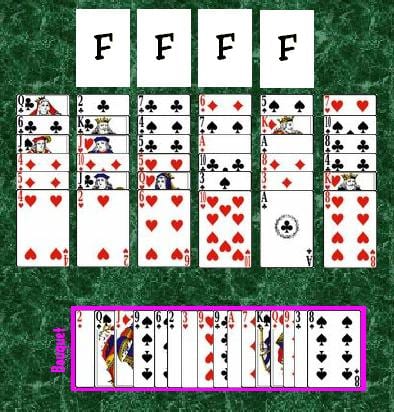
Flower Garden deals all 52 cards face up from the start, six fanned beds of six plus a sixteen-card bouquet, and asks you to move every playable card onto four suited foundations with no rearranging allowed.
Flower Garden, also called The Garden or Bouquet, is a classic single-player patience that dispenses with a stock pile altogether: every one of the 52 cards is dealt face up before the first move. Six piles called garden beds hold six cards each, fanned so every card is visible, while the remaining sixteen cards form a single face-up row called the bouquet. Four foundations are built up by suit from through (and the matching run in the other three suits), fed only by the frontmost card of each garden bed and by any of the sixteen bouquet cards, all of which stay available throughout the game. No card may ever be placed on another card in the tableau, so unlike Klondike or Spider there is no rearranging hand to speak of: the outcome of a deal is effectively fixed the moment the cards are laid out, and the only real task is to notice every playable card and move it before continuing. A deal that leaves a needed rank buried deep in a garden bed, with every card above it locked out of the current foundations, simply cannot be finished.
Quick Reference
- Deal six garden beds of six cards each, face up and fanned so every card shows but only the frontmost card of each bed is available.
- Lay the remaining sixteen cards face up in a row as the bouquet; every bouquet card is available at once.
- There is no stock and no waste pile: all 52 cards are in play from the very first move.
- Move any available card, a bouquet card or the front card of a garden bed, onto a foundation if it fits.
- Removing a bed's front card exposes the card beneath it, which becomes the new front card.
- Never place a card onto another tableau card; the beds and bouquet are draw-only, with no building allowed.
- There is no numeric tally: you either clear every card to the foundations or get stuck partway through.
- Compare stalled deals by counting how many of the 52 cards reached the foundations before no move remained.
Players
Flower Garden is a single-player patience game. It is sometimes played as a race between two players who each shuffle and deal their own deck; whoever clears their garden first wins, or, if both players get stuck, whoever has more cards on the foundations wins the round.
Card Deck
One standard 52-card deck, no jokers. Every foundation is dedicated to a single suit here, unlike suit-blind patiences such as Sir Tommy: each of the four foundations must be built up in strict order from through in its own suit.
Objective
Move all 52 cards onto the four foundations, each built up by suit from Ace to King. The game is won the instant the six garden beds and the bouquet are all completely empty.
Setup
- Shuffle the 52-card deck thoroughly.
- Deal six garden beds of six cards each, face up in a fan so every card in each bed is visible; only the last card dealt into a bed, its front card, is available to play.
- Deal the remaining sixteen cards face up in a single row as the bouquet. Every bouquet card is available at once, since none of them sit behind any other.
- Leave four empty spaces above the layout for the foundations. There is no stock and no waste pile in this game; all 52 cards are already in play before the first move is even made.
Gameplay
- Play an Ace: Any of the four Aces, wherever it turns up among the bouquet or the six bed fronts, can start its suit's foundation as soon as it becomes available.
- Build a foundation: Once a foundation has started, the next-needed card in that suit, one rank higher, may move up from the bouquet or from any bed's front card.
- Bouquet cards: All sixteen bouquet cards sit in the open for the whole game. Play any of them to a foundation the instant it fits; none of them ever block one another.
- Garden beds: Only the front card of each of the six beds is available. Once it is played to a foundation, the card beneath it becomes the new front card and may then be played if it fits.
- No building on the tableau: A card removed from the bouquet or a bed can only go to a foundation, never onto another bouquet card or bed. There is no way to rearrange piles and no way to bury a card any deeper than the original deal already has.
- Continue until stuck or clear: Keep moving every card that fits a foundation. Play ends either when all 52 cards have reached the foundations or when none of the sixteen bouquet cards and none of the six current bed fronts fits any foundation.
Scoring
- There is no numeric tally kept during play. A deal is either won outright or abandoned once every available card is unplayable.
- Because no legal move is ever a mistake, the fairest way to compare two failed deals is simply to count how many of the 52 cards reached the foundations before play stalled.
- In two-player races, whoever empties their own garden first wins the round outright; if both players get stuck, whoever has more cards on their foundations takes the round.
Winning
- Win: All six garden beds and the entire bouquet are empty, meaning all 52 cards sit on the four foundations in order from Ace to King.
- Loss: Play stalls when none of the sixteen bouquet cards and none of the six current bed-front cards is the next card any foundation needs.
- No redeal in the traditional game: Classic Flower Garden offers no way to reshuffle or recover once stuck; the deal is either won or given up as lost.
Variations
- Bouquet / The Garden (alternate names): Older 19th and early 20th-century patience books commonly refer to this exact game under these two names rather than Flower Garden.
- House rule redeal: Some players allow the unplayed bouquet and bed cards to be gathered up and redealt once, giving a stuck deal a second chance instead of ending in a loss.
- Two-player race: Two players each shuffle, deal, and play their own Flower Garden layout at the same time; whoever clears their garden first, or has more cards on foundations if both stall, wins the round.
Tips and Strategy
- There is no reason to ever delay a legal move: since nothing can be rearranged on the beds or the bouquet, playing every available card the instant it fits a foundation is always at least as good as waiting.
- Watch the six bed-front cards closely after every move. A single played card can expose a new front card that immediately unlocks a foundation.
- If a deal is going to fail, it usually becomes clear early: once every current bed front and every remaining bouquet card is the wrong rank for all four foundations, no later move can revive it.
- Do not assume a foundation can start immediately just because you want it to. An Ace buried deep in a garden bed may take several bed-front exposures before it finally appears.
Glossary
- Garden bed: One of the six fanned piles of six cards dealt at the start; only its front (last-dealt) card is available to play.
- Front card: The single playable card of a garden bed, the last one dealt into that bed; playing it exposes the card beneath.
- Bouquet: The sixteen cards dealt face up in a single row; unlike bed cards, every bouquet card is available for play at any time.
- Foundation: One of the four target piles built up by suit from Ace to King.
- Tableau: The garden beds and bouquet together, the layout of cards a player draws from; no card is ever built onto another card here.
- Stuck: The position where no bouquet card and no bed-front card is the next card any foundation needs, ending the deal in a loss.
Tips & Strategy
Play every legal move immediately, since nothing can ever be rearranged on the beds or in the bouquet; holding a fitting card back never creates an advantage. Track the front card of each garden bed after every move, since a single play can expose a card that unlocks a stalled foundation. If several checks in a row turn up no bouquet card and no bed front able to move, the deal has almost certainly failed.
Because no card can ever be rearranged on the beds or the bouquet, Flower Garden has far less strategic depth than games like Klondike or FreeCell. The closest thing to skill is paying close attention: recognizing the instant a bed's newly exposed front card fits a foundation, and recognizing early when a deal has no possible continuation left so play can stop rather than keep checking a dead layout.
Trivia & Fun Facts
Because every card is visible and nothing can ever be stacked on anything else in the layout, Flower Garden has essentially no meaningful decisions once the cards are dealt: the fate of a deal is fixed the moment the shuffle happens, and playing is really just a matter of noticing which cards are available. This makes it one of the few classic patience games that feels closer to a puzzle you watch unfold than one you actually solve.
-
01What makes Flower Garden unusual compared to most other solitaire games?Answer It deals every one of the 52 cards face up before the first move, with no stock or waste pile, and never allows a card to be placed on top of another card in the tableau, so the entire outcome is fixed the instant the deck is shuffled and dealt.
-
02What are the two most common alternate names for Flower Garden?Answer Bouquet and The Garden, both found in older patience-game books.
History & Culture
Flower Garden appears under several names, including Bouquet and The Garden, in patience-game collections dating back to the 19th century, alongside contemporaries such as Sir Tommy and Klondike. Its defining trait, dealing the entire deck face up with no stock pile at all, sets it apart from the reserve-and-stock patiences that came to dominate the genre later, and it is often cited in solitaire references as an example of an almost purely mechanical, no-choice game.
Flower Garden represents an older, simpler style of patience that predates the elaborate stock-and-waste mechanics of games like Klondike. Its near-total absence of decision-making is frequently used by solitaire historians and writers as a contrast case, illustrating just how much of a typical patience game's appeal comes from active choices rather than merely watching a shuffle resolve.
Variations & House Rules
Older patience books call the same game Bouquet or The Garden rather than Flower Garden. A common house rule allows one redeal of any leftover bouquet and bed cards after the layout stalls, giving a losing deal a second chance. Played as a two-player race, whoever clears their own garden first, or holds more foundation cards if both stall, wins the round.
For a gentler introduction, allow a single redeal of any cards left in the bouquet once the layout locks up, which turns many otherwise-lost deals into wins. For a race, deal two identical shuffles to two players and see who clears their garden first, or who has more foundation cards if both get stuck.
More Solitaire Variants


