
How to Play
Miss Milligan is a demanding one-player patience played with two shuffled-together 52-card decks across an 8-column tableau. Its signature reprieve rule lets you freely rearrange cards the instant a column empties, before deciding whether to fill it with a King, which makes the game far more winnable with skill than most two-deck patiences.
Miss Milligan is a one-player patience game played with two full 52-card decks shuffled together, making it a bigger and notably more skillful cousin of Klondike. Its signature feature is the reprieve: whenever a tableau column empties out during play, before you commit a King to it, you are allowed to freely rearrange cards among the other columns, ignoring the normal building rules, to dig out anything useful underneath. That single privilege turns Miss Milligan from a game of luck into one where a patient, careful player can win the overwhelming majority of deals. A full game typically runs 20 to 35 minutes.
Quick Reference
- Shuffle two 52-card decks together into one 104-card pack.
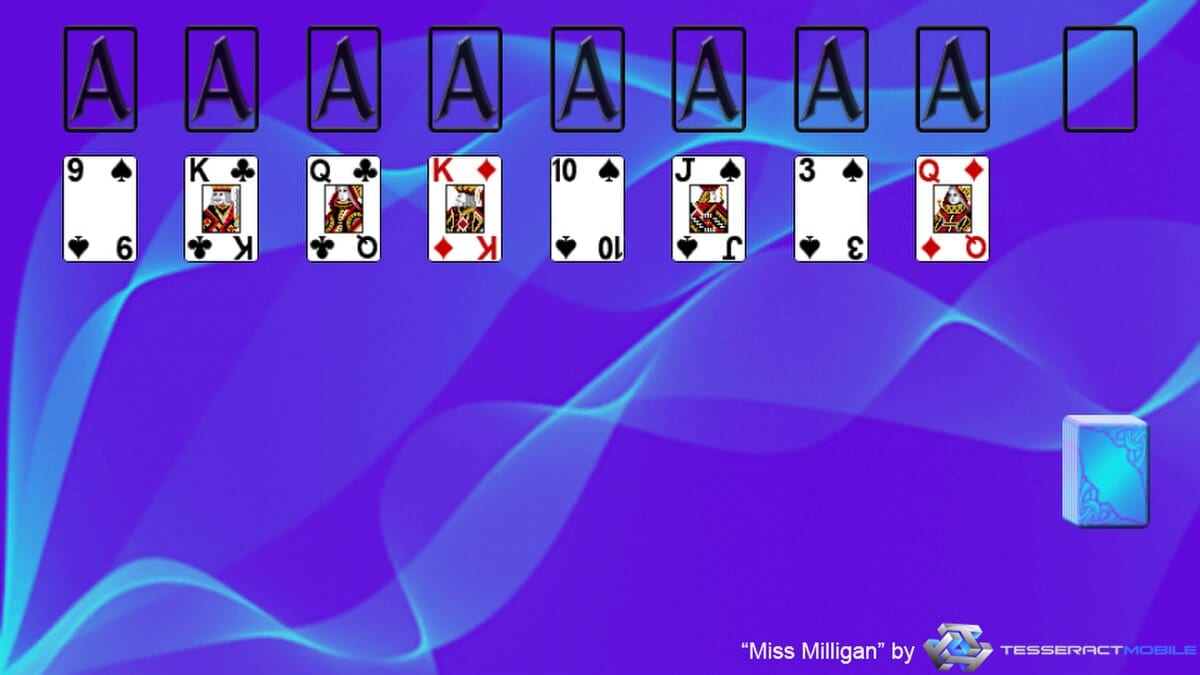
- Deal a single row of 8 cards face up, one per column, as the entire starting tableau.
- Hold the remaining 96 cards as a stock, to be dealt later in rows of 8.
- Move a single card or a properly built descending, alternating-colour run onto a tableau card one rank higher and opposite colour.
- Move single top cards to a matching-suit foundation in ascending order from Ace.
- When stuck, deal another row of 8 cards from the stock, one card on top of each column.
- When a column empties, freely rearrange the other columns (the reprieve) before placing a King there or leaving it empty.
- Win = all eight foundations complete from Ace to King (all 104 cards placed).
- Stock exhausted with no further moves available is a loss; no partial credit.
Players
1 player. Miss Milligan is strictly solitary.
Card Deck
Two standard 52-card decks (104 cards total) shuffled together into a single pack. All four suits (clubs, diamonds, hearts, spades) and all thirteen ranks are used, doubled up; no jokers. Because two decks are in play, each suit ultimately needs two completed foundations, → built twice over, one from each deck's set of cards.
Objective
Move all 104 cards onto eight foundations, two per suit, each foundation running from Ace up to King: →, and again → for the second heart foundation, and likewise for spades, diamonds, and clubs.
Setup and Deal
- Shuffle the two decks together into one 104-card pack.
- Deal a single row of 8 cards face up, one to each of 8 columns. This is the entire starting tableau: unlike Klondike, no column begins with hidden cards underneath.
- Set the remaining 96 cards aside face down as the stock, held in reserve for later rows.
- Leave space above the tableau for the 8 foundations, one for each suit-and-deck combination; foundations start empty.
Gameplay
- Tableau building: Move a single face-up card, or a properly built run of cards (descending rank, alternating colour, e.g. a black 8 on a red 9 on a black 10), onto another tableau card one rank higher and the opposite colour.
- Foundation building: Move a single top card onto a foundation of the same suit only if it is the next rank up (Ace starts a foundation, then 2, 3, … to King). Once played to a foundation, a card cannot return to the tableau.
- Dealing more rows: When no further tableau or foundation moves are available, deal another row of 8 cards from the stock, placing one card face up on top of each of the 8 columns (even a column that is currently empty simply receives its new card as a fresh single card). Repeat until the 96-card stock is exhausted, 12 rows in total.
- The reprieve: This is Miss Milligan's defining rule. The instant a column becomes completely empty through play (not simply because a row hasn't been dealt onto it yet), you may temporarily move any card or group of cards from any other column onto any other card, ignoring the usual rank-and-colour building rule entirely, purely to expose cards you need. This freedom lasts only while that column stays empty.
- Ending the reprieve: You end the reprieve either by placing a King (or a King-led run) into the empty column, or by choosing to stop and leave the column empty for now. Once you resume normal dealing or normal moves, any cards you shuffled out of sequence during the reprieve must already be in a state that is otherwise legal; the reprieve is a one-time chance to rearrange while the gap is open, not a permanent suspension of the rules.
- Empty columns: Only a King, or a run headed by a King, may ever be placed into an empty column outside of the temporary reprieve shuffling itself.
Winning
You win when all 104 cards have been placed on the eight foundations, each running complete from Ace to King. If the stock is exhausted and no tableau, foundation, or reprieve move remains available, the game ends in a loss. Because the game is solitary, there is no tie-break and no partial credit for an unfinished layout.
Tips and Strategy
- Treat every emptied column as a puzzle-solving opportunity, not just a slot for a King. The reprieve is most valuable when you use it to free buried low cards (Aces and 2s) that are blocking foundation progress elsewhere.
- Do not rush to fill an empty column with the first King you see. Once a King occupies the space, the reprieve for that column ends, so make sure you have already extracted everything useful from the other columns first.
- Try to keep at least one column empty, or close to empty, heading into each new row from the stock. An empty column gives you leverage during the reprieve exactly when a fresh row of 8 cards is about to complicate the tableau further.
- Prioritize uncovering the lower ranks of each suit early. With eight foundations to fill instead of Klondike's four, a single missing 2 or 3 can stall multiple foundations at once.
Variations
- Spanish Patience: A close relative that removes the reprieve rule entirely, making it noticeably harder and closer in spirit to a two-deck Klondike.
- Improved Miss Milligan: Deals the initial row of 8 cards face down except for the top card of each column, adding a Klondike-style discovery element before the reprieve rule comes into play.
- Single-deck Milligan: Played with one 52-card deck and 4 columns instead of 8, keeping the reprieve rule but shrinking every other number proportionally; a faster, easier introduction to the family.
- Strict Milligan: Only permits the reprieve to move cards that are already face up and does not allow breaking up a properly built run during the shuffle, a tighter reading of the rule favoured by some purists.
Glossary
- Tableau: The eight columns of playing cards in front of the player.
- Foundation: One of eight target piles, two per suit, built upward from Ace to King.
- Stock: The 96-card reserve dealt out in rows of 8 once tableau and foundation moves are exhausted.
- Reprieve: The temporary right to rearrange cards outside the normal building rules, granted the moment a column empties and lasting until a King is placed there or the player stops.
- Run: A sequence of tableau cards in descending rank with alternating colour, moved together as a single group.
- Alternating colour: Placing a red card on a black one or vice versa; the rule for ordinary tableau building outside of a reprieve.
Tips & Strategy
Treat every emptied column as a chance to dig for buried low cards rather than an automatic King slot; delay filling it with a King until you have used the reprieve to its fullest. Keep track of which foundations are missing their lowest ranks, since with eight foundations in play a single buried 2 can stall two suits' worth of progress at once.
The entire skill of Miss Milligan sits in how a player manages the reprieve. Emptying a column too early, before there is anything worth digging for underneath the other piles, wastes the privilege; emptying one too late leaves buried low cards trapped for the rest of the game. Strong players often engineer a column's emptying deliberately, holding back an obvious move until the position elsewhere is developed enough that the reprieve will actually free something valuable.
Trivia & Fun Facts
Miss Milligan is often singled out by patience historians as one of the few two-deck games where skilled play, not luck, decides most outcomes, thanks entirely to the reprieve rule. Because the reprieve only opens the instant a column empties naturally during play, experienced players sometimes deliberately delay an otherwise available move just to control exactly when that opportunity arrives. With 104 cards and 8 foundations to complete, a full game can involve well over 150 individual card moves from start to finish.
-
01What is the one rule that most distinguishes Miss Milligan from an ordinary two-deck Klondike?Answer The reprieve, the temporary right to rearrange tableau cards outside the normal building rules the instant a column empties, lasting until a King is placed there or the player stops.
-
02How many foundations must be completed to win a game of Miss Milligan, and why that number?Answer Eight; because two 52-card decks are used together, each of the four suits needs two separate Ace-to-King foundations to absorb both copies of every rank.
History & Culture
Miss Milligan is a traditional British patience game, first widely documented in the early 20th century by compilers such as Basil Dalton and later catalogued by David Parlett in his standard reference works on patience games. Card game folklore attributes the name to an Irish or Scottish governess who reputedly favoured the game, though like many patience names of that era the exact origin is undocumented. It predates the wave of Klondike-style patiences that computer solitaire packages popularized decades later.
Miss Milligan holds a respected place among traditional patience games as one of the clearest examples of a two-deck solitaire where deliberate rule design, rather than the luck of the shuffle, determines most outcomes. It remains a staple recommendation in patience compendiums for players who have mastered Klondike and Yukon and want a bigger, more strategic challenge from the same family.
Variations & House Rules
Spanish Patience removes the reprieve rule entirely, turning the game into a much harder two-deck Klondike variant. Improved Miss Milligan deals the opening row mostly face down for an added discovery phase. Single-deck Milligan shrinks the whole game to one 52-card deck and 4 columns for a quicker introduction, while Strict Milligan tightens exactly what the reprieve allows you to rearrange.
Newcomers can start with Single-deck Milligan to learn the reprieve mechanic on a smaller, faster board before moving up to the full 104-card game. Players who find the standard game too forgiving can switch to Spanish Patience, which removes the reprieve entirely and plays much closer to a punishing two-deck Klondike.
More Solitaire Variants


