
How to Play
Chinchón is a Spanish rummy-style draw-and-discard game where players form sets and runs to close with minimal deadwood. The 7-card same-suit Chinchón wins outright; reach 100 penalty points and you are eliminated.
Chinchón is a Spanish rummy-style draw-and-discard game played with the Spanish 40- or 48-card deck. Each player holds 7 cards and races to arrange them into sets and runs to 'close' the round with the least possible 'deadwood' (penalty value of unmatched cards). The seven-card same-suit run that gives the game its name is called a Chinchón and wins the round outright. Players who pass an agreed penalty total (typically 100 points) are eliminated, and the last player still active wins the match.
Quick Reference
- Use a 40 or 48-card Spanish deck (often plus 2 jokers).
- Deal 7 cards each, anti-clockwise; flip 1 card to start the discard pile.
- Player to the dealer's right plays first.
- Draw one card from the stock or the discard pile.
- Build sets (same rank) or runs (consecutive same suit) in hand.
- Discard one card to end your turn.
- Close when your hand has melds plus <=5 points of deadwood (varies by rule).
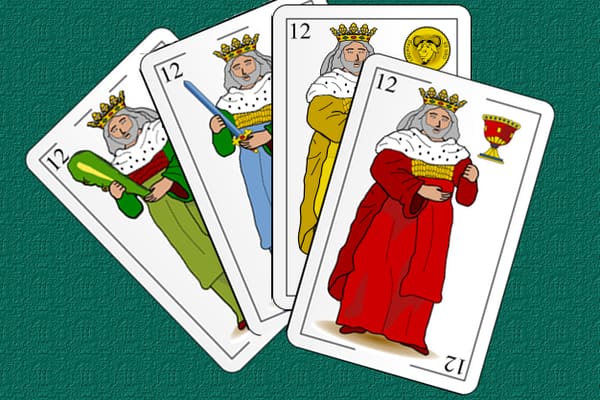
- Unmelded cards add face value to your penalty score (Sota 8, Caballo 9, Rey 10).
- Chinchón (7-card same-suit run) wins the round and subtracts 10 from your score.
- Crossing 100 points eliminates you (some rules allow one buy-back).
Players
Chinchón is best for 3-4 players but supports 2-8. The 2-player game is a quick head-to-head; with 5+ players a second deck is sometimes added. This guide describes the standard 3-4 player Spanish game with a 48-card pack.
Card Deck
- Use a 40-card Spanish deck (Coppe, Denari, Spade, Bastoni; remove the 8s and 9s) OR a 48-card Spanish deck WITH the 8s and 9s included PLUS 2 jokers as wildcards.
- Card rank within a suit (40-card pack): 1 (Ace), 2, 3, 4, 5, 6, 7, Sota (Jack/10), Caballo (Knight/11), Rey (King/12).
- Card rank within a suit (48-card pack): Adds 8 and 9 in their natural sequence between 7 and Sota.
- Penalty values for deadwood at end of round: Numerals (1-9) count face value; Sota = 8; Caballo = 9; Rey = 10. (Some house rules count all face cards as 10.)
- Jokers and the (optional) 2 of the bottom suit are wild cards in some variants and can substitute for any card in a meld.
Objective
Be the last player not yet eliminated. Players are eliminated when their cumulative penalty score crosses 100 points. Each round, your goal is to close (go out) with as little deadwood as possible, or ideally form a 7-card same-suit run (Chinchón) to win the round outright and reset your own score.
Setup and Deal
- Cut for first dealer; the deal then passes anti-clockwise after each round.
- Deal 7 cards face-down to each player one at a time, anti-clockwise.
- Turn the next card face-up to start the discard pile; the rest of the pack forms the face-down stock.
- The player to the dealer's right plays first.
Gameplay
- Draw one card from either the top of the stock OR the top of the discard pile.
- (Optional) form melds in hand. Melds are not laid down during play in standard Chinchón; they are only revealed when you close the round. A meld is either a SET (3 or 4 cards of the same rank) or a RUN (3 or more consecutive cards in the same suit).
- Discard one card face-up to the top of the discard pile, ending your turn.
- Closing (going out): On your turn, after drawing, you may close if your hand can be arranged into valid melds with at most one card of deadwood (the card you discard counts as discarded, not deadwood). Some house rules require zero deadwood (a 'pure' close), but the most common rule is that your unmelded total in hand after discarding must be 5 points or less.
- Chinchón: If your 7 cards form a single same-suit 7-card run, e.g. 1-2-3-4-5-6-7 of Coppe, you have a Chinchón. Reveal it on your turn before discarding; the round ends and you win it outright with the maximum bonus.
- End of round: When a player closes (or declares a Chinchón), all other players reveal their hands and arrange them into the best possible melds. Each unmelded card counts its face value as penalty points added to that player's running score.
Scoring
- Each player's penalty: Sum of all unmelded cards left in hand at the end of the round, by the values listed above.
- Closer: Adds 0 (or the value of any deadwood remaining if the house allows up to 5 points).
- Chinchón declarer: Subtracts 10 from their running score (sometimes wipes their score back to 0 in the most generous house rules); all other players add their full hand to their score.
- Elimination: When a player's cumulative score CROSSES 100 (some groups: 101 exactly), they are eliminated from the match.
- Buy-back: Many house rules allow an eliminated player to 're-enter' the match once by accepting the current second-highest score as their new total. This is optional.
Winning
The last player not yet eliminated wins the match. If only two players remain and they choose to keep going, play continues until one of them crosses the elimination threshold. In the rare case that the last two players cross 100 in the same round, the lower final total wins.
Common Variations
- Argentine Chinchón: Uses the 48-card Spanish deck plus 2 jokers; jokers count 25 penalty points if left in hand. Closing rule is 'pure' (zero deadwood) only. Elimination at 100 points; one buy-back allowed by re-entering at the highest active score.
- Conga (Uruguayan): A close cousin where you may close only with 5 deadwood points or fewer (or with 96+ on your running score, a 'desperate close').
- Chinchón con Comodines: Adds 2 jokers; jokers may substitute in any meld but a meld containing a joker still scores deadwood elsewhere normally. The Chinchón hand of 7 same-suit cards must be all natural cards (no joker) for the bonus.
- French-deck Chinchon: Plays the same with a 52-card pack stripped to 40 (no 8s, 9s, 10s) or a full 52-card pack with face cards counting 10 and Aces 1.
Tips and Strategy
- Close fast and dirty. A round closed with 5 points of deadwood is almost always better than one chased to a perfect zero, because every extra turn risks the opponent closing first and dumping a big deadwood total on you.
- Track the discard pile. When an opponent picks up the 7 of Coppe, that suit's run building is now 50% likely to be in their hand; do not feed them more of that suit.
- Disguise your build. Discarding a card adjacent to a run you are building (e.g. discarding a 5 of Coppe while collecting 3-4-6-7) tells opponents your hand is NOT in that suit, the bluff worth several points.
- Save the seven-card pure run dream. Chinchón is rare; only chase it if you already hold 5 of the 7 cards by turn 4 or so.
- Manage your total. A player at 95 points is one bad round from elimination; closer-to-elimination players should close as soon as legal, even with high deadwood, rather than risk being caught.
Glossary
- Meld (combinación): A set of 3-4 cards of the same rank, or a run of 3+ consecutive cards in the same suit.
- Deadwood: Unmelded cards left in your hand at the end of the round; their face value is added to your penalty score.
- Close (cerrar): Declare the end of the round by laying down a hand that contains only valid melds (and at most 5 points of deadwood, by house rule).
- Chinchón: The 7-card same-suit run that wins the round outright and grants its holder a major bonus.
- Stock / Discard pile: The face-down draw pile and the face-up discarded-card pile in the centre of the table.
- Sota / Caballo / Rey: The Spanish-deck face cards (Jack/10, Knight/11, King/12 in rank; 8/9/10 in deadwood value).
Tips & Strategy
Closing quickly with a few points of deadwood usually beats chasing a perfect zero. Watch what opponents pick from the discard pile to map their builds, and switch your discards to suits and ranks that do NOT feed their visible structure. The Chinchón itself is a once-a-night rarity; collect toward it only if you already hold 5 of the 7 cards by turn 4.
Chinchón is a duel of information. Every card you draw from the discard pile reveals exactly what you have to your opponents, so weigh whether the card you take is worth the leak. Conversely, playing sound discards (cards safe from completing visible builds) is often more valuable than drawing aggressively.
Trivia & Fun Facts
A 'real' Chinchón of seven consecutive cards in the same suit (e.g. 1-2-3-4-5-6-7 of Espadas) is so unusual that it is considered a story-worthy moment in Spanish card culture; some groups celebrate it with a round of drinks for the lucky player.
-
01In Chinchón, what specific hand of seven cards is called a Chinchón and what reward does it give?Answer Seven consecutive cards of the same suit (e.g. Ace through Seven of Cups, or 7-Sota-Caballo-Rey of one suit if using a 48-card pack). It wins the round outright and subtracts 10 from the declarer's score (or, in the most generous house rules, resets it to zero).
History & Culture
Chinchón is named after the town of Chinchón, near Madrid. It is documented in Spanish gaming books from the early 20th century and travelled with Spanish emigration to South America, where it became especially popular in Uruguay (as Conga) and Argentina. It belongs to the broader rummy family that descends from late-19th-century European card games.
Chinchón is woven through Spanish bar and family life and is the dominant rummy-family game across Argentina, Uruguay, and Spain. It is frequently the first card game taught to children in Spanish-speaking households alongside Mus and Brisca.
Variations & House Rules
Argentine Chinchón uses 48 cards plus 2 jokers and a strict 'pure close' rule. Conga (Uruguay) uses a 5-point deadwood close. Chinchón con Comodines adds wildcards. House rules vary on jokers, deadwood limits, and whether eliminated players may buy back in.
Adjust the elimination threshold (50 for a quick game, 100 for a standard evening, 150 for a long match). Allow one buy-back per player to keep eliminated players engaged, or play with progressive elimination only.


