
How to Play
Kalooki (also Kaluki, Jamaican Kaluki) is a 9-deal Contract Rummy variant from the Caribbean. Players use a 108-card shoe (two 54-card packs) and meet escalating contracts of Threes (sets) and Fours (runs) across 9 deals. Jokers are wild but cannot sit adjacent; 'calling' a discard is the game's signature early-hand weapon. Lowest cumulative penalty wins.
Kalooki (also Kaluki, Jamaican Kaluki, Caribbean Kalooki) is a Contract Rummy variant hugely popular in Jamaica and across the Caribbean, where it is the default card game of family gatherings, barbershops, and domino halls. This entry describes the Jamaican 9-deal contract form; the European/North American 'Kaluki' (single-deal with a 40- or 51-point first meld) is covered separately. Players use a 108-card shoe: two standard 54-card decks (each a 52-card pack plus 2 Jokers) shuffled together. A full game is 9 deals, each with an escalating 'contract' (a specific combination of Threes and Fours) that a player must achieve to go out and score well. Threes are sets of 3 or more same-rank cards (like a traditional Rummy set). Fours are runs of 4 or more same-suit consecutive cards (Rummy sequences, but minimum 4 cards, not 3). Jokers are wild but cannot be placed consecutively. A signature mechanic is calling: a player who has NOT yet laid down any melds may call for another player's discard when it is not the caller's turn, taking the discard plus one extra penalty card from stock. The player with the lowest cumulative penalty score after 9 deals wins.
Quick Reference
- 3 to 8 players, 108-card shoe (two 54-card packs with all 4 Jokers).
- Deal 1 starts with 9 cards each; each deal adds 1 card, up to 16 cards in deal 9.
- Each deal has a specific contract (e.g., deal 1 = 3 Threes, deal 9 = 4 Fours).
- Draw one card (stock or discard).
- Optionally meld the full contract and tack on other melds after.
- Discard one card to end the turn.
- Call: claim an opponent's discard when it is not your turn IF you have not yet melded (take the card plus 1 extra stock card).
- Penalty values: Joker = 50, black Ace = 15, red Ace = 1, K/Q/J/10 = 10, 2-9 = face value.
- Going out = -50 bonus for the deal. Failing to meet the contract = +50 penalty plus hand-card values.
- Lowest cumulative score after 9 deals wins.
Players
3 to 8 players, each for themselves. 4 to 6 is the Jamaican home standard. A full 9-deal match runs 1.5 to 3 hours, so Kalooki is a proper evening game. Turn order is clockwise; the first dealer is chosen by drawing for low card, and the deal rotates clockwise after each deal.
Card Deck
- 108-card shoe: two 54-card Anglo-American packs (each 52 + 2 Jokers) shuffled together. 104 standard cards plus 4 Jokers.
- Rank order: Ace (high or low), K, Q, J, 10, 9, 8, 7, 6, 5, 4, 3, 2. Aces can be HIGH (Q-K-A) or LOW (A-2-3) for Fours but may not wrap (K-A-2 is invalid).
- Penalty values for unmelded cards at hand end: Joker = 50, black Ace (spades or clubs) = 15, red Ace (hearts or diamonds) = 1, Kings/Queens/Jacks/10s = 10, 2 through 9 = face value.
- Jokers are wild for any card in any meld, BUT may not be placed consecutively (e.g., 9-Joker-Joker-Q is invalid; 9-Joker-J-Joker is valid).
Melds: Threes and Fours
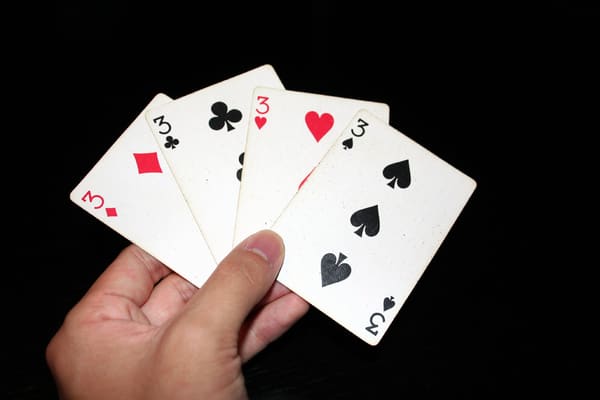
- Three: a set of 3 OR MORE cards of the same rank; suits do not matter and duplicate suits across packs are allowed. Example: 7♠-7♥-7♦ is a 3-card Three; 7♠-7♥-7♦-7♣-7♠ is a 5-card Three using both packs.
- Four: a run of 4 OR MORE cards of the same suit in consecutive rank order. Minimum length is 4 cards, not 3 as in standard Rummy. Example: 5♠-6♠-7♠-8♠ is a valid Four; 5♠-6♠-7♠ (three cards only) is NOT a valid Four in Kalooki.
- Joker placement: a Joker in a Three or Four represents a specific card; two Jokers may not sit next to each other.
- Joker replacement: the player who originally laid a Four containing a Joker may, on a later turn, REPLACE the Joker with the natural card it represents and move the Joker to either END of the Four. In Threes, Jokers are frozen and cannot be moved once melded.
Objective
Minimise your cumulative penalty score across 9 deals. Each deal has a specific meld contract (listed below); meeting the contract and going out earns a 50-point bonus (or minus 50 points applied to your running score). Failing to meet the contract at the end of a deal adds 50 penalty points PLUS the face value of every card still in your hand. After 9 deals, the lowest total wins.
Setup and Deal
- Combine two 54-card packs (with all 4 Jokers) into a 108-card shoe. Shuffle thoroughly.
- For deal 1 the hand size is 9 cards; each subsequent deal adds one more card (deal 2 = 10, deal 3 = 11, and so on) up to deal 9, with one exception: deal 5 also has 12 cards.
- The player to the dealer's right cuts.
- Deal the appropriate number of cards, one at a time, clockwise.
- Place the remaining shoe face-down as the stock; flip the top card face-up beside it to start the discard pile.
- The player to the dealer's left takes the first turn.
The Nine-Deal Contract Schedule
- Deal 1: hand size 9, contract is 3 Threes (three 3-of-a-kinds).
- Deal 2: hand size 10, contract is 2 Threes and 1 Four.
- Deal 3: hand size 11, contract is 1 Three and 2 Fours.
- Deal 4: hand size 12, contract is 3 Fours (no Threes).
- Deal 5: hand size 12, contract is 4 Threes.
- Deal 6: hand size 13, contract is 3 Threes and 1 Four.
- Deal 7: hand size 14, contract is 2 Threes and 2 Fours.
- Deal 8: hand size 15, contract is 1 Three and 3 Fours.
- Deal 9: hand size 16, contract is 4 Fours (no Threes; a demanding final deal).
- To GO OUT and score the bonus, you must have laid down the exact contract for the current deal AND emptied your hand.
Turn Flow
- Draw: take the top card of the stock (face-down) OR the top card of the discard pile (face-up). Drawing the discard pile card triggers no penalty under normal turn flow (unlike a call, see below).
- Meld (optional): if you have not yet met this deal's contract, you may lay down melds that together SATISFY the full contract. You cannot lay down partial contracts; either put down all required melds now or wait until you can.
- Tack (optional after melding): once you have met the contract, you may TACK single cards onto any meld on the table (yours or any opponent's) that legally extend it. After tacking, you may NOT form any new melds on the same turn.
- Discard: end your turn by placing one card face-up on the discard pile. You may not discard a Joker without melding it first.
- Turn passes clockwise.
Calling: The Signature Kalooki Mechanic
- A player who has NOT yet laid down any melds or tacked any cards may CALL for a card another player has just discarded (when it is not the caller's turn).
- The call is effectively a bid for the fresh discard. The player who just discarded decides whether to ALLOW or DISALLOW the call.
- Allowed call: the caller takes the discarded card AND draws one extra card from the top of the stock. The caller now has 2 extra cards in hand (a calculated risk: extra cards are ammunition for melds but also penalty risk if the deal ends badly). The caller's turn does NOT begin; the game continues in normal order.
- Disallowed call: the player whose turn it would normally be gets first refusal on the discarded card. If they take it, they begin their turn; if they refuse, the card stays on top of the discard pile and the normal turn begins.
- A player who has ALREADY melded cannot call. This makes calling an early-hand weapon only; once your first contract is down, the tool is locked away.
- Only one call per discard; if multiple players call simultaneously, the first-spoken takes priority (group convention).
Scoring
- Going out (meeting the contract and emptying your hand): subtract 50 points from your cumulative score (score -50 for this deal).
- Players who did NOT go out: score penalty points equal to the face-value total of all unmelded cards in hand (see penalty values in Card Deck section).
- Contract-not-met penalty: if a player did not lay down the required melds during a deal, they score an additional 50 PENALTY points on top of their hand-card penalties (because they never even contracted).
- Cumulative scoring: penalty points accumulate across all 9 deals. The winner is the player with the LOWEST total at the end of the 9th deal.
Winning
After all 9 deals, the player with the LOWEST cumulative penalty score wins the match. Many Jamaican home sessions play best-of-3 matches (27 deals total) for higher stakes; others play single matches for a set pot contributed per player. In organised play, ties are broken by a sudden-death single deal with the same contract as deal 9.
Common Variations
- European / North American Kaluki: a different game entirely: 2-5 players, 106 cards (no extra Jokers), 13 cards each, ONE deal at a time to a cumulative score, first meld must be worth at least 40 points (some groups 51). Not a 9-round contract game.
- South African Kaluki: another regional form with its own contract schedule; less common in the UK and US.
- No-calling variant: drops the calling mechanic for simpler family play.
- Open-hand Kalooki: played with all hands face-up for beginners learning the contract schedule.
- Progressive stakes: chips are bet per deal, and the 50-point bonus for going out also pays a chip bonus.
- 7-deal short form: collapse deals 2-3 and 7-8 into single deals for a faster 2-hour game.
- Joker penalty variations: some groups use 25 points rather than 50 for a held Joker.
Tips and Strategy
- Memorise the contract schedule before playing; you cannot meld until you have exactly the right combination, so knowing which deal demands '2 Threes and 2 Fours' vs '3 Threes and 1 Four' is critical.
- Call aggressively in the early turns of a deal when you have not yet melded; the extra 2 cards (one called, one drawn) are useful ammunition but call only when the discarded card directly helps a visible path to the contract.
- Track Jokers. With 4 in the shoe, they are scarce; holding a Joker unmelded costs 50 penalty points (the steepest in the game).
- Do not hoard high cards (10s, face cards, black Aces). Each is a 10 or 15 point liability if you do not go out; discard them when building melds.
- Do not force the contract on early deals. Sometimes it is better to accept a 50 + 30 = 80 point penalty on deal 2 (contract not met) if your hand is hopeless, and focus on the later deals.
- On deal 9 (4 Fours, 16 cards), calling early is hugely valuable because the contract requires 16 cards in sequences and Jokers become your main bridge.
- Tacking is almost-free points; once you have met the contract, tack every loose card on every deal, because each tacked card is one fewer card in hand that might become hand-end penalty.
Glossary
- Contract: the specific meld combination (e.g., '3 Threes and 1 Four') required to go out in a given deal.
- Three: a Kalooki set of 3 or more same-rank cards.
- Four: a Kalooki run of 4 or more same-suit consecutive cards (minimum 4 cards, unlike standard Rummy).
- Shoe: the two 54-card packs combined into 108 cards.
- Joker: a wild card; 50 penalty points if unmelded at hand end.
- Calling: claiming another player's discard when it is not your turn, if you have not yet laid any melds.
- Tacking: adding a single legal card to any existing meld on the table, after you have met the contract.
- Going out: meeting the deal's contract and emptying your hand to score the -50 bonus.
- Penalty score: the sum of unmelded card values at hand end; you want this LOW.
Tips & Strategy
Memorise the 9-deal contract schedule; you cannot partially meld, so hitting the exact required combination is everything. Call aggressively in the early turns before you meld; calling costs 2 cards in hand but gives you a targeted card to build the contract. Jokers are your scarcest resource (4 in 108 cards and 50 points if unmelded); use them to bridge gaps in Fours where the natural card is hard to find, and replace them later when the natural card arrives. Discard high cards (10s and face cards) first; each is a 10-point liability if you do not go out.
The contract structure makes Kalooki fundamentally different from free-form Rummy: you cannot partial-meld, so the decision of WHEN to call or take a discard hinges on how close that card brings you to the EXACT contract, not just to any useful meld. Joker management is central: with only 4 Jokers in 108 cards, each is valuable both as a meld bridge (building Fours where the natural card is missing) and as a late-turn replacement (swap Joker back when the natural card arrives, freeing the Joker to end a Four). Calling is a high-leverage early decision; once you have 12 or 14 cards in hand from calling, your meld paths multiply but so does the risk of a 50-point unmelded penalty.
Trivia & Fun Facts
Kalooki is one of the few card games where a meld (a Four) requires MORE cards than the standard Rummy minimum. The game's 9-deal structure mirrors the 9 innings of cricket, reflecting its Caribbean cultural setting. Jamaican Kalooki tournaments often feature ritualised 'calling' speeches (players calling aloud with elaborate flourishes), which veterans consider part of the game's social pleasure. The Ace's asymmetric penalty value (1 for red Aces but 15 for black Aces) is a quirky house rule that has become the Caribbean standard but is not universal in other Kaluki variants.
-
01In Kalooki, what is the minimum card count for a Four, and how does that differ from standard Rummy runs?Answer A Four in Kalooki must contain at LEAST 4 same-suit consecutive cards, one more than the standard Rummy minimum of 3. A run of 3 (like 5♠-6♠-7♠) is NOT a valid Kalooki Four, which is why the game's Four melds feel noticeably larger than in other Rummy variants.
-
02What is the 'calling' mechanic in Kalooki, and what restriction determines who can use it?Answer Calling lets a player who has NOT yet laid any melds claim another player's discard when it is not their turn; the caller takes the discard AND draws one extra card from stock (2 cards added to hand). Once a player has laid down even one meld or tacked even one card, they can no longer call for the rest of the deal. This makes calling a strictly early-hand tool.
History & Culture
Kalooki is the Jamaican and Caribbean national form of Contract Rummy, widely played across Jamaica, Trinidad and Tobago, and Guyana since at least the mid-20th century. It derives from the broader Contract Rummy family (also called Progressive Rummy, Liverpool Rummy, Shanghai Rummy) that emerged in American home play in the 1930s and 1940s. The Caribbean form is distinctive for its 108-card shoe, Joker-centric mechanics, and calling rule. 'Jamaican Rummy' is a common North American name, and Kalooki tournaments are a fixture of Caribbean diaspora card-club culture in London, New York, and Toronto.
Kalooki is a defining element of Caribbean card-game culture, played across socioeconomic classes at weekend barbecues, funerals, church halls, and professional domino-and-kalooki clubs. Its 9-deal rhythm gives an evening game a fixed arc. The Caribbean diaspora has spread Kalooki to UK West Indian community centres, New York church basements, and Toronto and Montreal social clubs; tournament Kalooki is competitive and stakes-heavy. The game is also a generational bridge: children learn it young from grandparents, and high-stakes matches between veterans are community events.
Variations & House Rules
The most important variant is European / North American Kaluki: a completely different game (2-5 players, 106 cards, 13-card hands, first-meld threshold of 40 or 51 points, cumulative single-deal scoring). South African Kaluki has a different contract schedule. The no-calling form simplifies for family play. Progressive-stakes Kalooki adds chip bets per deal. A 7-deal short form is popular when time is limited.
New players should first play 3 or 4 deals only (not the full 9) until they internalise the contract schedule. Use a printed reference card showing all 9 contracts; this cuts down on mid-game rule disputes enormously. Play open-hand for the first match so new players can see how veterans assemble contracts. For progressive learning, start with the simpler calling-free variant and add the calling rule in the second match.


