
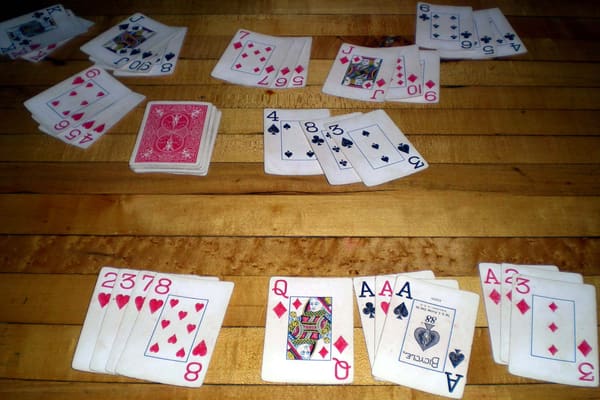
How to Play
The archetypal draw-and-discard card game. Form sets (same rank) or runs (same-suit sequences), lay them face up, and be the first to empty your hand. Opponents score penalty points for leftover cards.
Rummy (sometimes called Standard Rummy, Basic Rummy, or Straight Rummy to distinguish it from its many descendants) is the archetypal draw-and-discard card game. Each turn, a player draws one card from the face-down stock or the face-up discard pile, optionally lays down any completed melds (three or more of a kind, or three or more in suit-sequence), lays off extra cards onto melds already on the table, and ends by placing one card on the discard pile. The first player to arrange every card in their hand into melds and then discard their final card goes out and wins the deal. All the other players score penalty points for the cards still trapped in their hands. Rummy's straightforward mechanics have spawned dozens of major descendants (Gin Rummy, Rummy 500, Canasta, Contract Rummy, Indian Rummy, Rummikub), but the basic two-to-six player game described here is the common ancestor and remains one of the most-played card games in the world.
Quick Reference
- 2-4 players use one 52-card deck; 5-6 use two decks.
- Deal 10 cards each (2 players), 7 each (3-4), or 6 each (5-6 single deck).
- Stock face down; flip top card to start the discard pile.
- Draw one card from stock or discard pile.
- Optionally lay down sets (3+ same rank) or runs (3+ same-suit sequence).
- Optionally lay off single cards onto any meld on the table.
- Discard exactly one card to end your turn (not the one just drawn from the pile).
- Winner (first to empty hand): 0. Others: sum of their remaining cards.
- Face cards = 10; Aces = 1; number cards = face value.
- Match ends when a player crosses the agreed threshold.
Players
Two to six players, each for themselves. Two to four is the classical size; five to six requires a second deck. Turns go clockwise; the deal rotates one seat left after each hand. A single deal runs 10 to 20 minutes, so matches to a target score (often 100 or 500) take 45 to 90 minutes.
Card Deck
- One standard 52-card deck for 2-4 players. Add a second deck (104 cards total) for 5-6 players. Some family rules add 2 jokers as wild cards.
- Ranking for runs (low to high): A, 2, 3, 4, 5, 6, 7, 8, 9, 10, J, Q, K. In most modern rules the Ace is LOW only (A-2-3 is a valid run but Q-K-A is not). House rules that allow Ace high or low (but never both in one run: K-A-2 never wraps) are common and should be agreed before play.
- Card penalty values for end-of-deal scoring: A = 1 point, 2-10 = face value, J = 10, Q = 10, K = 10. Jokers count 15 points if wild cards are used.
- Suits matter only for runs (same-suit sequences). Sets (three or four of a kind) ignore suits.
Objective
Be the first player to empty your hand by melding, laying off, and discarding. A meld is either a SET (three or four cards of the same rank, any suits) or a RUN (three or more cards of the same suit in consecutive rank order). When all your cards are on the table in melds and you play your final card to the discard pile, you 'go out' and win the deal. Every other player scores penalty points for the cards still in their hand.
Setup and Deal
- Choose first dealer by drawing high card. Deal rotates left (clockwise) after each hand.
- The dealer shuffles; the player to the dealer's right cuts.
- The dealer distributes cards face down one at a time, clockwise, starting with the player on their left. Hand sizes by count: 2 players = 10 cards each, 3 players = 7 cards each, 4 players = 7 cards each, 5-6 players = 6 cards each (single deck) or 10 cards each (two decks).
- Place the remaining cards face down in the middle as the stock. Flip the top card face up beside the stock to start the discard pile.
- If the first discard is a card that could immediately form a meld in the dealer's hand, house rules vary: most simply proceed with the deal.
Gameplay
- Step 1 (draw): On your turn, draw EXACTLY ONE card from the top of the face-down stock OR from the top of the face-up discard pile. You must do this before any other action.
- Step 2 (meld, optional): If you now hold a complete set (3 or 4 same rank) or run (3+ same-suit sequential), you may place it face up in front of you. There is no limit on how many melds you may lay down per turn.
- Step 3 (lay off, optional): You may add single cards from your hand to any meld already on the table (yours or an opponent's). Example: if any player's meld includes , you may lay off a or a onto it. You may not rearrange or split existing melds.
- Step 4 (discard): End your turn by placing exactly ONE card from your hand face up on the discard pile. You must discard even if you laid down melds on this turn.
- Same-card discard rule: If you drew from the discard pile this turn, you CANNOT discard that same card back on the same turn (you must discard something else).
- Going out: You win the deal the moment you have no cards left in your hand. The last card played (to a meld, layoff, or discard) ends the deal. You can go out by melding your entire remaining hand (with or without a final discard), or by laying off your last card onto an existing meld.
- Stock exhausted: If the stock runs out before anyone goes out, take the discard pile (minus the top card, which stays), shuffle it, and place it face down as the new stock. The top discard remains available for the next draw.
Scoring
- At the moment a player goes out, every other player tallies the penalty value of cards still in their hand.
- Card values: A = 1; 2-10 = face value; J, Q, K = 10 each; jokers (if used) = 15.
- Standard scoring: Each non-winner writes their penalty total as a positive score and the winner records 0 for that deal. The goal across multiple deals is the LOWEST cumulative total when one player crosses an agreed ceiling (commonly 100 points = eliminated; last player under wins).
- Winner-takes-all scoring (alternate): The winner collects the sum of all opponents' penalty values as their score. Play until someone reaches a target (commonly 100 or 200).
- Rummy bonus: If the winner goes out in one turn without having previously melded or laid off (laying their whole hand down and discarding the last card on a single turn), they score a 'Rummy' and doubled penalties are collected from opponents in winner-takes-all scoring.
Winning
Each deal has one winner (the player who went out). The match is decided by total score across many deals: in standard scoring, the last player under the elimination threshold wins; in winner-takes-all, the first to reach the target wins. A single deal with no winner ever (stock cycles endlessly without anyone going out) is resolved by declaring the player with the lowest hand-card total the deal winner.
Common Variations
- Gin Rummy: A two-player variant where the draw-discard mechanic is identical but players do not meld during play. Instead, when one player's unmatched cards (deadwood) total 10 or less, they 'knock' to end the hand; the other player may lay off onto the knocker's melds.
- Rummy 500: Players score bonuses for cards in their own melds as well as penalties for cards in hand. The whole discard pile can be taken if the top card helps form an immediate meld, and all cards below it go into hand too. Target score: 500.
- Contract Rummy: Each of the 7 deals has a specific meld requirement (the 'contract') that must be met before a player can go out. Contracts escalate across the rounds.
- Indian Rummy: Uses two decks plus jokers, 13-card hands, and requires at least one 'pure' sequence (run with no wild card) before going out.
- Rummikub: Played with numbered tiles rather than cards, but with the same set/run logic plus the ability to rearrange melds already on the table.
- Wild-card Rummy: Deuces or jokers are wild and may substitute for any card in a meld. A player holding the real card a wild represents may swap it in during their turn.
Tips and Strategy
- Aces and face cards are heavy penalty cards (1 and 10 respectively). Discard them early unless they connect to a likely meld.
- Middle cards (5 through 9) are the most flexible; they can extend runs in either direction. Keep a mix of ranks rather than only high or only low cards.
- Watch what opponents pick from the discard pile. A player who grabs the 8 of hearts probably needs either 8s (set) or hearts near the 8 (run); avoid feeding them.
- Holding a meld in hand to set up a 'Rummy' (go-out without prior melding) can triple your score in some variants, but risks being beaten to the go-out by a careful opponent.
- Lay off aggressively once you have melded: it reduces your hand while not helping opponents.
- Remember the same-card discard rule. If you take the top discard, you cannot hand it straight back; plan the turn before drawing.
Glossary
- Meld: A valid set or run laid face up on the table.
- Set / Book: Three or four cards of the same rank, any suits.
- Run / Sequence / Straight: Three or more cards of the same suit in consecutive rank order.
- Lay off: Adding a card from your hand to a meld already on the table.
- Go out: Play your last card (to meld, layoff, or discard); this ends the deal and you win the hand.
- Stock: The face-down pile of remaining cards from which players may draw.
- Discard pile: The face-up pile of discarded cards; its top card is always available to draw.
- Rummy: Laying down your entire hand in a single turn without any prior melds (bonus in some variants).
- Deadwood: Cards still in hand when the deal ends; their value is the player's penalty.
Tips & Strategy
Discard Kings, Queens, and Jacks early unless you are certain they fit a meld; each one is 10 penalty points in hand. Keep middle cards (5 through 9) for flexibility. Track discards to avoid feeding opponents their completion cards.
Rummy is a game of information. The discard pile is perfect public information, and disciplined tracking of which ranks and suits have been discarded lets you infer opponents' hands within a few turns. Defensive discarding (never the card an opponent is visibly collecting) is often worth more than aggressive melding.
Trivia & Fun Facts
The word 'Rummy' is of disputed origin; one theory connects it to British slang 'rum' (odd, strange), another to the rum given to sailors playing card games on Royal Navy ships. Canasta, a Rummy descendant, was the fastest-growing card game in American history in the early 1950s, eclipsing even Bridge for a few years. Gin Rummy became so popular during WWII that a US War Department pamphlet included it in leisure guidance for soldiers.
-
01In standard Rummy, what is the minimum number of cards required to form a valid run?Answer Three, all of the same suit in consecutive rank order.
-
02Which 20th-century card game that briefly outsold Bridge in America is a direct descendant of Rummy?Answer Canasta, which reached peak popularity in the early 1950s.
History & Culture
Rummy's direct ancestor is the 19th-century Mexican game Conquian, itself descended from the Spanish game Conquien. It reached the United States in the late 1800s, became a pastime of American railway workers and saloon players, and explosively diversified in the 20th century into Gin Rummy (Elwood T. Baker, 1909), Canasta (Uruguay, 1940s), and Rummikub (Ephraim Hertzano, 1940s).
Rummy and its descendants form one of the most successful card-game families in the world. In India, Rummy is culturally on par with Bridge; in Latin America, Canasta gatherings anchor social life in many communities; in Israel, Rummikub is a national pastime. The family's accessibility and endless variation have made Rummy a bridge between generations worldwide.
Variations & House Rules
Gin Rummy is the two-player knocking variant. Rummy 500 scores for melds and uses larger discard pile grabs. Contract Rummy imposes specific meld contracts each deal. Indian Rummy requires a pure sequence. Rummikub is the tile-based cousin with shared melds.
Add two jokers as wild cards for a more forgiving game. Lower the elimination threshold to 50 points for a quicker session, or raise it to 200 for a long evening. For large groups, split into two four-player games rather than stretching one deck over six.


