
How to Play
A shedding game where all cards are dealt and players race to empty their hand by extending four suit sequences that grow up and down from the 7.
Fan Tan, also called Sevens, Dominoes, or Parliament, is a classic shedding game in which all the cards are dealt out and each player tries to empty their hand by extending four suit sequences that grow up and down from the 7. Turns are short, rules are simple, and the decisive skill is knowing when to stall a 7 to stop your opponents.
Quick Reference
- Deal all 52 cards as evenly as possible to 3 to 8 players.
- Each player antes one chip to the pot.
- The first deal starts with whoever holds the 7 of diamonds.
- Play the 7 of any suit to open a new row, the 8 of a started suit to its right, or the 6 of a started suit to its left.
- If you have no legal play, pass and put one chip in the pot.
- You must play if you can; being caught holding a legal card costs three chips.
- First player to empty their hand wins the pot for that deal.
- Each loser pays the winner one chip for every card still in hand.
- Play an agreed number of deals and count chips at the end.
Players
Best for 4 to 6 players, but works for 3 to 8. Each player plays for themselves; there are no partnerships.
Card Deck
- Standard 52-card French-suited deck, no jokers.
- Suits are equal; no suit ranks above another.
- Within a suit the cards run Ace (low), 2, 3, 4, 5, 6, 7, 8, 9, 10, Jack, Queen, King (high). The 7 is the starter card for its suit: .
Objective
Be the first player to play every card from your hand onto the four suit layouts on the table. Cards can only be placed if they legally extend a layout or start a new one with a 7.
Setup and Deal
- Pick any player to shuffle and deal. The turn to deal passes left after each hand.
- Deal all 52 cards one at a time, clockwise, face down. With 3, 5, 6, or 7 players some hands will be one card larger than others; players with a short hand receive compensation by putting one fewer chip into the pot for that deal.
- Each player antes one chip to a central pot before looking at their hand.
- The player to the dealer's left leads the first card of the first deal. For every later deal, the winner of the previous deal leads.
Gameplay
- Step 1 (opening the layout): The first player who holds the 7 of diamonds must play it to the middle of the table. If the leader does not hold it, they pass and pay one chip to the pot; the turn moves left until the 7 of diamonds appears. No other card may be played until the 7 of diamonds is down.
- Step 2 (legal plays): On your turn you must do exactly one of three things if you can: (a) play any other 7 below (or beside) the 7 of diamonds to open a new suit row, (b) place the 8 of a started suit to the right of its 7 to build upward, or (c) place the 6 of a started suit to the left of its 7 to build downward. Each further card must be exactly one rank above the highest card on the right end of its row, or exactly one rank below the lowest card on the left end of its row: .
- Step 3 (no voluntary pass): You must play if you have any legal card. Only if none of your cards can legally extend a row or open a new 7 do you pass. Every pass costs one chip to the pot; holding a legal card and passing on purpose is penalised by three chips to the pot if detected.
- Step 4 (turn order): Play continues clockwise. A row grows until its King is placed on the high end and its Ace on the low end; once a row is complete it is set aside.
- Step 5 (ending the deal): The deal ends the moment one player plays their last card. That player wins the pot.
Scoring
- The winner of the deal collects the whole pot (antes plus pass penalties).
- In the common stake variant, each other player also pays the winner one chip for every card still in their hand at the end of the deal.
- If you are caught holding a playable card (failing to play when you could), pay three chips to the winner in addition to your held-card chips.
- Play a fixed number of deals (one per player as dealer is typical) and count chips to find the overall winner.
Winning
The player who sheds their last card first wins the current deal and the pot. Over a session, the player with the most chips when the agreed number of deals has been played is the overall winner. Ties are broken by counting unplayed cards in the final deal: whoever held the fewest wins the tie.
Common Variations
- Any seven starts: Some circles let any 7 open the layout rather than forcing the 7 of diamonds to lead.
- Pip scoring: Instead of chips per held card, count pips at the end; number cards are face value, Jack 11, Queen 12, King 13, Ace 15. Lowest cumulative total wins.
- Sjuan (Sweden): Must lead with the 7 of hearts; all other rules as above.
- Cinquillo (Spain): Uses a 40-card Spanish deck and starts from the four 5s placed simultaneously.
- Shichi Narabe (Japan): Removes all four 7s before the deal and places them centrally as fixed starters.
Tips and Strategy
- Count your 6s and 8s per suit. If you hold both the 6 and 8 of a suit and an opponent is short there, delaying the 7 can stall them while you shed other cards.
- Release cards from your shortest suit first; an isolated Ace or King in a suit you barely hold is useless until the sequence reaches it.
- Watch passes. A player who passes twice in a row on the same suit tells you they have no 6 or 8 in it; if you hold that 7, you may benefit by stalling.
- Never hold a 7 past the point your own long suit needs it. The penalty for being caught holding a playable card (three chips) usually outweighs the blocking value.
Glossary
- Ante: The chip each player pays into the pot at the start of a deal.
- Layout: The four rows of cards on the table, one per suit.
- Pass: Declaring you cannot play; costs one chip to the pot.
- Sevens / Dominoes / Parliament: Alternate names for Fan Tan.
- Shed: To play a card from your hand onto the layout.
Tips & Strategy
Track passes to read opponent weakness, hold a 7 only when you need the blocking value, and shed short-suit cards first so your remaining hand can always feed an open row.
The decisive skill is timing your 7s. A 7 delayed at the right moment forces opponents to pass, paying chips and leaving them stuck with high or low cards in that suit.
Trivia & Fun Facts
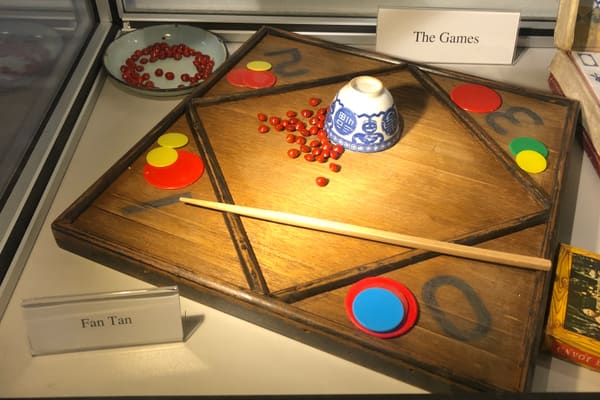
Despite sharing a name, the card game Fan Tan and the Chinese counting game Fan Tan played in gambling houses are entirely separate games with no shared mechanics or history.
-
01Which rank of card must be played before any other card can join a suit row in Fan Tan?Answer The 7 of that suit; and in the most common opening rule, the 7 of diamonds must lead the very first play of the deal.
History & Culture
Fan Tan of the card family appears in European play as Dominoes or Parliament as early as the 19th century and spread widely through the British Empire. It shares the name but nothing else with the Chinese bead-counting game called Fan Tan.
Fan Tan has been a parlour staple across Europe and Asia for over a century and regional variants (Sjuan in Sweden, Shichi Narabe in Japan, Cinquillo in Spain) serve as casual family games suitable for all ages.
Variations & House Rules
Regional variants change the starter card (7 of diamonds, 7 of hearts, or any 7), the deck (52-card French or 40-card Spanish), and whether pass penalties are paid per chip or per pip at game end.
For a faster game, remove pass penalties and simply count held cards at the end. For a longer, more strategic session, raise the pass penalty to two chips and play one round per player as dealer.


