
How to Play
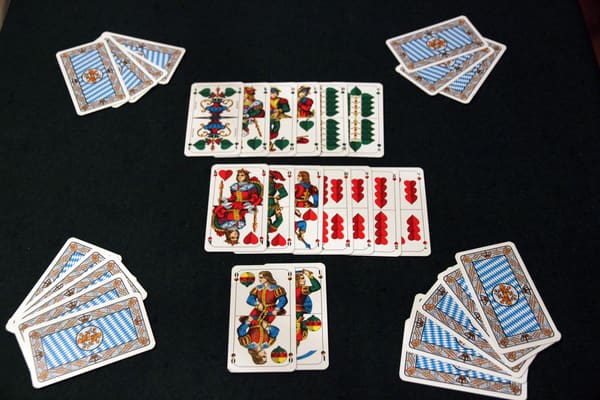
Parliament is the British name for the classic shedding game (also called Fan Tan, Sevens, or Dominoes) in which all 52 cards are dealt out and players race to empty their hand by building suit rows outward from the 7 of diamonds.
Parliament is the British name for the classic shedding card game better known internationally as Sevens, Fan Tan, or Dominoes. Played with a standard 52-card deck, all cards are dealt out and players try to be the first to empty their hand by laying cards into a shared layout on the table. The game begins with a single 7, and from there each suit grows outward: players add the next higher or lower rank of the same suit adjacent to cards already played. When a player cannot make a legal play they must pass (often putting a chip in a pot). Parliament is one of the simplest strategic shedding games and is a favourite in British pubs and family parlours; it rewards hand-management and tempo awareness over pure luck.
Quick Reference
- Deal all 52 cards to 3-8 players as evenly as possible.
- Player holding the 7 of diamonds plays it first.
- Arrange the layout as 4 rows, one per suit.
- Play one card: any 7, the next higher in an existing row's suit, or the next lower.
- If you cannot play, you must pass (often paying 1 chip to the pot).
- You must play if you can; deliberate passes are illegal.
- Hand winner: first to empty hand; may collect the pot.
- Penalty variant: winner scores sum of pips left in opponents' hands.
- Session: best over 4-8 deals.
Players
3 to 8 players, best at 4 to 6. Each plays for themselves; there are no partnerships. Deal rotates clockwise; play also runs clockwise. With more than 6 players the deck divides into small hands and games become very short; with fewer than 4, the game is near-solitaire because each player almost always has every rank they need.
Card Deck
One standard 52-card deck, no jokers. Rank within a suit, high to low: A, K, Q, J, 10, 9, 8, 7, 6, 5, 4, 3, 2. Sequences in this game run from Ace (high) down to 2 (low) in each suit, starting from the 7 which is the middle pivot. There is no trump, no rank comparison, and suits matter only for the layout: all 4 suits build their own independent row. Card points are irrelevant; it is a pure shedding game.
Objective
Be the first player to empty your hand by playing cards into the shared layout. When a player runs out of cards, they win the hand. Continue play among remaining players for penalty scoring, or declare a new deal.
Setup and Deal
- Shuffle the 52-card deck thoroughly.
- Deal all 52 cards one at a time clockwise. Some players will hold one extra card if the count does not divide evenly.
- Each player sorts their hand by suit and rank privately.
- First play: The player holding the 7 of diamonds must play it face up to the centre of the table. Some house rules use the 7 of clubs, any 7 at the dealer's choice, or whoever holds the lowest diamond (if a player was dealt no 7 of diamonds, the holder of the 7 of clubs or the 7 nearest the middle starts).
- The player to the left of the opening 7-player takes the next turn.
Gameplay
- Your turn: On your turn, you must play one card if you can. There are three legal plays at any moment: (1) any 7 of any suit (starts a new row for that suit); (2) the card one rank higher than the top of an existing row in the same suit (e.g., the 8♠ next to the 7♠, then 9♠ above that, up to A♠); (3) the card one rank lower than the bottom of an existing row in the same suit (6♠ below the 7♠, then 5♠, down to 2♠).
- Pass (forced): If you cannot play any legal card, you must pass. In the standard house rule, a passing player places 1 chip in the central pot; when the game ends, the winner collects the pot.
- Cannot refuse: If you have a legal play, you must make it. Deliberately passing when you could play is illegal and subject to penalty (often surrendering your best card).
- Layout grows: Over the hand, the four suit rows grow from their 7s, upward to Ace and downward to 2. The layout typically ends looking like four rows of 13 cards each.
- Winning the hand: The first player to play their last card wins the hand immediately. Other players stop playing when the first is out.
- Strategic passes: Although passing is forced when you have no legal play, some house rules allow voluntary passing (choosing to pay a chip rather than play) to retain a key blocking card; most standard British Parliament rules do not permit voluntary passing.
Scoring
- Basic win: The first player to empty their hand wins the hand.
- Chip pot: When using forced-pass chips, the hand winner collects the entire pot accumulated from passes.
- Penalty scoring (variant): For multi-deal sessions, the winner scores the sum of remaining cards in all other players' hands (face value: A = 1, 2-10 = pip value, J/Q/K = 10 each). Some groups invert this so losers score penalty points against themselves and the lowest cumulative loser wins.
- Match target: Play a fixed number of deals (one deal per player as dealer) or to an agreed chip/score total.
Winning
A hand is won by the first player to play their last card; a multi-deal match is won by whoever has collected the most pots (chip play) or the most hand-wins (non-scoring play) by the end of the session. Many British pubs play a best-of-five session.
Common Variations
- Fan Tan (international name): Identical rules; 'Fan Tan' is the American and Australian name, 'Parliament' the British name, 'Dominoes' used in some British regions, and 'Sevens' in most family contexts.
- Any-7 start: Any player may play any 7 on their turn; does not require the 7 of diamonds to open. Speeds up the game.
- Turn-the-corner: Aces and Kings may be played adjacent to each other, wrapping the sequence (Ace connects to King), letting low-card-heavy hands still play high cards. Extends game interest.
- Voluntary passing: Allowed with a chip penalty; lets strategic players hold back blocking cards. Common in pub play.
- Last Card!: Players must announce 'last card' when down to their final card, or be forced to draw two cards as a penalty (borrowed from Uno culture).
- Penalty scoring variant: Losing players score penalty points equal to face-value pips left in hand; lowest total after a round wins.
- Multi-deck Fan Tan: Two decks shuffled together for 7+ players; play with 8 rows (two per suit) or allow parallel builds.
Tips and Strategy
- Hold your 7s as long as possible when you hold multiple cards of that suit. A 7 unlocks a new suit row for every opponent; keeping a 7 back forces the other players to pass rather than play.
- Play the end-cards (Aces and 2s) as soon as you can. They are the easiest to become stuck on, since opponents cannot extend past them.
- Track which players have passed recently. A player who has passed repeatedly is likely short in the suits already on the table but may hold many cards of a suit no one has opened (a 7 still in someone's hand).
- If you hold the sole 7 of a suit, time its play. Playing it early helps opponents; playing it late can force multiple forced passes from opponents who hold low or high cards of that suit.
- Keep hand shape balanced. A hand concentrated in one suit is vulnerable to being blocked if that suit's extreme cards stay in opponents' hands.
- The player to the left of the 7-of-diamonds player has a natural tempo advantage. If that is you, prioritise plays that force opponents into forced passes.
Glossary
- Layout: The shared face-up area in the middle of the table; grows into 4 suit-rows during the hand.
- 7 of diamonds: The traditional opening card; the only legal first play in the standard British rules.
- Row / ladder: One suit's build, growing up toward Ace and down toward 2 from the opening 7.
- Forced pass: A player with no legal play must pass (and commonly pays a chip to the pot).
- Pot: The chip or scoring pool accumulated from forced passes; collected by the hand winner.
- Turn-the-corner: An optional rule allowing Ace-to-King wrap sequences.
- Blocking card: An end-rank card (Ace or 2) or a held 7 that prevents opponents from advancing a row.
Tips & Strategy
Hold your 7s when you are long in that suit: every 7 you keep in hand forces opponents into forced passes when they cannot build without it. Play your Aces and 2s as soon as you can to avoid being stuck with those suit-ending cards.
Parliament's depth lies in 7-management and end-card tempo. Strong players carefully time the release of 7s (which unlock suit rows) and the play of Aces and 2s (which terminate rows), creating forced-pass sequences for opponents while keeping their own flexibility. In a 5-player game, a player who holds back a single 7 can single-handedly force 3 to 5 passes before the hand ends.
Trivia & Fun Facts
The name Parliament comes from the 19th-century observation that the game's progression of each suit 'debating' around the central 7 resembled Members of Parliament arguing from their benches. In French and Chinese tradition the same game is called 'Dominos' or 'Fan Tan' after a completely different Chinese gambling game that shares no mechanics.
-
01What is the very first card that must be played to start a standard game of Parliament?Answer The 7 of diamonds; the player holding it opens every deal.
-
02What are the two most common international names for Parliament outside Britain?Answer Sevens and Fan Tan; Parliament is the British name, Sevens is the family/casual name, and Fan Tan is the American card-catalog name.
History & Culture
Parliament (Sevens / Fan Tan) developed from earlier European layout-building card games in the late 18th century and was standardised in its modern 52-card form by the mid-19th century. It was a particular favourite of British middle-class parlours through the Victorian era and remains a staple of British pub and family card play; 'Parliament' is the name preferred in formal British contexts while 'Sevens' dominates casual and family usage.
Parliament is woven into British card-play culture as a gentler, more genteel shedding game than Whist or Bridge, and is a common bridge (pardon the pun) between beginner family play and more complex trick-taking games. Its slow, rule-light progression makes it a popular 'teaching' game for children learning card-game conventions.
Variations & House Rules
Fan Tan is the international name for the same rules. Any-7 start removes the 7-of-diamonds requirement. Turn-the-corner lets Ace wrap to King for extended sequences. Voluntary passing (with chip penalty) rewards strategic blocking. Penalty scoring turns the game into a multi-deal cumulative low-score-wins match.
For faster play with experienced groups, use the any-7 opening rule. For strategic depth, enable voluntary passing with chip penalties. For a longer match, use penalty scoring across 4-8 deals. For bigger groups, use a double deck and allow parallel builds within the same suit.


