
How to Play
Carioca is a Chilean contract-rummy game played across eight escalating rounds. Each round requires a specific combination of trios and runs, and the lowest cumulative penalty after all eight rounds wins.
Carioca is a Chilean-origin contract-rummy game, extremely popular across Spanish-speaking South America (Chile, Argentina, Uruguay, Peru). Each game is a sequence of eight escalating rounds, and in every round each player must assemble a specified combination of trios (three of a kind) and escalas (same-suit runs of at least four cards) before they can lay down any card. Jokers and 2s are wild. The player with the lowest cumulative penalty after all eight rounds wins.
Quick Reference
- 2-6 players; use 2 decks plus 2 jokers (106 cards); jokers and 2s wild.
- Deal 11 cards each in Rounds 1-7, 13 cards in Round 8.
- Stock face-down, one card face-up to start the discard pile.
- Draw from stock or take the top discard.
- Once you hold the full round contract, lay it all down in one play.
- Add to any player's melds only after you have laid your own contract.
- Discard one card to end your turn (except on final play of Round 8).
- Joker = 50, A = 15, K/Q/J = 10, 10-3 = face value, wild 2 = 25.
- Going out: 0 points (or -10 bonus).
- Cards left in hand count as penalty points against you.
Players
Carioca works for 2 to 6 players, best with 3 or 4. Each player plays individually; there are no partnerships. Deal passes counter-clockwise after each round (traditional Chilean direction).
Card Deck
- Use two standard 52-card decks plus two jokers, for 106 cards in total. With 5+ players, add a third deck and two more jokers (159 cards).
- Wild cards: Jokers are the primary wild. 2s are also wild in most Chilean houses (agree before play: 'dos libres' = 2s free).
- Rank order in runs: A, 2, 3, 4, 5, 6, 7, 8, 9, 10, J, Q, K; the Ace may also wrap around as the top: Q, K, A. An A-2-3 run is allowed; a K-A-2 wrap is not.
- Penalty values at end of each round: Joker = 50, Ace = 15, King/Queen/Jack = 10, 10 through 3 = face value, 2 (wild) = 25.
Objective
Across eight rounds of escalating difficulty, complete the contract for each round, unload your hand to earn a 'going out' advantage, and end with the lowest total penalty score. Unlike traditional rummy, you cannot lay down anything until your contract is fully satisfied.
The Eight Contracts
- Round 1: Two trios (two sets of 3-of-a-kind).
- Round 2: One trio and one escala (run of 4+ same-suit).
- Round 3: Two escalas (runs of 4+ same-suit).
- Round 4: Three trios.
- Round 5: Two trios and one escala.
- Round 6: One trio and two escalas.
- Round 7: Three escalas.
- Round 8: Four trios OR four escalas, the player's choice. The player must go out in one play (no discard).
Setup and Deal
- Before each round, the dealer shuffles, and the player to the dealer's right cuts the deck.
- Round 1-7: Deal 11 cards to each player, counter-clockwise. Round 8: Deal 13 cards. (Some houses use 12 for all rounds; agree before play.)
- Turn the next card face-up to start the discard pile. If it is a joker or a 2, bury it and turn another.
- Place the rest of the deck face-down as the stock.
- The player to the dealer's right plays first.
On Your Turn
- Draw first: Take the top card of the stock, OR take the top card of the discard pile (any round, any player, no conditions).
- Lay down your contract (if able): The first turn on which you hold the exact required combinations for the current round, you may place all of them face-up in front of you in one play. You cannot lay partial contracts on one turn and finish on another. Minimum cards used must fit the contract exactly; surplus cards remain in hand.
- Add to existing melds (optional, once you have laid down): After laying your contract, on each subsequent turn you may add cards to any player's already-laid-down melds (yours or opponents'). You cannot add to another player's melds until after your own contract is laid down.
- Wild-card replacement: If a meld on the table contains a joker or 2 filling a specific slot, any player with the exact natural card for that slot may, on their turn, take the joker for their own hand and substitute the natural card. The wild card is now usable by the taker for their contract or melds.
- Discard last: End your turn by placing one card face-up on the discard pile (except on the final play of Round 8, when going out requires using every card).
Going Out and Ending the Round
- A round ends when one player goes out by playing or discarding their last card.
- The first to go out scores zero (or a -10 bonus in some houses).
- All other players total the penalty value of the cards still in their hand; that total is added to their cumulative match score.
- A player who has not laid down their contract at the end of the round adds the full value of every card in their hand, including what would have formed melds.
- Round 8 ('close round'): A player can only win Round 8 by going out in a single play: they must lay down all 13 cards in one move (the contract's four trios or four escalas using 12 cards, and discarding the 13th). Cannot lay down across multiple turns.
Scoring
- Card penalty values: Joker = 50, Ace = 15, King/Queen/Jack = 10, 10 through 3 = face value, 2 (wild) = 25.
- The going-out player scores 0 for that round (or -10 if agreed).
- All other players add their hand's penalty value to their match total, whether or not they laid down their contract.
- After 8 rounds: lowest cumulative total wins the match. Ties share victory or go to a deciding tiebreaker round (typically repeat Round 8).
Winning
After all eight rounds have been played, the player with the lowest total penalty score wins the match. A typical Carioca game lasts 60 to 90 minutes; tournament play often uses best-of-three eight-round matches.
Common Variations
- Chilean Standard: Eight rounds as described; 2s wild. The near-universal form in Chile.
- Argentine Carioca: Sometimes seven rounds rather than eight, and 2s are NOT wild. Slight reshuffling of contract order.
- Peruvian Rumi Carioca: Allows players to lay partial contracts across multiple turns, reducing difficulty.
- Carioca Chico ('Little Carioca'): Four-round speed version using only Rounds 1, 3, 5, 7.
- Open hand: Each player shows their hand; a simpler teaching form.
- Scoring variants: Some houses score Joker at 30 or 20; some score wild 2s at 20; agree before play.
Tips and Strategy
- Discard pile is precious. The ability to take the top discard at any time, from any previous player's throw, rewards tracking what has been thrown. Always count what each opponent has been taking.
- Hoard jokers in the early rounds. A joker in Round 1 is a 50-point penalty risk but a guaranteed contract completer. Spend jokers when needed; don't force plays just to get them out of hand.
- Late-round penalty management. If you cannot realistically make your contract in Round 7 or 8, deliberately discard your most valuable cards (Aces, Kings) early to minimise final penalty.
- Watch the going-out pattern. A player who takes the discard then immediately lays down a huge contract will likely go out in two turns. Time your own contract accordingly.
- Wild card substitution is a subtle trick. If an opponent has played a joker in a trio of 5s and you have a natural 5, swap it out when it helps your own melds more than your opponent's.
- Round 8 is all-or-nothing. Plan Round 7 discards carefully; do not discard a card you might need in Round 8.
Glossary
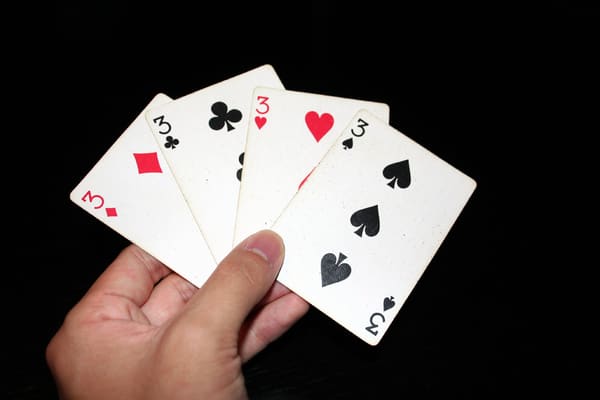
- Trio: A three-of-a-kind (three cards of the same rank).
- Escala: A run of four or more cards in the same suit in consecutive rank.
- Contract: The specific combination required to be laid down in a given round.
- Going out: Ending a round by playing/discarding one's last card.
- Wild card: A joker or (in many houses) a 2, usable in place of any natural card in a meld.
- Discard pile / Pozo: The face-up pile of cards any player may draw from.
- Stock / Mazo: The face-down pile from which cards are drawn in turn.
Tips & Strategy
Plan one round ahead whenever possible. In Round 3 (two escalas), hold the 2s and 3s that could become part of a trio in Round 4. Discard high-value cards (Ace, King, joker) only when you cannot use them in the current round, since they are heavy penalties if you get stuck.
Carioca's eight-round structure is a compound game: a player's best round-by-round strategy is to hoard flexibility. The rounds' contract requirements overlap imperfectly, so cards that fit the current round may not fit the next. Top players consciously balance 'going out fast' against 'collecting cards that will serve multiple future contracts'.
Trivia & Fun Facts
The game's name is borrowed: 'carioca' means 'from Rio de Janeiro', but Carioca the card game is beloved in Chile and barely played in Rio. A Chilean proverb runs: 'En el último redondo, todo se pierde o se gana' ('In the last round, everything is lost or won').
-
01In Round 8 of standard Carioca, what is the unique rule compared to every other round?Answer A player can only go out (and win the round) by laying down all cards in a single play; partial contracts across multiple turns are not allowed.
History & Culture
Carioca developed in Chile during the 1950s, blending Contract Rummy (an American game of the 1940s) with local card traditions. The name 'carioca' is Portuguese for a resident of Rio de Janeiro, but the game has no Brazilian origin; Chileans adopted the name for its stylish feel. The game spread across the Southern Cone and is now one of the most widely played home games in Chile, Argentina, and Uruguay.
Carioca is the dominant rummy-family game in Chile and a major competitor to Truco in Argentina. It is a regular feature of Chilean family gatherings, office lunches, and holiday afternoons. In recent years organised tournaments have grown in Santiago and Buenos Aires, treating Carioca as a semi-competitive skill game.
Variations & House Rules
Chilean Carioca is the standard eight-round form. Argentine Carioca often drops wild 2s. Peruvian Rumi Carioca allows partial contract layouts. Carioca Chico is the four-round speed version.
For a two-hour session, play all eight rounds. For a quick hour, play only Rounds 1, 3, 5, 7 (four rounds of escalating complexity). Agree on joker value (20, 30, or 50) before play; 50 is the Chilean standard.


