
How to Play
Robbers' Rummy is the open-manipulation rummy where every meld on the table is public property and any player can split, combine, or extend table melds on their turn to incorporate cards from their hand, provided all melds remain valid at turn end. Uses two 52-card decks plus Jokers. Typical rules include a 40-point opening meld requirement (Rummikub convention). The direct card ancestor of Rummikub.
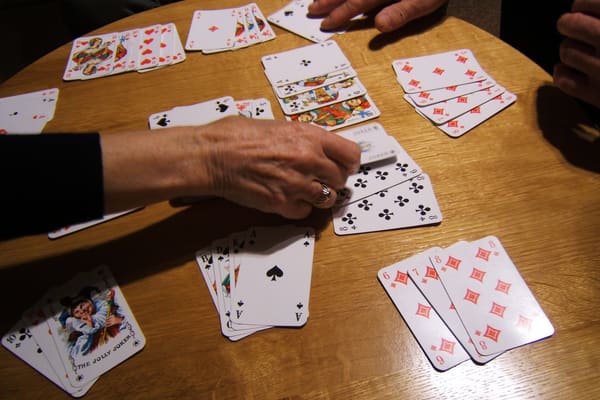
Robbers' Rummy (also known as Vatikan, Hindu Rummy with stealing, or the 'open manipulation' form of rummy) is the rummy variant that is the direct card-based parent of Rummikub: every meld on the table is considered public property and may be disassembled and recombined by any player on their turn to accommodate cards from their hand, as long as every group on the table is still a valid meld when play ends. It is the purest 'puzzle rummy' in the family: a single turn can transform the entire table. Played with two 52-card decks plus 2-6 Jokers (106-110 cards) and 11-13 cards dealt to each of 2-5 players, the aim is simply to be the first to empty your hand by forming valid sets (3+ same-rank, different suits) and runs (3+ suited sequence) and, crucially, by 'robbing' existing table melds to piece together new ones. The most famous house rule is a minimum opening meld of 40 points (drawn from Rummikub) before a player is allowed to rearrange the table; once opened, the player has unlimited manipulation power. Jokers substitute for any card and may be redeemed (swapped out) for the natural card they represent later. It is a cerebral, slow-paced, and deeply strategic family game, famous for turns that take 2-3 minutes of table-rearrangement while opponents watch nervously.
Quick Reference
- 2-5 players; two 52-card decks + Jokers (usually 108 cards).
- Deal 11-13 cards each; face-down stock.
- Play cards from hand as new melds, and/or rearrange table melds to absorb your cards.
- Opening meld must total 40+ points (standard); after that, free rearrangement.
- All table melds must be valid at end of turn; if not, undo and draw from stock.
- Going out = 0 points; others count unmelded cards.
- Joker=30, A=15, K/Q/J=10, 2-10=face value.
- Lowest cumulative after agreed rounds wins.
Players
2 to 5 players, each playing for themselves. 3 or 4 is the sweet spot. With 2, the game is a direct manipulation duel; with 5, the table fills quickly and rearrangement chains become dramatic. There are no partnerships. First dealer is chosen by cutting for the highest card; deal rotates clockwise.
Card Deck
Two standard 52-card decks combined (104 cards) plus 2-6 Jokers (most commonly 4 Jokers, for 108 cards). Card rank for suited sequences, low to high: A, 2, 3, 4, 5, 6, 7, 8, 9, 10, J, Q, K. Ace is low only (A-2-3 is legal; K-A-2 is not). Jokers are wild and substitute for any single card in a meld. Penalty values for unmelded cards: Joker = 30 points, Ace = 15 (when used as 1, some house rules: 11 when used as high), K/Q/J = 10 each, 2-10 = face value.
Objective
Be the first player to empty your hand by laying valid melds and by robbing (rearranging) existing table melds to fit your cards. When you empty your hand, the round ends and you score 0; every other player counts their unmelded cards as penalty points. A match is won by the lowest cumulative penalty total across multiple rounds, or (by agreement) the first person to go out zero times in a best-of-three.
Setup and Deal
- Shuffle all cards (2 decks + jokers) thoroughly; player left of dealer cuts.
- Deal each player 13 cards face-down (2-3 players), 11 cards (4-5 players); the exact count is a house-rule choice, but every player gets the same number.
- Place remaining cards as a face-down stock at the centre of the table. There is no discard pile in the Rummikub-style Robbers' Rummy; some card-game variants do use one (see Variations).
- The player to the dealer's left takes the first turn.
Gameplay
- On your turn, you have two actions: (A) play cards to the table by forming new melds and/or rearranging existing table melds; or (B) if you cannot or choose not to play, draw one card from the stock and end your turn.
- Valid melds: Set: three or four cards of the same rank, different suits (duplicate suits not allowed within one set; because two decks are in play, this is a live constraint). Run: three or more cards of the same suit in consecutive rank order.
- Opening meld (initial melding requirement): Before a player may rearrange the table, their first melding turn must put down melds totalling at least 40 points (Rummikub convention; some games use 30 or 51). Melds laid for the opening cannot incorporate cards from the table; only your hand. After opening, a player may freely manipulate the table.
- Rearranging ('robbing') the table: After opening, any player may split, combine, extend, or otherwise reshape existing table melds to incorporate cards from their hand, provided that at the end of their turn, every group on the table is a valid meld. For example: the table shows [4♠, 5♠, 6♠, 7♠] (a run) and you hold and [4♠, 4♥, 4♦]; you can add your to the front to extend the run, and then split off the into your 4-set (with and ), yielding [3♠, 5♠, 6♠, 7♠] (still a valid 4-card run) plus a new set [4♠, 4♥, 4♦] on the table.
- All table melds must be valid at end of turn. If you cannot conclude a rearrangement with everything valid, you must undo your manipulations and draw a card from the stock; your turn ends. Some stricter house rules penalise a failed manipulation by requiring you to take 3 cards from the stock.
- Jokers in melds: A Joker in an existing table meld may be redeemed by a player who holds the card the Joker is standing in for; they swap the real card into the meld and take the Joker into their hand to use elsewhere (including on the same turn).
- Stock exhaustion: When the stock runs out, play continues until a player goes out or no player can lay or rearrange anything for a full round. If play stalls, the player with the fewest unmelded cards wins the round.
- Going out: The moment your hand is empty, declare 'out'; the round ends.
Scoring
- Going out: 0 penalty points for the round.
- All other players: Count card values still in hand: Joker = 30, Ace = 15 (low) or 11 (house rule for high), K/Q/J = 10 each, 2-10 = face value.
- Match scoring: Play multiple rounds; the player with the lowest cumulative penalty after an agreed number of rounds (typically 5) wins the match. Alternatively, play first-to-go-out-three-times.
- Failed manipulation penalty (optional): 3 cards from the stock.
- Joker redemption bonus (optional house rule): A player who successfully redeems a Joker scores a 5-point bonus.
Winning
A round ends when a player empties their hand. The match winner is the player with the lowest cumulative penalty total after all agreed rounds, or (in the game-to-go-out variant) the first player to go out three times. Ties are broken by most rounds going out; if still tied, play one additional round among the tied players.
Common Variations
- Rummikub-style (tiles replace cards): The game is almost identical to the tile game Rummikub; this card form is its direct ancestor. Use the same rules but with cards.
- No opening meld: Skip the 40-point opening requirement; allow rearrangement from turn 1. Shorter games, higher variance.
- 30-point opening: Reduce the opening requirement for faster early play.
- 51-point opening (tournament Rummikub): Higher threshold; opens later and rewards patient card-gathering.
- Discard-pile variant: Add a face-up discard pile; players may draw from it instead of the stock (classic card-rummy option).
- Timed turns: Add a 2-minute timer per turn; if time runs out, the player must undo their manipulation and draw from the stock.
- No-Joker: Drop Jokers for a purer manipulation puzzle (no wild cards).
- Vatikan (Turkish Remi / Okey-card hybrid): Uses two 52-card decks plus 4 Jokers in rules functionally identical to Robbers' Rummy; Turkish household variant.
- Hindu Rummy with stealing: Indian subcontinent variant; similar rules, sometimes allows laying off onto opponents' melds after opening.
Tips and Strategy
- Plan the full turn mentally before touching cards. Once you start rearranging, you cannot easily back out; a mid-turn mistake may cost you the whole play.
- Open early with a modest meld. A 40-point opening (e.g., [A♠, A♥, A♦] for 45 or a [K♣, Q♣, J♣] for 30 plus a small set) frees you to rearrange from then on. Delaying the opening to build a big first play costs flexibility.
- Watch for chain reactions. The most satisfying turns use one card from hand to split a table run, which then lets you place three more cards from hand across the new gaps. Look for these chains before simpler single-card plays.
- Hold Jokers for opportunistic manipulations. A Joker in hand is worth 30 penalty points, but it is also a lock-pick: it substitutes for any card you need to unlock a rearrangement. Use Jokers late, not early, unless they let you immediately go out.
- Redeem Jokers aggressively. A table Joker is a free card waiting for the right owner. If the table has a Joker substituting for and you hold , swap on your next turn and use the rescued Joker wherever you like.
- Read the table every turn. Because the table is mutable, a meld that was a threat two turns ago may now be a puzzle-piece for your hand. Revisit the layout each turn.
- Defensive placement. Late in a round, if you must place a card on the table to reduce hand penalty, prefer adding to a run (a single extension) over breaking into a set (easy for opponents to split). A sealed four-card run of a single suit is hard to rearrange profitably.
- Minimise opening wastage. The 40-point opening should be met without committing too many versatile cards; prefer opening with three Aces (45 points) and a small run over a large, flexible suited run that you would rather keep manipulable.
Glossary
- Robbing / Manipulating: Rearranging existing table melds to incorporate cards from your hand.
- Set: 3 or 4 cards of the same rank in different suits.
- Run: 3 or more cards of the same suit in consecutive rank order.
- Meld: Either a set or a run on the table.
- Opening meld: The first melding turn by a player, which must total at least 40 points (house-rule variable).
- Joker: A wild card substituting for any single card in a meld. In Robbers' Rummy Jokers are redeemable (the player holding the natural card may swap it in).
- Stock: The face-down draw pile.
- Redemption: Swapping a Joker in a table meld for the card it was standing in for; the Joker goes to your hand.
- Going out: Emptying your hand to end the round with zero penalty.
- Vatikan: The Turkish card-rummy version of Robbers' Rummy; near-identical rules.
- Rummikub: The tile game directly descended from Robbers' Rummy, published 1978 by Ephraim Hertzano.
Tips & Strategy
Plan the full turn mentally before touching cards. Open early with a modest meld (three Aces for 45 points) to unlock rearrangement power. Hold Jokers as 'lock-picks' for late-game chains, not early filler. Redeem table Jokers whenever you hold their natural card. Look for chain manipulations where a single card from hand triggers three placements across restructured melds.
Robbers' Rummy requires a kind of working-memory gymnastics rare in card games. The optimal line in a complex late-round turn may involve 4-6 separate rearrangements, each validly re-formed, with a chain of card placements that the player must hold entirely in mind. Expert players practise the characteristic chains (splitting a run to create two sets, then restitching the run with opposing suits; or using a Joker redemption to cascade a Joker through three successive melds). The game rewards patience, precision, and the ability to see the whole table as a single combinatorial object.
Trivia & Fun Facts
Rummikub, the tile descendant of Robbers' Rummy, became Israel's best-selling export game in the 1980s and has sold more than 60 million copies worldwide; most tile-rummy players have never played the card progenitor, even though the rules are substantially identical. The 40-point opening meld threshold is a mid-20th century innovation attributed to Hertzano himself, who found that without it the game bogged down in 'micro-opening' arguments; the threshold became canonical in Rummikub and spread back into the card form.
-
01Which famous tile-based game was directly descended from Robbers' Rummy, and what key rule makes both games unique among their relatives?Answer Rummikub, published in 1978 by Israeli designer Ephraim Hertzano, is the direct tile-game descendant of Robbers' Rummy. The defining rule they both share, distinguishing them from all other rummy variants, is that every meld on the table is public property and any player may rearrange (rob) existing melds on their turn to incorporate cards/tiles from their hand, as long as every group on the table remains a valid meld when the turn ends. No other mainstream rummy allows manipulation of opponents' melds.
History & Culture
Robbers' Rummy is the card ancestor of Rummikub, designed by Ephraim Hertzano (a Romanian-Jewish immigrant to Israel) in the 1930s-40s and first commercially published in 1978. Hertzano based the tile game on a Romanian-family card game of the same manipulation family, itself derived from the broader European Rummy tree and Central-Asian card games. The card version survives in Turkish homes as Vatikan, in Indian households as a stealing-rummy variant, and in many European family circles under various local names. It is the most cerebrally-demanding of the mainstream Rummy variants and rewards players who can hold the entire table state in working memory.
Robbers' Rummy was a core family game in Eastern European and Middle Eastern Jewish households in the mid-20th century and survives today across diverse card-playing cultures including Turkish, Israeli, Indian, and the broader Rummikub-playing world. Its transformation into Rummikub in 1978 made it, in tile form, one of the most-played abstract strategy games in the world. The card form retains a smaller but devoted following among purists who prefer shuffling a deck to handling plastic tiles.
Variations & House Rules
Tile Rummikub is the best-known descendant. No-opening-meld plays faster but with higher variance. 30- or 51-point opening thresholds adjust pacing. Discard-pile variants are the classic card form. Timed turns prevent long rearrangements. No-Joker raises the puzzle difficulty. Vatikan is the Turkish card form. Hindu Rummy with stealing is the Indian form.
For a family game, drop the opening-meld requirement and allow lay-offs on opponents' melds for faster play. For a competitive group, enforce a 51-point opening and add a 90-second turn timer. For teaching, allow undo of manipulation within one turn (up until the next player starts their turn). To keep pace, play a max-5-round match rather than lowest-total-score.


