
How to Play
A seven-round rummy variant where each round requires a specific meld contract (sets and runs of increasing difficulty); the player with the lowest cumulative penalty after all seven rounds wins.
Contract Rummy is a structured rummy variant played over exactly seven rounds, each requiring a specific meld combination (called a contract) that every player must lay down before they can score low. The contracts escalate in complexity from round to round: Round 1 demands two sets of 3, Round 2 one set and one run, and so on up to Round 7 which requires three runs of 4 with no discard. A card's point value accrues as penalty points if it remains in your hand at the end of a round; the player with the lowest cumulative score after all seven rounds wins. The game emerged from American rummy clubs in the 1940s under many names (Zioncheck, Combination Rummy, Progressive Rummy, Frustration Rummy, Joker Rummy) and is nearly identical in rules across those names, differing mainly in whether a 'buy' mechanic is allowed that lets out-of-turn players snatch the top discard at the cost of drawing a penalty card. Contract Rummy uses two or three 52-card decks with Jokers as wild cards; the number of decks scales with the player count.
Quick Reference
- Use 2 decks (3-4 players) or 3 decks (5+) plus 4-6 Jokers.
- Deal 10 cards (rounds 1-4) or 12 cards (rounds 5-7).
- Stock in middle; turn top card to start discard pile.
- Draw from stock or top discard (optional buy for out-of-turn pickup).
- Meld exact contract combination, then optionally lay off.
- Discard one card to end turn (except when going out in Round 7).
- Ace=15, K/Q/J/10=10, 2-9=5, Joker=15 (all as penalty).
- Contract by round: 1) 2 sets of 3; 2) 1 set + 1 run of 4; 3) 2 runs of 4; 4) 3 sets of 3; 5) 2 sets + 1 run of 4; 6) 1 set + 2 runs of 4; 7) 3 runs of 4.
- Lowest cumulative score after 7 rounds wins.
Players
Three to eight players, each playing individually (no partnerships). Deal rotates clockwise after each round. A full 7-round match with 4 players takes approximately 60-90 minutes; with 8 players, it can run over two hours.
Card Deck
3 or 4 players: Two standard 52-card decks plus 4 Jokers (108 cards). 5 to 6 players: Three decks plus 6 Jokers (162 cards). 7 to 8 players: Three or four decks plus 6-8 Jokers. All decks shuffled together into one combined shoe. Card point values for end-of-round scoring: Ace = 15, face cards (K, Q, J) and 10 = 10 points each, numbers 2-9 = 5 points each, Joker = 15 points. Aces play high or low in runs (Ace-2-3 or Q-K-A) but not round-the-corner. Jokers are wild in any meld and count their represented card for meld purposes.
Objective
Over seven rounds, complete each round's contract (the required meld combination) and empty your hand as soon as possible. The player with the lowest cumulative penalty score after seven rounds wins. Penalty points accumulate from cards left in hand when any player goes out.
Setup and Deal
- Shuffle all decks together into a single shoe.
- Determine the first dealer (lowest card from an offered card is traditional). Deal rotates clockwise after each round.
- Rounds 1-4 deal size: 10 cards to each player, dealt clockwise one at a time.
- Rounds 5-7 deal size: 12 cards to each player. Round 7 is sometimes dealt 13 cards.
- Place the rest of the cards face-down as the stock and turn the top card face-up beside it to start the discard pile.
- The player to the dealer's left plays first each round.
Contracts (What Each Round Requires)
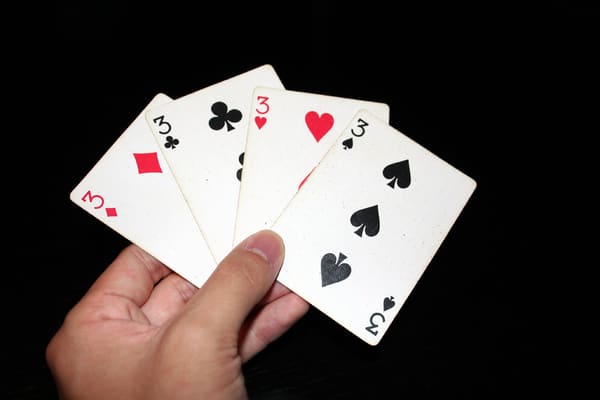
- Round 1: Two sets of 3 (two separate three-of-a-kind groups).
- Round 2: One set of 3 and one run of 4 (three of a kind plus a four-card run in the same suit).
- Round 3: Two runs of 4.
- Round 4: Three sets of 3.
- Round 5: Two sets of 3 and one run of 4 (deals 12 cards).
- Round 6: One set of 3 and two runs of 4.
- Round 7: Three runs of 4 (12 cards total in contract); no discard required to go out in round 7.
- A set is 3 or more cards of the same rank (suits irrelevant). A run is 3 or more consecutive cards of the same suit (Ace high or low, not both). Once a contract requires 'two runs of 4' they must be in different suits OR different starting ranks to avoid identical duplicate melds.
Turn Sequence
- Draw: Draw one card from the stock OR take the top card of the discard pile.
- Buying (optional house rule): A player not on turn may buy the top discard by announcing 'buy!' before the current player draws. Buying costs the buyer an extra card drawn from the stock (penalty card); the buyer then keeps the discard card plus the stock card in hand. The buyer does not take a turn; play continues normally to the next player. Limit: usually 3 buys per round per player.
- Meld (only after fulfilling the contract): You may only lay cards down after you have melded exactly the contract combination for the current round. If you have 10 cards and the Round 1 contract is two sets of 3 (six cards), you must lay down all six contract cards at once.
- Lay off: Once your contract is on the table, you may on subsequent turns add cards (sets extending, runs extending) to any meld on the table, including opponents' melds. Unlike Rummy 500, layoffs credit to the meld owner, not the layer-off; you gain only the benefit of shedding a card.
- Discard: End your turn by discarding one card face-up on the discard pile. Exception: Round 7, where going out requires laying down your contract without a final discard (so you must meld your entire hand on your winning turn).
- Joker rules: A Joker is wild in any meld. A Joker on the table in a run may be replaced by any player on their turn with the natural card it represents, freeing the Joker for use in that player's next meld (provided the layer took the Joker, discarded the natural card in a legal position, or some house rules let the Joker just be swapped without a turn penalty).
Ending a Round
- A round ends when one player goes out by playing all cards from their hand (including the final discard, except in Round 7).
- All other players count their penalty points from cards still in hand.
- If the stock is exhausted before anyone goes out, the discard pile (minus its top card) is shuffled and turned face-down as the new stock. If a second exhaustion occurs, the round ends with everyone scoring penalty for remaining cards.
Scoring
- Penalty card values (cards left in hand at round's end): - Ace: 15 points. - King, Queen, Jack, 10: 10 points each. - Numbers 2-9: 5 points each. - Joker: 15 points.
- Going-out player: Scores 0 for the round (no cards in hand). No going-out bonus in standard rules.
- Other players: Sum penalty values of cards still in hand; add to their running total.
- Track cumulative scores on paper. After seven rounds, the lowest total wins.
- Partial-meld penalty (house variant): Some groups allow a player to lay down their contract on their final turn and still count hand cards as zero, even if the final discard makes them a short-stacked winner.
Winning
The player with the lowest cumulative penalty score after all seven rounds wins the match. Ties are broken by the score in Round 7 (lowest wins). A complete match is a single 7-round session; repeat sessions start fresh unless playing a tournament bracket.
Common Variations
- Progressive Rummy: Nearly identical to Contract Rummy but with different contract sequences in each round; some versions start with 10 cards and add 1 card per round.
- Zioncheck: Another name for Contract Rummy; identical rules in most publications.
- Frustration Rummy: Contract Rummy with the buy mechanic enabled by default and usually limited to 3 buys per round.
- Joker Rummy: Contract Rummy with extra Jokers; sometimes 6 or 8 Jokers per game.
- Custom contracts: Some groups create house-rule contract tables, e.g. 'Round 7 is four runs of 3' or 'Round 4 is four sets of 3'.
- Short match: 5-round versions that drop Rounds 5 and 6; useful for teaching new players.
Tips and Strategy
- Focus on the contract first: You cannot lay down any card until the exact contract is in hand. Don't get distracted by potential 'good' melds; every card that doesn't fit the contract is potential deadweight.
- Save Jokers for late rounds: Jokers are worth 15 points in deadwood but are wild in any meld. Rounds 5-7 with 12-card hands and long runs are where Jokers shine.
- Count face cards: High-value cards (Aces, face cards) are 15 or 10 point penalties. Getting them into melds early protects your score. If you are going to miss the contract, discard high cards first.
- Use buying strategically: Each buy costs an extra card from the stock, so only buy when the discard directly helps your contract AND you can afford the bulk. Buying late in a round is usually a mistake.
- Lay off aggressively: Once your contract is down, dump cards onto opponents' melds to empty your hand. Even a 5-point layoff reduces your potential penalty by 5.
- Watch Round 7: No discard means you must meld your entire hand on your going-out turn. Plan the sequence carefully: draw, meld the three runs of 4, and go out in one turn.
Glossary
- Contract: The specific meld combination required in a given round (e.g. 'two sets of 3 and one run of 4' in Round 5).
- Set (Group): 3 or more cards of the same rank.
- Run (Sequence): 3 or more consecutive same-suit cards.
- Go out: Play all cards from hand, ending the round.
- Buy: Out-of-turn pickup of the top discard; costs an extra card from stock.
- Deadwood / Penalty cards: Cards remaining in a player's hand when the round ends; their values are added to the player's penalty total.
- Wild card: A Joker substituted for any card in a meld.
- Joker swap: Some rules let a player replace a Joker on the table with its natural card, freeing the Joker for reuse.
Tips & Strategy
Focus solely on completing the exact contract before trying to lay off extra cards. Save Jokers for late rounds when contracts require two runs of 4 or more. Get high-value Aces and face cards into melds early so they do not land as penalty points when an opponent goes out.
The most important strategic decision each turn is whether to pick from the discard pile (revealing information about your hand to opponents) or the stock (hidden draw). Take from the discard pile only when the card directly completes part of your contract. Late in a round, shift from contract-building to hand-reducing: dump high-value cards quickly so that a surprise going-out costs you little.
Trivia & Fun Facts
Contract Rummy is known by many regional names: Zioncheck in parts of the Midwest (after the 1936 film), Combination Rummy in bridge circles, Joker Rummy when played with extra Jokers, and Frustration Rummy when the buy mechanic is enforced. Despite the varied naming, the core 7-round contract system is remarkably consistent across all versions.
-
01How many rounds are in a standard Contract Rummy match, and what makes the final round unique?Answer Seven rounds, each with a specific meld contract. Round 7's defining feature is that the contract (three runs of 4) requires no final discard to go out: the winner must meld their entire hand in a single turn.
History & Culture
Contract Rummy emerged in American card-playing clubs in the 1940s as players sought structure and round-to-round progression compared to basic Rummy. Albert H. Morehead and Geoffrey Mott-Smith's 1949 rummy compendium codified the seven-round form, and the game spread across North America and Europe through the 1950s under names like Zioncheck, Combination Rummy, and Joker Rummy.
Contract Rummy represents the evolution of rummy games from simple meld-forming to structured competitive play with clearly defined round objectives. It has been a staple of social card gaming in North America and parts of Europe for over 70 years, particularly among retirees and card clubs where its 60-90 minute match length fits a comfortable after-dinner session.
Variations & House Rules
Progressive Rummy uses slightly different contract orders or scales hand size. Frustration Rummy enables buying by out-of-turn players. Joker Rummy adds extra Jokers. Short 5-round versions drop the two hardest rounds. Custom-contract variants tailor round requirements to house preferences.
For a faster game, play 5 rounds instead of 7 (drop Rounds 5 and 6). Adjust Joker count based on desired wild-card flexibility. Enable the buy mechanic for a more reactive, faster-paced game. Create custom contracts that match your group's skill level or preferences.


