
How to Play
A British seven-deal contract-rummy with escalating meld requirements, a distinctive buying mechanic for out-of-turn discards, and wild jokers that can be reclaimed by holding the card they represent. Lowest cumulative penalty score wins.
Liverpool Rummy is a seven-deal contract-rummy variant played with two (or three) decks plus jokers. Each of the seven deals has its own mandatory meld contract, getting steadily harder: the first deal requires two books of three cards, the seventh is a single sequence of seven cards in one suit. On each turn, a player draws a card, may lay down their contract once the requirements are met, lays off onto table melds, and discards one card. The game's signature mechanic is 'buying': a player not in turn may take the top discard out of sequence by also taking one penalty card from stock. Jokers act as wild cards and may be reclaimed ('swapped') by a player holding the real card the joker represents. At the end of each deal, cards remaining in hand score penalty points; the lowest cumulative total after seven deals wins. Liverpool Rummy is a staple of British family card nights and the direct British cousin of American Contract Rummy and May I?
Quick Reference
- 2 decks + jokers (3-4 players), 3 decks + jokers (5-8).
- Deal 10 cards (deals 1-4) or 12 cards (deals 5-7).
- Top stock card starts the discard pile.
- Draw from stock or discard; optionally buy (with a penalty card) out of turn.
- Lay down the contract once the requirement is met (only once per deal).
- Lay off onto table melds; discard to end turn.
- Penalty per card left in hand: A = 15, 10/J/Q/K = 10, 2-9 = 5, Joker = 15.
- Deal ends when someone goes out; lowest 7-deal total wins.
Players
Three to eight players, each for themselves (no partnerships). Four to six is the sweet spot. Play runs clockwise; the deal rotates left after each round. A full seven-deal match lasts 60 to 120 minutes.
Card Deck
- 3-4 players: Two standard 52-card decks plus 2 to 4 jokers (106-108 cards).
- 5-8 players: Three standard 52-card decks plus 3 to 6 jokers (159-162 cards).
- Aces may be played LOW (A-2-3) or HIGH (Q-K-A) in sequences, but never wrap around (no K-A-2). Agree before the match.
- Jokers are wild; they may substitute for any card in a book or sequence. See Joker Swap Rule.
- Card penalty values at deal end: Ace = 15, K/Q/J/10 = 10 each, 9-2 = 5 each, Joker = 15.
Objective
Be the player with the lowest cumulative penalty score after seven deals. In each deal, complete the specified contract (mandatory set of melds) as quickly as possible, then lay off extra cards onto table melds, and then discard your final card to 'go out'. Any cards still in your hand when someone else goes out count as penalty points against you.
The Seven Contracts
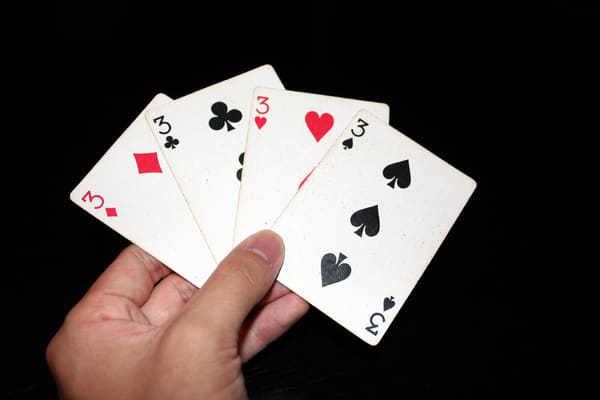
- Deal 1: Two books of three (B-B). A 'book' is three or more cards of the same rank, any suits. Minimum 6 cards used.
- Deal 2: One book of three and one sequence of four (B-S). A 'sequence' is four or more cards of the same suit in consecutive rank. Minimum 7 cards used.
- Deal 3: Two sequences of four (S-S). Minimum 8 cards used.
- Deal 4: Three books of three (B-B-B). Minimum 9 cards used.
- Deal 5: Two books of three and one sequence of four (B-B-S). Minimum 10 cards used.
- Deal 6: One book of three and two sequences of four (B-S-S). Minimum 11 cards used.
- Deal 7: One sequence of seven in a single suit (S7). This is the only contract with no extra cards to discard: you go out at the moment you complete the 7-card sequence (no final discard required).
Setup and Deal
- Shuffle together the number of decks appropriate for the player count. The player to the dealer's left cuts.
- Hand sizes: deals 1 through 4 receive 10 cards each; deals 5 through 7 receive 12 cards each. (Some house-rule tables use 10 throughout; agree in advance.) Deal clockwise one at a time.
- Place the remaining cards face down as the stock. Turn the top card face up beside the stock to start the discard pile.
- The player to the dealer's left takes the first turn. The deal rotates clockwise between rounds.
Turn Structure
- Step 1 (draw): Draw one card from the top of the stock OR the top of the discard pile.
- Step 2 (buy offers): Before or after drawing, see Buying rules below for out-of-turn interactions.
- Step 3 (meld contract): If you hold the current deal's contract, you may lay it face up in front of you. You can only lay down your contract ONCE during a deal; after it is down, no further books or sequences may be added as separate melds (all excess cards must be laid off).
- Step 4 (lay off): If your contract is already on the table, you may lay off single cards from your hand onto any meld on the table (yours or an opponent's). Cards must validly extend books (same rank) or sequences (same suit, consecutive rank).
- Step 5 (discard): End your turn by placing ONE card from your hand face up on the discard pile. If your contract is deal 7 (sequence of seven), the final card completes the contract itself and no discard is required.
Buying Discards
- When it is not your turn and the current player declines the top discard, any other player may announce 'Buy!' to take it.
- If two or more players announce at the same time, the buyer closest to the current player (going clockwise) wins the discard.
- The buyer takes the discard AND a penalty card off the stock, adding both to their hand (no meld, no discard; your turn still rotates normally).
- Each player may buy up to THREE times per deal. After your third buy you cannot buy again that deal.
- Buying is strictly optional; no one is forced to buy.
Joker Rules
- Jokers are wild and may represent any card in either a book or a sequence. A book must contain at least two natural (non-wild) cards; a sequence may contain at most one joker per four-card segment in many house rules (agree in advance).
- Joker swap: On your turn (during your meld or lay-off phase), if you hold the natural card a joker represents on the table, you may swap your natural card for that joker and use the reclaimed joker immediately as a wild in your own meld.
- A joker left in your hand at deal end scores 15 penalty points.
- You may not add a second joker to a meld that already contains a joker unless the meld's natural cards clearly identify the second joker's position (house rules vary).
Going Out and Scoring the Deal
- A player 'goes out' by emptying their hand: discarding the final card, or completing the deal-7 sequence with their last card.
- Once a player goes out, the deal ends immediately. Other players count the penalty value of the cards still in their hand.
- If no player goes out by the time the stock runs out, some groups reshuffle the discard pile (except the top card) as a new stock and continue; others end the deal and score all unpaid hands.
- Record each player's running total. The next deal begins with a new dealer.
Winning
After all seven deals have been played, the player with the LOWEST cumulative penalty total wins the match. Ties are resolved by replaying the final deal or by comparing penalty totals in the seventh deal. Some groups play a shorter 5-deal or longer 9-deal match.
Common Variations
- May I? (Progressive Rummy): The explicit permission phrase 'May I?' is required before buying; limits and contracts vary slightly from deal to deal.
- Shanghai Rummy: Similar seven-deal structure but with its own contract list and a 3-buy-per-deal cap; hands may be shared between partners in 4-player teams.
- Continental Rummy: Uses a single large hand with progressively harder contracts.
- 9-deal Liverpool: Adds two further contracts: 3 sequences of 4 (S-S-S) at deal 8, and 2 sequences of 5 (S5-S5) at deal 9. Favoured by groups wanting a longer evening.
- Fixed-hand Liverpool: All 7 deals use 10-card hands; the final contract becomes a sequence of 6 or 7 depending on house rule.
- No-buy Liverpool: Disallows buying for faster, purer play; relies entirely on the stock/discard draw cycle.
Tips and Strategy
- Focus early turns entirely on the contract; do not waste card-management effort on other card combinations until the contract is on the table.
- Buy discards when the top card clearly fits your contract and you have fewer than three buys left. Otherwise, the extra penalty card often outweighs the benefit.
- Reclaim jokers at every opportunity. A joker in hand costs you 15 penalty points if caught; a joker in your own meld is a 15-point saving.
- In the final deals (6 and 7) with 12-card hands, plan your sequence work early. A sequence of seven in one suit is notoriously hard to assemble without jokers; track which cards in each suit have been discarded.
- If you hold three of a rank late in a book-heavy deal, consider holding a single card back to force an opponent to take it rather than risk exposing your plan. Discarding obvious 'safe' cards lets opponents lay off easily.
- Count buys per player. Once an opponent has used their 3 buys, you can discard more freely knowing it cannot be taken out of turn.
Glossary
- Contract: The required meld pattern for the current deal; cannot be split across multiple turns.
- Book: Three or more cards of the same rank, any suits.
- Sequence / Run: Four or more cards of the same suit in consecutive rank order.
- Buy / Buying: Taking the top discard out of turn at the cost of an extra stock card; limited to 3 per player per deal.
- Lay off: Adding a single card from hand to an existing meld on the table (yours or an opponent's).
- Joker swap: Replacing a joker in a table meld with its natural card, reclaiming the joker for your own use.
- Go out: Empty your hand by discarding or melding the last card; ends the deal.
Tips & Strategy
Get the contract down as fast as possible in each deal; every turn spent without it costs laying-off opportunities. Buy only when the discard clearly fits your contract; the penalty card usually outweighs the benefit. Reclaim your jokers when you hold the real card they represent.
Liverpool Rummy rewards efficient contract completion over opportunistic melding. The buy mechanic is a double-edged sword: each buy adds a penalty card to your hand, so it pays off only when the discard is clearly a completion card. Joker management is the deepest strategic layer, because jokers are both worth 15 penalty points and irreplaceable contract-completers.
Trivia & Fun Facts
Despite the name, Liverpool Rummy is played throughout Britain, Ireland, and the Commonwealth, and has no documented special relationship with Liverpool. The seven-deal contract progression has been widely copied in bridge-tournament-style social card games. Contract Rummy's 'buy' mechanic directly inspired the trading rules in later proprietary card games such as Phase 10.
-
01What is the contract for the seventh and final deal of Liverpool Rummy?Answer A single sequence of seven cards in one suit.
-
02How many times may each player buy a discard during a single deal?Answer Three times.
History & Culture
Liverpool Rummy is the British cousin of American Contract Rummy, itself descended from Coon-Can and Pinochle-family family games popularised in the United States in the 1930s. The 'Liverpool' name attached to the game in the early 20th century and became widely used across Britain even though the game is not specifically tied to the city of Liverpool. Progressive Rummy and May I? are closely related American cousins with near-identical contract structures.
Liverpool Rummy is a backbone of British family card nights and an everyday social game in pubs, clubs, and community centres across the UK and Commonwealth. Its seven-deal structure gives the game a distinct tournament feel even in casual play, making it a common choice for card clubs and charity card drives.
Variations & House Rules
May I? is the polite-phrase American form. Shanghai Rummy adds partnership twists and a joker-swap rule. 9-deal Liverpool extends the match with extra sequences. Fixed-hand variants keep 10 cards per deal across all seven rounds.
For shorter sessions, play only the first 5 deals. For quicker pacing, remove the buy mechanic entirely. Use two sets of poker chips as buy tokens so each player can see their remaining buys at a glance.


