
How to Play
Gin Rummy is the most popular 2-player Rummy variant. Each player holds 10 cards and races to arrange them into melds (sets and runs). Knock when deadwood is 10 or fewer, or go Gin for a bonus; undercuts punish careless knocks. First to 100 points plus bonuses wins the game.
Gin Rummy is the most popular 2-player Rummy in the English-speaking world, invented by Elwood T. Baker in New York in 1909 and famously associated with Hollywood's golden age of card play. Each player is dealt 10 cards from a standard 52-card pack. The 21st card starts the discard pile face-up and the remaining 31 cards form the face-down stock. Aces are always low (A-2-3 is a valid sequence; Q-K-A is not). On each turn a player draws one card (from the stock or the top of the discard pile) and discards one. The goal is to arrange your 10 cards into 'melds': sets (3 or 4 of a rank in different suits) and runs (3+ consecutive cards of the same suit); cards that cannot be melded are 'deadwood'. When your deadwood totals 10 points or less you may KNOCK at the end of your turn (after drawing, by discarding face-down) to end the hand. If your deadwood is zero (every card melded), you 'go Gin' for a bonus. The knocker wins the difference in deadwood if theirs is lower; if the opponent's deadwood equals or is lower, the opponent UNDERCUTS the knocker for a bonus plus the difference. The game plays to 100 points; winning bonuses add a 100-point game bonus (or 200 for a shutout) plus 20 per 'box' (hand won).
Quick Reference
- 2 players, standard 52-card deck.
- Deal 10 cards each. Flip the 21st card as the upcard (first discard).
- Non-dealer may take the upcard first; if refused, dealer may take it; otherwise non-dealer draws from stock.
- Draw 1 card from stock OR top of discard pile.
- Discard 1 card face-up (or face-down to knock). Aces are low only; no wrap runs.
- Melds: set (3 or 4 of a rank, different suits) or run (3+ consecutive same-suit cards). A card is in at most one meld.
- Knocker wins: difference (opponent deadwood minus knocker deadwood) if opponent's is higher.
- Undercut: opponent's deadwood equal or lower = opponent scores difference + 25 bonus.
- Gin: 25 bonus + opponent's full deadwood; no undercuts or layoffs possible.
- Game: 100 to win + 100 game bonus (200 if shutout) + 20 per box won.
Players
2 players, head-to-head. Occasional 3-player cutthroat (dealer sits out) and 4-player partnership forms exist but are uncommon; this entry describes the dominant 2-player game. A single hand takes 5 to 15 minutes; a full game to 100 runs 20 to 60 minutes depending on card flow. The first dealer is chosen by a cut (low card deals); thereafter the LOSER of each hand deals the next (some groups alternate instead; agree before starting).
Card Deck
- Standard 52-card French-suited pack. No jokers.
- Card values for scoring deadwood: Ace = 1, 2 through 10 = face value, Jack/Queen/King = 10 each.
- Rank order for runs: A, 2, 3, 4, 5, 6, 7, 8, 9, 10, J, Q, K. Aces are LOW only; they do NOT wrap (Q-K-A is not a valid run).
- Suits have no inherent hierarchy. They matter only for defining a run (same suit) and a set (different suits).
Objective
Reduce your 10 cards into melds (sets and runs) faster than your opponent. End the hand either by knocking (deadwood 10 points or fewer) or by going Gin (deadwood zero). Over the game, reach 100 points (including hand scores and undercut/gin bonuses) first, then collect the game bonus plus box bonuses.
Melds: Sets and Runs
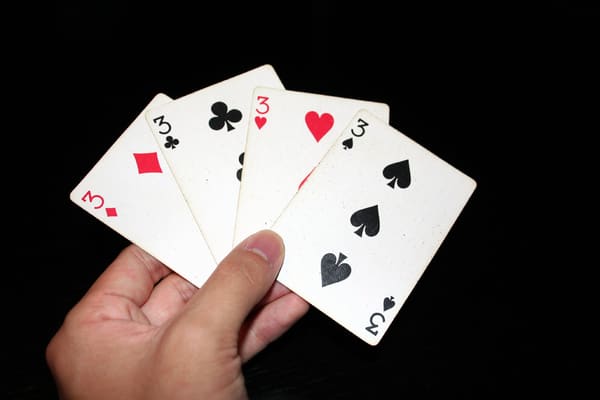
- Set (also 'group' or 'book'): 3 or 4 cards of the same rank, in DIFFERENT suits. Examples: 7♠-7♥-7♦ (valid 3-card set) and K♠-K♥-K♦-K♣ (valid 4-card set).
- Run (also 'sequence' or 'straight'): 3 or more consecutive cards of the SAME suit. Examples: 4♣-5♣-6♣ (valid 3-card run) and 9♦-10♦-J♦-Q♦-K♦ (valid 5-card run).
- No dual use: a single card cannot belong to both a set and a run at the same time. Example: 7♠-7♥-7♦ and 5♠-6♠-7♠ cannot both include the 7♠.
- Aces low only: Ace may anchor a run at A-2-3 (low end) but never at Q-K-A (wrap) because Aces are low only.
- Deadwood: any card not placed in a meld at hand end is deadwood and counts its face value as penalty points.
Setup and Deal
- The dealer shuffles and the non-dealer cuts.
- Deal 10 cards face-down to each player, one at a time starting with the non-dealer.
- Flip the 21st card face-up beside the stock; this is the UPCARD and the first card of the discard pile.
- Place the remaining 31 cards face-down as the stock.
- First-turn special: the non-dealer may TAKE the upcard or refuse. If refused, the dealer may take or refuse. If both refuse, the non-dealer draws the top of the stock and play continues normally.
- Whichever player takes (or draws first from) the upcard then discards one card to end the first turn.
Turn Flow
- Draw: take the top card of the stock (face-down) OR the top of the discard pile (face-up). You must draw before any other action.
- You may now KNOCK (see below) or discard.
- Discard: if not knocking, place one card from your hand face-up on top of the discard pile. You may NOT immediately discard the same card you just took from the discard pile on this turn.
- Play alternates; the opponent then draws.
Knocking and Going Gin
- At the END of your turn, after drawing, if the total value of cards that are NOT in any meld is 10 or fewer, you may KNOCK.
- To knock, place your final discard FACE-DOWN on the discard pile (instead of face-up), then expose your hand arranged into melds plus a small deadwood pile.
- Deadwood calculation: deadwood includes every card not placed in a valid meld. Values: Ace = 1, 2 through 10 = face value, Jack/Queen/King = 10.
- Going Gin: if your deadwood is ZERO (all 10 cards in valid melds), you have 'gone Gin'. Gin can be declared only after drawing, by placing your final discard face-down and exposing the full melded hand.
- Layoff (only after a knock, not Gin): the OPPONENT may extend the knocker's melds with their own unmelded cards to REDUCE their own deadwood. Extensions: adding a 4th card to a 3-of-a-kind set, or extending a run at either end. Laying off is only allowed when the knocker did NOT go Gin.
- No layoff vs. Gin: if the knocker went Gin, the opponent cannot lay off; all their non-melded cards remain deadwood.
Scoring a Hand
- Knocker wins when opponent's deadwood is HIGHER than the knocker's. The knocker scores the difference (opponent deadwood minus knocker deadwood).
- Undercut when opponent's deadwood is EQUAL to OR LOWER than the knocker's. The opponent wins the hand (called an undercut) and scores the difference PLUS a 25-point bonus (some groups use 10).
- Gin bonus: if you went Gin, you score 25 points bonus PLUS the opponent's entire deadwood count. Gin can never be undercut.
- Game box bonus: at the end of the full game (100 points reached), each player adds 20 points for each hand they won (a 'box' or 'line bonus').
- Game bonus: the player who reaches 100 first adds a 100-point game bonus. If the OPPONENT failed to score any points during the game, the game bonus doubles to 200 (called a 'schneider' or 'shutout').
- Stock-running-low rule: if the stock is reduced to just 2 cards and the current player takes a card without knocking, the hand is DEAD (no score). Same dealer deals the next hand.
Winning
The first player to reach 100 points (cumulative, across hands) wins the GAME. They then add the 100-point game bonus (200 if the loser was shut out), plus 20 per hand-box won. The opposing score is subtracted, and the final net difference is the settlement for that game. Gin Rummy matches typically play a best-of-3 or best-of-5 games; some play to 250 or 500 for a longer evening.
Common Variations
- Oklahoma Gin: the upcard's rank determines the maximum knockable deadwood for that hand (if the upcard is a 7, you can only knock with 7 or less deadwood; if an Ace, only Gin is allowed; if a 10 or face card, the standard 10 applies). If the upcard is a spade, all hand scores double for the hand.
- Hollywood Gin: three concurrent game columns; each hand's winner scores into the first column they have not yet scored in, then also into later columns. Creates a longer, overlapping match structure.
- Straight Gin: no knocking allowed; players must go Gin (0 deadwood) to end a hand. Hands run longer and more risky.
- Partnership Gin: 4 players in 2 partnerships, each partner plays a separate game; team scores are combined each hand. Partnership bonuses for both partners winning the same hand.
- Manhattan Gin / Chicago Gin: urban variants with minor scoring tweaks (different bonuses for undercuts or different deadwood caps).
- Spade doubles: if any knocker's hand has the opponent's discard-pile top as a spade, the hand score doubles; a popular house rule.
Tips and Strategy
- Build flexible meld candidates. A 6 can slot into a 4-5-6 run OR a 5-6-7 run OR a 6-6-6 set; cards with multiple meld paths are more valuable.
- Pay attention to the discard pile. If your opponent discards a 7♠, they are almost certainly not building 7-of-a-kind or any 7♠ run.
- Do not over-invest in a single run. Four cards to a run (e.g., 4-5-6-7 of hearts) ties up 4 cards for 3-card meld value; prefer 3-card runs plus a set for coverage.
- Count deadwood ruthlessly. High cards are 10 points each; holding K-Q-J as a potential run is 30 points of deadwood if it fails.
- Knock early if the hand is dangerous. A hand with 6 points of deadwood at move 4 is often worth knocking on move 5 rather than waiting for Gin, because every turn your opponent could Gin first.
- Do NOT knock at 10 against an opponent who has drawn many from the discard pile; they have predictable melds and are likely to undercut.
- The 50/50 rule: by hand 5 or 6, if you have not made progress, seriously consider dumping your highest deadwood cards to reduce risk; the opponent is probably close to knocking.
- Going Gin is rare. Average hands yield knocks at 4 to 8 deadwood; set Gin as a stretch goal, not the default target.
Glossary
- Meld: a valid set or run used in your final arrangement.
- Set / group / book: 3 or 4 cards of the same rank in different suits.
- Run / sequence / straight: 3+ consecutive same-suit cards.
- Deadwood: any card not in a meld at hand end; counts its value as penalty.
- Knock: end the hand by placing your final discard face-down when your deadwood is 10 or fewer.
- Gin: knock with 0 deadwood (every card melded); scores a 25-point bonus plus opponent's full deadwood.
- Undercut: if the opponent's deadwood equals or is lower than the knocker's, they beat the knocker and score the difference plus a 25-point bonus.
- Layoff: after a knock (not Gin), the opponent extends the knocker's melds with their own non-melded cards to reduce their deadwood.
- Upcard: the 21st card, flipped face-up at the start of the deal; the non-dealer may take it first.
- Box / line bonus: 20-point bonus per hand won, added at game end.
- Game bonus: 100 points for winning a game; 200 if the loser scored zero.
Tips & Strategy
Build flexible hands with cards that can slot into multiple melds. Watch the discard pile: every card your opponent discards is information about what they are NOT building. Knock aggressively once your deadwood is safely under 10; the cost of waiting for Gin is often an opponent-Gin before you get there. Avoid knocking at exactly 10 points against an opponent who has drawn heavily from the discard pile (they are likely to undercut). Memorise that face cards plus 10s are all 10-point deadwood each, so three face cards in hand is 30 points of risk.
Expert Gin players balance knock timing against undercut risk: knocking at 3 to 4 deadwood is usually safe; knocking at 8 to 10 against a suspect opponent is risky. Discard reading is the second pillar: a player who keeps drawing from the discard pile is declaring what melds they are building, so adjusting your own discards to avoid feeding them is crucial. The third pillar is meld flexibility: the best hands are the ones where your 'keeper' cards have two or three plausible meld paths, so whichever cards come up, you can slot them in.
Trivia & Fun Facts
Elwood T. Baker named the game 'Gin' because its parent game was called 'Whiskey Poker', so a 'lighter' name was chosen. Gin has appeared in many films and TV shows (The Odd Couple memorably) as shorthand for old-Hollywood downtime. The Gin game bonus structure (100 for game, 200 for shutout, 20 per box) has been remarkably stable since the 1930s.
-
01In Gin Rummy, what is the term for a hand where every card is in a valid meld (zero deadwood), and what is the bonus for achieving it?Answer Going Gin. A Gin hand scores a 25-point bonus plus the opponent's entire deadwood count, and it cannot be undercut. The opponent also cannot lay off any cards against a Gin hand.
-
02What is an 'undercut', and what bonus does it pay?Answer An undercut occurs when a player knocks but the opponent, after any permitted layoffs, has deadwood EQUAL to or LOWER than the knocker's. The undercutting opponent wins the hand and scores the difference PLUS a 25-point bonus. It is the main penalty for knocking too early or with too high a deadwood count.
History & Culture
Gin Rummy was invented by Elwood T. Baker in New York City in 1909, as a faster two-player variant of Whiskey Poker (itself a Rummy variant). Baker designed it to be playable in short café games and it quickly became popular in New York and then Hollywood, where it became a fixture of movie-set downtime in the 1930s and 1940s. Celebrity players included Lana Turner, Clark Gable, Humphrey Bogart, and Omar Sharif, cementing its association with glamour. Gin remains one of the most analysed card games; computer solvers have produced near-optimal knock-threshold theory for competitive play.
Gin Rummy remains one of the most iconic 2-player card games in the English-speaking world, a standard of cafés, cruise-ship lounges, and family kitchens. Its Hollywood associations in the 1930s-1950s and its portability (two players, one deck, table or tray) made it a durable cultural institution, and it is frequently the first 'serious' card game taught in North American families after the children's level.
Variations & House Rules
Oklahoma Gin varies the knock threshold based on the upcard and doubles scores on spade upcards. Hollywood Gin scores three concurrent games at once. Straight Gin bans knocking; you must go Gin. Partnership Gin pairs 4 players into 2 partnerships. Manhattan and Chicago Gin are urban variants with small scoring tweaks.
Use standard knock-at-10 rules when teaching new players; add Oklahoma's variable knock threshold once players are comfortable. For a short session, play to 50 points instead of 100; for a long evening, play to 250. Introduce a simple spade-doubles house rule to add late-hand drama.


