
How to Play
A classic 18th-century English stops game played with a specially marked circular board of eight compartments. 3 to 8 players shed cards in ascending sequence while collecting chips from compartments triggered by specific cards (Pope, Matrimony, Intrigue, trump honours).
Pope Joan is a classic English 'stops' game from the 18th and 19th centuries, played with a specially-made circular staking board divided into eight compartments. A standard 52-card deck has the 8 of Diamonds removed (reducing the pack to 51 cards); the missing card creates a built-in 'stop' in the diamond suit, used throughout gameplay. The dealer 'dresses' the board before each deal by placing chips in fixed amounts into the eight compartments: Pope (6 chips), Matrimony and Intrigue (2 chips each), and Ace, King, Queen, Jack, and Game (1 chip each). Cards are dealt around the table with one extra 'dead' hand placed face-down beside the dealer; the last card dealt to the dead hand is turned up to set the trump suit for that deal. Play is a laying-sequence stops game: the eldest hand leads their lowest card of any suit, the next higher same-suit card is then played (by whoever holds it), and the sequence continues upward until it is stopped by a King, the missing 8 of Diamonds, or a card stuck in the dead hand. When the sequence stops, the last player starts a new sequence with their lowest card. Players collect from specific compartments by playing the 9 of Diamonds (Pope Joan), Ace, King, Queen, or Jack of trumps, or by playing King-and-Queen or Queen-and-Jack of trumps in sequence (Matrimony and Intrigue). The first player to empty their hand wins the Game compartment plus a chip from each other player for every card still in their hand (Pope-holders are usually exempt from this payment). The game was a staple of Georgian and Victorian drawing rooms and featured by name in Jane Austen, Emma.
Quick Reference
- 3 to 8 players. Remove the 8 of Diamonds from a 52-card deck (51 cards).
- Prepare a board with 8 compartments: Pope, Matrimony, Intrigue, Ace, King, Queen, Jack, Game.
- Dealer dresses the board (Pope 6, Matri 2, Intrigue 2, A/K/Q/J/Game 1 each).
- Deal cards around players and one dead hand; flip dead hand's last card for trumps.
- Eldest leads any card; next-higher card of the same suit follows automatically.
- Sequence stops on a King, the missing 8♦, or a dead-hand card.
- Last player of a stopped sequence leads the next with their lowest card.
- Collect compartment chips when playing the 9♦, Ace/K/Q/J of trumps, or K-Q / Q-J of trumps consecutively.
- First player out wins Game + 1 chip per card remaining in each opponent's hand.
- Unclaimed compartment chips carry over to the next deal.
- Most chips at session end (6-12 deals) wins the match.
Players
3 to 8 players, best at 4 to 6. No partnerships. Play rotates clockwise; deal passes one seat to the left after each hand. A session typically lasts 30 to 90 minutes with 6 to 12 deals. The traditional equipment is a round wooden staking board on a central pillar; modern play uses a sheet of paper marked with the compartments or a row of eight small cups or egg cups.
Card Deck and Board
- One standard 52-card French-suited pack, with the 8 of Diamonds removed, leaving 51 cards. The 8 of Diamonds is discarded face-up and visible to everyone; it is not used during the deal.
- Rank within each suit (low to high for sequence play): A, 2, 3, 4, 5, 6, 7, 8, 9, 10, J, Q, K. Kings are stops (no higher card in the suit). Aces are low.
- The Pope Joan board has eight compartments, typically arranged around the rim of a circular tray: Pope (the 9 of Diamonds), Matrimony (K♦ + Q♦ in trumps), Intrigue (Q♦ + J♦ in trumps), Ace, King, Queen, Jack, and Game. If you do not have a traditional board, use eight labelled cups or a paper grid with eight squares.
- Chips, counters, or coins for stakes. Each player should start with 30 to 50 counters depending on session length.
Objective
Empty your hand first to win the Game compartment and collect payments from every other player's remaining cards. In addition, collect chips from the other seven compartments throughout the hand by playing their 'trigger' cards: the 9 of Diamonds (Pope), Ace/King/Queen/Jack of trumps, and the Matrimony and Intrigue combinations. Over a session, accumulate more chips than anyone else.
Setup and Deal
- Remove the 8 of Diamonds from the 52-card deck and set it aside face-up so everyone can see it.
- Each player places a starting chip stack in front of them. Choose first dealer by cut or agreement.
- Dress the board: the dealer places chips in each compartment according to the traditional schedule: Pope 6, Matrimony 2, Intrigue 2, Ace 1, King 1, Queen 1, Jack 1, Game 1. (These 'dressings' are paid by the dealer each hand, so being dealer costs 15 chips up front.)
- Shuffle the remaining 51 cards. Deal face-down to each player AND one extra 'dead' hand placed beside the dealer. Distribute one card at a time clockwise, starting with the player to the dealer's left. The dead hand receives its cards in the normal rotation.
- The last card dealt to the dead hand is turned face-up and placed visibly beside the dead hand. This card's suit is the trump suit for this deal, and this specific card is also part of the dead hand (will not be played).
- Each player examines their hand privately; the dead hand remains face-down throughout play.
Gameplay
- Opening the sequence: the eldest hand (player to the dealer's left) plays any card from their hand, face-up to the centre, and announces it (e.g., 'Seven of Clubs'). The eldest may choose any card; most players lead their lowest card in their longest or weakest suit.
- Continuing the sequence: whoever holds the next higher card of the same suit plays it immediately and announces. This continues upward through the suit: if 7♣ was led, the holder of 8♣ plays next, then 9♣, then 10♣, and so on.
- Stops: a sequence stops when any of the following occurs: (a) the next card in sequence is a King (which is a natural stop), (b) the next card is in the dead hand, (c) the next card is the 8 of Diamonds (the removed card, which creates a stop in the diamond suit above the 7 and below the 9), or (d) no player has the next higher same-suit card because the trump turn-up is it (same effect as dead-hand).
- Starting a new sequence: the player who played the last card in the stopped sequence starts a new sequence with any card from their hand. They usually lead their lowest card in a fresh suit.
- Collecting compartment chips: every time a player plays a designated trigger card, they collect the entire contents of that board compartment: the 9 of Diamonds takes the Pope compartment (6 chips + any carried-over); Ace of trumps takes Ace (1 chip); King of trumps takes King; Queen of trumps takes Queen; Jack of trumps takes Jack.
- Matrimony: playing the King of trumps immediately followed by the Queen of trumps (both by the same player, as the sequence continues), or both cards by the same player on consecutive turns of the same sequence, wins the Matrimony compartment (2 chips).
- Intrigue: playing the Queen of trumps immediately followed by the Jack of trumps (same player, consecutive plays) wins the Intrigue compartment (2 chips). Note: Matrimony and Intrigue may both be won in a single sequence if a player holds K, Q, and J of trumps and plays them consecutively.
- Going out: the moment a player plays their last card, they win the hand: they take the Game compartment (1 chip) and collect 1 chip from every other player for every card still in that player's hand (the dead hand is not charged).
- Pope-holder exemption: if the player who is out holds the 9 of Diamonds at the moment they go out (i.e., they failed to play it), in some traditional rules they pay instead of collect for their own remaining cards. More commonly, a player who has played the Pope during the hand is exempt from the per-card payment to the winner.
Scoring and Chip Flow
- Dealer's dressing (per deal): Pope 6, Matrimony 2, Intrigue 2, Ace 1, King 1, Queen 1, Jack 1, Game 1 = 15 chips total that the dealer pays into the board each deal.
- Pope (9 of Diamonds): whoever plays it takes 6 chips (or whatever the compartment holds, including carryover).
- Matrimony and Intrigue: 2 chips each, won by playing K-Q or Q-J of trumps consecutively.
- Ace, King, Queen, Jack (of trumps): 1 chip each, won by playing the corresponding trump card.
- Game (1 chip): won by the player who goes out first.
- Per-card payment: when someone goes out, every other player pays 1 chip per card remaining in hand directly to the winner. A player holding 5 cards pays 5 chips; a player who already has zero cards in hand but came second has zero to pay.
- Carry-over: any compartment NOT won this deal (e.g., the trump Queen is in the dead hand and is never played) keeps its chips. They remain on the board for the next deal, which is re-dressed on top, making the compartment richer.
- Match end: typical Victorian sessions ended when one player went bust (out of chips) or at a fixed number of deals (often 12). The player with the most chips when play stops is the session winner.
Winning
A single hand is won by the first player to empty their hand; they take the Game compartment and receive per-card payments from the other players. The session winner is whoever has the most chips at the agreed stop, typically after 6 to 12 deals or when one player runs out of chips. Large compartments (especially Pope with carryover) drive the chip economy; a player who wins the Pope compartment after several carryovers can collect 20 to 40 chips in a single play.
Common Variations
- Simplified Pope Joan: omit Matrimony and Intrigue; dress only Pope, Ace, King, Queen, Jack, and Game. Faster and easier to teach.
- Pope without trump compartments: remove the Ace/King/Queen/Jack trump compartments; keep only Pope, Matrimony, Intrigue, Game. Higher variance on the Pope.
- Spinado / Spin: the Ace of Diamonds (Spinado) acts as a wild card that can replace any card in a sequence; whoever plays it may collect an additional side payment.
- Newmarket blending: the Pope Joan board is combined with the four 'boodle cards' (Ace of Hearts, King of Clubs, Queen of Diamonds, Jack of Spades from a spare deck) for side-bet play.
- Variable ante Pope: the dealer places extra chips in their choice of compartments, adjusting which cards are valuable this hand.
- 19th-century 'long game' (14 deals = once-around): play continues until every player has dealt twice, then totals are struck.
- Round-the-table chip pass: if no player collects the Pope compartment after 3 consecutive deals, it is split equally among all players.
Tips and Strategy
- Track the turn-up card: the last card of the dead hand is face-up, so you know one specific card that cannot be played. If it is a trump King, Matrimony is impossible this hand (the King is dead); if it is the 9♦, the Pope compartment cannot be won.
- Count dead-hand stops: each suit has a certain number of cards missing from play (the cards in the dead hand). As sequences stop on 'missing' cards, deduce which cards are likely in the dead hand; this tells you which compartments are achievable.
- Lead your shortest suit with your highest card. If you hold only Q-K in spades, leading the Q (if the J is visible) starts a sequence you will definitely finish, letting you then lead fresh with your lowest card in another suit.
- Hoard the 9♦ for a rich Pope. If the Pope compartment is full from carryovers, wait to play the 9♦ until you can also go out shortly after; the combined chip take of Pope + Game can be enormous.
- Match King-Queen of trumps for Matrimony whenever possible. If you hold both, time their play so you play King then Queen consecutively (easier if you are starting a new sequence in trumps).
- Dead-hand reading improves with practice. Good Pope Joan players effectively play the dead hand by deduction: as cards are played or stopped, they map out which cards must be dead and use that information to plan their end-game.
- Do not delay going out. Unless you can also collect a major compartment (Pope, Matrimony, or Intrigue), going out first is almost always the biggest single win of the hand.
Glossary
- Pope Joan: the 9 of Diamonds, the game's most valuable card. Named after the legendary medieval female pope.
- Dead hand: the extra face-down hand dealt to the board; its cards are never played and create hidden stops in sequences.
- Stop: a card that cannot be beaten in the current sequence, ending the sequence (Kings, the missing 8♦, dead-hand cards).
- Matrimony: the combination of King and Queen of trumps played consecutively by the same player. Worth 2 chips.
- Intrigue: the combination of Queen and Jack of trumps played consecutively by the same player. Worth 2 chips.
- Dressing the board: the dealer's duty at the start of each deal; placing 15 chips across the eight compartments.
- Carryover: chips that stay in a compartment because no player played the trigger card during the hand.
- Game: the compartment won by the first player to empty their hand. Worth 1 chip plus per-card payment from opponents.
Tips & Strategy
Track the face-up dead-hand turn-up: it tells you one trump card that cannot be played, ruling out certain compartments. Count stops throughout play to deduce which other cards are in the dead hand. Lead your shortest suit with your highest card there to clear it cleanly, then lead fresh with a low card in another suit. Hoard the 9 of Diamonds when the Pope compartment has large carryovers; the combined Pope-plus-Game win can be 20+ chips. If you hold K and Q of trumps, time them so you play King then Queen in the same sequence to claim Matrimony; add Jack and you also claim Intrigue. Do not delay going out for anything less than a major compartment payout; first-out almost always wins the hand.
Pope Joan is mostly a stops-and-shedding game with a strong chip-economy overlay. Strategic play revolves around three axes: (1) identifying which compartments are winnable (by deducing which trump honours are in the dead hand), (2) leading efficient sequences that maximise your bonus-card captures while cleaning out your hand, and (3) timing the 9 of Diamonds for maximum Pope carryover. The dead-hand reading skill compounds over a session: attentive players effectively know every dead card by the end of the second round.
Trivia & Fun Facts
Antique Pope Joan boards from the 18th and 19th centuries are now valued collectibles; surviving Georgian examples with all original chips and compartments can fetch thousands of pounds at auction. The game's name preserves the medieval legend of Pope Joan, a female pope who supposedly reigned between Leo IV and Benedict III; the card-game character is drawn from that legend. The 9 of Diamonds earned the separate nickname 'Curse of Scotland' in Scottish card folklore, a parallel tradition to its role as Pope Joan in this game.
-
01Which specific card is removed from the deck before playing Pope Joan, and why?Answer The 8 of Diamonds is removed before the deal, leaving 51 cards. Its absence creates a built-in 'stop' in the diamond suit between the 7 and 9, so that any ascending diamond sequence passing 7 will stop because the 8 is not in play.
-
02Which card is nicknamed 'Pope Joan' in this game, and how much is its compartment worth when dressed?Answer The 9 of Diamonds is called Pope Joan; its compartment is dressed with 6 chips per deal by the dealer, more than any other compartment on the board.
History & Culture
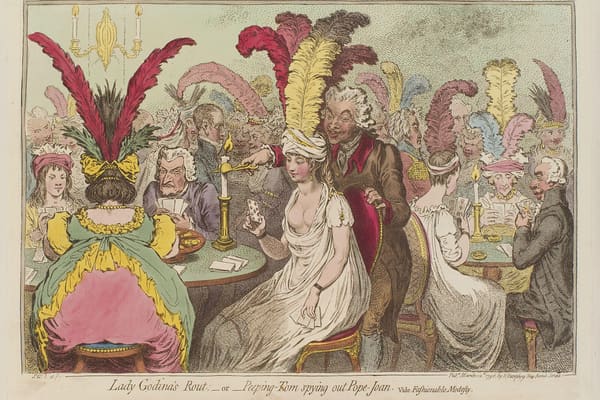
Pope Joan is named after the medieval legend of a woman who disguised herself as a man and was elected Pope before being unmasked during a public procession. The game dates to the 17th century in England and was most popular during the Georgian (1714-1830) and Victorian (1837-1901) eras, when a decorated turning staking board was a common feature of drawing rooms. Jane Austen mentions Pope Joan by name in Emma (1815), and Charles Dickens refers to the game in Martin Chuzzlewit. The circular Pope Joan board was the archetypal card-game furniture of the British middle class through most of the 19th century.
Pope Joan is a quintessential Georgian and Victorian English parlour game, celebrated in literature (Austen, Dickens) and in the shape of the unique circular staking board itself, which became a standard piece of drawing-room furniture for over a century. The game fell out of popular play in the early 20th century as Whist and later Bridge displaced family card games, but it retains cultural importance as a window into 18th- and 19th-century English domestic life. Antique boards are prized collectibles.
Variations & House Rules
Simplified Pope Joan omits Matrimony and Intrigue for a faster game. Spinado makes the Ace of Diamonds a wild card with a side payment. Newmarket blending adds the four boodle cards for additional bets. Variable-ante versions let the dealer distribute the 15 dressing chips in any proportion they choose. Once-around sessions end after every player has dealt twice.
If you do not have a traditional Pope Joan board, use eight labelled cups, egg cups, or small bowls arranged in a circle, or mark a sheet of paper into eight squares. Adjust the compartment amounts to taste: doubling Pope to 12 chips creates bigger swings but longer games. For children, use the Simplified version without Matrimony or Intrigue. For a richer session, let compartment carryovers accumulate for 3 to 4 deals before being equally split.


