
How to Play
Crazy Eights is a shedding-type card game where the goal is to be the first to play all your cards. Players match cards by rank or suit, with special rules for eights, which serve as wild cards.
Crazy Eights is a 2-to-7-player shedding game in which the 8s are the only wild cards. On your turn you play one card from your hand onto the central discard pile, matching either the rank OR the suit of the current top card. If you cannot match, you draw from the stock until you can (or until the stock is exhausted). Playing an 8 lets you change the required suit to anything you choose, which is the game's signature move. First player to shed their last card wins the hand and scores the opponents' remaining hand values as penalty points; games usually run to a cumulative score of 100 or more, lowest score wins.
Quick Reference
- Deal 7 cards each for 2 players, or 5 cards each for 3+ players.
- Place remaining cards face-down as draw pile.
- Flip top card to start the discard pile.
- Play a card matching the rank or suit of the top discard.
- Eights are wild and let you declare a new suit.
- If you cannot play, draw from the pile until you can.
- First player to empty their hand wins the round.
- If draw pile runs out, fewest cards remaining wins.
Players
Crazy Eights works for 2 to 7 players individually, best at 3 to 5. With more than 5 players, shuffle two 52-card decks together for enough cards to go around. Play proceeds clockwise. A single hand takes 5 to 10 minutes; a multi-hand match to 100 penalty points runs 30 to 60 minutes. The first dealer is chosen by any fair method (high card); the deal rotates clockwise after each hand.
Card Deck
- One standard 52-card pack for up to 5 players; two decks shuffled together for 6-7 players.
- No jokers in the base game (some house variants add them as super-wilds).
- Rank order is irrelevant for trick-taking (there are no tricks); only rank and suit matching drive play.
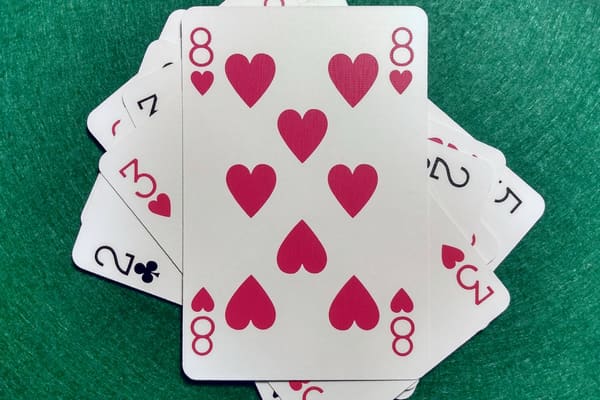
- The four 8s are wild: . Any 8 may be played on any card and lets the player declare the new suit to match.
- Card values for penalty scoring: each 8 = 50, each face card (J, Q, K) = 10, each Ace = 1, each number card = face value (2-10). Eights are huge, so being stuck with one is painful.
Objective
Be the first player to shed every card in your hand onto the discard pile each hand. The hand winner scores zero for that hand; the opponents score penalty points equal to the total pip value of the cards they are still holding (each 8 = 50). The MATCH is typically played to a cumulative penalty target (100 for a short game, 200 standard, 500 long): the first player to REACH or exceed that target loses, and whoever has the LOWEST total at that moment wins.
Setup and Deal
- Shuffle the deck. The dealer deals cards face-down one at a time clockwise.
- 2 players: deal 7 cards each. 3 or more players: deal 5 cards each.
- Place the remaining deck face-down in the centre as the stock (draw pile).
- Starter card: flip the top card of the stock face-up next to the stock to form the discard pile. If the flipped starter is an 8 (the wild), bury it in the middle of the stock and flip again until a non-8 appears, so the first player has a concrete suit and rank to match.
- The player to the dealer's left plays first; turns rotate clockwise.
Gameplay
- On your turn: play one card from your hand face-up onto the discard pile. The card you play must match either the RANK or the SUIT of the current top card. Example: top card is -> you may play any 7 OR any diamond.
- Wild 8s: you may play any 8 at any time, regardless of the current rank or suit. After playing an 8, you announce the new required suit (any of the four; it does not have to be the 8's own suit). Subsequent players must match the announced suit (or play another 8 to re-declare).
- Unable to play: if you hold no legal card (no rank match, no suit match, no 8), you must draw cards from the stock one at a time. In the standard rules, you draw until you can play; in a popular house variant you draw up to three, then pass if still stuck.
- Stock exhausted: if the stock runs out, either (a) shuffle all but the top card of the discard pile to form a new stock, or (b) if you cannot play and the stock is empty, pass your turn. Agree before play.
- Winning the hand: the first player to play their last card wins the hand. Their opponents' remaining cards are scored as penalty points against them.
Scoring
- Hand winner: scores 0 points for that hand.
- Losers: count the pip value of cards still in hand. Each 8 = 50; each face card (J, Q, K) = 10; each Ace = 1; number cards = face value.
- Total match score: add each hand's losses to a running tally.
- Match target: play until any player's total reaches the agreed target (100 short / 200 standard / 500 long). The player who REACHES the target has LOST; the player with the LOWEST total at that moment is the match winner.
- Tie-break: if two players tie at the end of the hand that triggers the match end, play one more hand as sudden death; lowest total wins.
Winning
The first player to shed all their cards wins the hand. The match ends at the close of any hand in which at least one player's cumulative penalty score reaches or exceeds the target (typically 100 or 200); the player with the LOWEST total wins the match. Because 8s carry a 50-point penalty each, a single bad hand with two 8s left in hand can cost 100 points; this makes holding on to 8s a risky but potent strategy.
Common Variations
- Swedish Rummy / Eights: the same game under another common English name; identical rules.
- Mau Mau (Germany), Skwitz, Tschau Sepp: European national variants with similar mechanics and their own extra action cards.
- Action-card Crazy Eights: adds special effects to certain ranks: 2 = next player draws 2 (or plays another 2); 3 or 4 = draw 3 (house rules vary); Jack = skip next player; Queen = reverse direction (matters most with 3+ players); Ace = play any card on it. Popular house rule set.
- Chain-draw: a played 2 may be blocked by stacking another 2 (which passes the burden and doubles it: draw 2 becomes draw 4, then 6, and so on). Found in many European variants.
- UNO (proprietary): a 1970s commercial adaptation with its own deck. Rules overlap almost entirely; 8s are replaced by the 'Wild' card. Sister game, not a variant of Crazy Eights.
- Switch (British): similar shedding game with 'power cards' for every rank; see separate Switch entry (id=223).
- Crazy Aces: Aces replace 8s as the wild card; speeds up matches because Aces are worth only 1 penalty point when held.
- Stop-the-round: one house rule lets a player call 'stop!' when they have 5 or fewer points in hand, halting play; if their remaining total is lowest, they win the hand.
- No-8 double-hold: you may refuse to declare suit on an 8 until the NEXT player's turn (a small power-up seen in a few European tables).
Tips and Strategy
- Save 8s for dire moments. An 8 is worth 50 penalty points if you are stuck with it, but it is also your free escape card. Hold one for when you cannot match suit; burn it immediately when you can shed a long suit sequence.
- Count the discarded suits. After several tricks, you can tell which suits opponents have shed and which they are struggling with; declare a suit change to a suit opponents are likely void in.
- Shed face cards first. Face cards are 10 points each. If you can play one, do it; you do not want three Kings and two Queens in your hand when someone goes out.
- Track the suit chain. The discard top card dictates your match options. If you hold a long run in one suit (say five diamonds), stall on non-diamond plays so opponents stay in a suit where you can dump in a streak.
- Endgame 8-dump: if your final card is an 8, you automatically win (it always plays). Setting up to end on an 8 is a common winning line.
- Know the stock rule. House variants vary: some force you to draw until you can play; others cap at three. Drawing too deep creates penalty stacks; asking up front saves arguments.
Glossary
- Discard pile: the central face-up pile of played cards; only the top card matters for matching.
- Stock (draw pile): the face-down reserve from which players draw when unable to play.
- Starter: the first card flipped face-up at the start of play to seed the discard.
- Wild 8: any 8; playable on any card, and the player announces the new suit.
- Going out: playing your last card and winning the hand.
- Penalty points: the pip total of cards remaining in a loser's hand at hand end (8=50, face=10, Ace=1, number=face value).
- Mau Mau: the German-speaking family of near-identical shedding games.
- Switch / UNO: close cousins; Switch shares the British heritage, UNO is a proprietary commercial adaptation.
Tips & Strategy
Pay attention to the cards played by opponents and strategically use eights to change the direction of play. Plan ahead to minimize the number of cards in your hand.
Crazy Eights involves strategic decisions, especially when choosing which cards to play and when to use eights. Observation and planning are key.
Trivia & Fun Facts
In some variations, a special rule may be introduced where certain cards have additional effects when played.
In Crazy Eights, what is the term for playing a card that matches the rank or suit of the top card of the discard pile?
History & Culture
Crazy Eights is a classic game with variations played worldwide. It shares similarities with games like Uno and Mau Mau.
Crazy Eights is a widely played and recognized game, often enjoyed in both casual and competitive settings. It is known for its simplicity and strategic depth.
Variations & House Rules
Crazy Eights has variations, including Switch, where players can play multiple cards of the same rank, and variations with special action cards.
Experiment with variations and house rules to add excitement. You can also create custom decks with additional special cards.


