
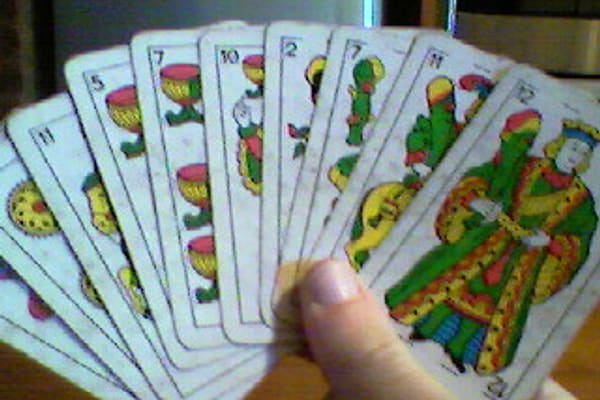
How to Play
Tute is a major Spanish point-trick game (in the Marriage family) played with a 40-card Spanish-suited deck. Rank high to low: A, 3, K, Knight, Jack, 7, 6, 5, 4, 2. Players sing (declare) a King-Knight marriage for 20 points (40 if trump) and may win instantly by holding all four Kings or all four Knights (a Tute). Played 2 to 6 players across multiple regional variants (Individual, Partnership, Cabrero, Subastado).
Tute is one of Spain's most popular card games and a cornerstone of the Iberian and Latin American card-game tree. It is a point-trick game in the Marriage / Bezique / Bella family, with a defining sing-the-marriage mechanic: a player who holds the King and Knight (Caballo) of the same suit may 'sing' (cantar) them after winning a trick, scoring 20 bonus points for a plain-suit marriage (a veinte) or 40 for the trump-suit marriage (a cuarenta). It is played with the traditional 40-card Spanish-suited deck (coins, cups, swords, clubs) or an equivalent 40-card French deck with the 8s, 9s, and 10s removed. Cards rank in a distinctive Spanish order: Ace is high with 11 points, the 3 is second with 10 points, then King (4), Knight (3), Jack (2), then the pip cards 7 through 2 which have no scoring value. The deck carries 120 card points plus 10 for the last trick = 130 total, and a player or team wins by exceeding the agreed target. A hand can also end instantly with a Tute declaration (the Tute itself): holding all four Kings or all four Knights at any point entitles the holder to call Tute, which wins the hand outright. Tute is played in multiple regional forms: the 2-player Tute Individual, the 4-player Tute Partnership (Tute en Parejas), the 3-or-more-player Tute Cabrero, and the bidding-based Tute Subastado.
Quick Reference
- 2-6 players; 40-card Spanish deck.
- Deal 8 cards each (or 10 in 4-player partnership); turn next card for trump.
- 2-player: draw from stock after each trick.
- Follow suit and beat when able (arrastre); must trump if void; must over-trump if able.
- After winning a trick, sing King+Knight: veinte (20) plain, cuarenta (40) trump.
- Four Kings or four Knights in hand = Tute, instant win.
- A=11, 3=10, K=4, Knight=3, Jack=2; other pips=0.
- Last trick +10; veinte +20; cuarenta +40.
- Target: 101 (partnership) or 50 (individual).
Players
2 to 6 players across several variants: Tute Individual = 2 players; Tute Partnership = 4 players in two fixed partnerships with partners sitting opposite; Tute Cabrero = 3-6 players each for themselves (with trick-avoidance twists); Tute Subastado = 3-4 players with an auction for trump choice and a declarer-versus-defenders structure. The 4-player partnership form is the most common in Spanish households; the 2-player form is most common in Spanish bars. Deal rotates anticlockwise (traditional Spanish direction).
Card Deck
A 40-card Spanish-suited deck with four suits (Oros/Coins [♦], Copas/Cups [♥], Espadas/Swords [♠], Bastos/Clubs [♣]), each with ranks Ace, 2, 3, 4, 5, 6, 7, Jack (Sota), Knight (Caballo), King (Rey); alternatively a 40-card French deck with the 8s, 9s, and 10s removed (use J, Q, K as Jack, Knight, King in sequence). Card ranking, high to low within each suit: Ace, 3, King, Knight, Jack, 7, 6, 5, 4, 2. Point values per card: Ace = 11, 3 = 10, King = 4, Knight = 3, Jack = 2, all other cards (2, 4, 5, 6, 7) = 0. Deck total = 120 card points plus a 10-point bonus for winning the last trick, for a grand total of 130 points per hand. One suit is trump, determined at the start of each hand.
Objective
Take tricks containing high-value cards (Aces = 11 each, 3s = 10 each) and 'sing' marriages (King + Knight of the same suit) for 20 or 40 bonus points, accumulating more card points than your opponent(s) or the agreed target. Alternatively, instantly win the hand by declaring Tute (all four Kings or all four Knights in one hand). Match play aggregates scores across multiple deals to a target (typically 101 points for partnership or 50 for individual).
Setup and Deal
- Cut for first dealer: lowest card deals first. Deal rotates anticlockwise.
- Shuffle the 40-card deck. The player to the dealer's left cuts.
- Deal 8 cards to each player in two batches of four, anticlockwise (partnership and 2-player forms). For Tute Cabrero with more than 4 players, deal so the remaining stock has at least 10 cards; adjust accordingly.
- Turn the next card of the remaining stock face-up and place it partially underneath the stock to indicate the trump suit for this hand. The turn-up remains face-up until drawn into play.
- Remaining stock: The face-down draw pile sits beside the turn-up. In 2-player Tute, players draw cards from the stock after each trick to refill their hand to 8 cards until the stock is exhausted; in 4-player Tute en Parejas, all 40 cards are dealt (no stock) and no drawing occurs.
- The player to the dealer's right leads the first trick.
Gameplay
- The leader plays any card face-up. Subsequent players play anticlockwise.
- Follow suit if able. If you cannot follow the led suit, you must play a trump if you hold one; if you hold neither the led suit nor any trump, you may discard any card.
- Must-beat rule (Arrastre / Spanish 'must head'): When following suit, you are generally required to play a higher card of the same suit than the highest already played to the trick, if you have one. The exact force of this rule differs by form: Tute en Parejas almost always applies it; Tute Individual sometimes relaxes it.
- Must-overtrump: If you cannot follow suit and you play a trump, you must play a trump higher than any trump already played to the trick, if you hold one.
- Trick resolution: If any trump was played, the highest trump wins. Otherwise the highest card of the led suit wins.
- Drawing (2-player form): After each trick, the trick winner draws first from the stock to refill their hand to 8 cards; the other player draws next. When the stock is down to 1 card plus the face-up trump turn-up, the loser of the last trick takes the turn-up card.
- Cantar (singing a marriage): Immediately after winning a trick, a player may declare they hold the King and Knight of a suit by saying 'veinte en copas' (20 in cups), 'cuarenta' (40, when it is the trump marriage), or a similar announcement. The player reveals the King and Knight, scores the bonus, and returns them to hand. Each marriage may be sung at most once per hand. Veinte (20 points) is for a plain-suit marriage; cuarenta (40 points) is for a trump-suit marriage. You must still hold both cards at the moment of singing.
- Tute declaration (instant win): If at any point in the hand a player holds all four Kings or all four Knights simultaneously in hand, they may declare 'Tute' and win the hand outright. The hand ends immediately. Declaring Tute is optional; the holder may choose to play the hand normally and take the card points instead.
- Hand ends: The hand ends when all cards are played (or when Tute is declared). Count points: each team's card-point total + last-trick 10 bonus + all sung marriages.
Scoring
- Card points: Ace = 11, 3 = 10, King = 4, Knight = 3, Jack = 2, all other pip cards = 0. Deck total = 120.
- Last-trick bonus: +10 points for the team/player that wins the final trick.
- Plain-suit marriage (veinte): +20 points for the King and Knight of a non-trump suit, sung after winning a trick.
- Trump-suit marriage (cuarenta): +40 points for the King and Knight of the trump suit, sung after winning a trick.
- Tute declaration: Instant win of the hand.
- Hand score: Sum of card points + last-trick + declared marriages. In partnership play, scores combine across partners.
- Match target: Typical Spanish-household match targets: 101 points for partnership Tute, 50 points for individual 2-player Tute. Tute Cabrero uses avoidance scoring (see variations).
Winning
Hand winner: The team or player with the higher total of card points + last-trick bonus + sung marriages. Match winner: The first team or player to reach the agreed target (typically 101 or 50) at the end of a hand. A Tute declaration wins the hand outright (and often the match, depending on agreement). In Tute Cabrero the winner is the player who takes the fewest points (avoidance); in Tute Subastado the winning side is determined by the auction contract.
Common Variations
- Tute en Parejas (Partnership Tute): The canonical 4-player household game; partnerships of two, partners sit opposite. No stock; all 40 cards are dealt (10 per player). Marriages and Tute apply. Target 101.
- Tute Individual (2-player): 8 cards each plus stock; draw after each trick; target 50 points per player. Most common bar form.
- Tute Cabrero: 3-6 players individually; trick-avoidance variant. Each player tries to win the fewest points; in some rules, the player who wins most and the player who wins least both score negative, with the middle player(s) winning.
- Tute Subastado (Auction Tute): 3-4 players; auction for the right to choose trumps. Winning bidder plays solo against the others, must meet the bid target.
- Guiñote: A close cousin (Aragonese regional variant) in which Jacks and Knights swap ranks and point values; Jacks become the higher court card.
- Tute Habanero / Cubano: Cuban and Spanish-Caribbean variant with local scoring tweaks and an extra pastime of musical cantar declarations.
- Tute Arrastre: A version where the must-beat rule is strictly enforced from trick 1, and failing to beat when able is a revoke.
- Brisca (close cousin): Separate game in the Briscola family, no cantar system, simpler point-trick rules. Listed as a separate entry (id 147).
- Manilla declarations: In some regions you can also declare a 'manilla' bonus for holding the Ace and 3 of the same suit.
- Foot / Pie (four-card deal variant): Some provinces deal only 4 cards at first and replenish from the stock.
Tips and Strategy
- Guard your Kings and Knights for cantar. A King and Knight of the same suit is 20 points plain or 40 in trump; never drop either into a trick unless you are certain you cannot sing them. Lead with your 3s and Jacks first to retain court cards for declarations.
- Aim to win a trick before singing. You can only cantar immediately after winning a trick. Plan a sequence where you take a cheap trick with a low trump or a led-suit capture, then declare.
- Tute declaration is rare but transformative. All four Kings (or all four Knights) together is a 1-in-a-hundred-plus hand. If you see you are close (three Kings and the last King is visible in an opponent's side-suit cantar), aim to capture it.
- Last trick is worth 10 points. Keep a winning card for trick 10; losing the last trick on top of losing hand points turns a close game into a rout.
- Track trumps. There are 10 trumps in the deck (Ace, 3, King, Knight, Jack, 7, 6, 5, 4, 2). Count every trump played; the last trump out is often the game-winning stopper.
- Respect the arrastre rule. Failing to play a higher card when you can is a revoke in strict play. Always check your hand before following suit.
- In partnership, signal with discards. When void of the led suit, discarding a clearly-winning card of another suit signals to partner that you hold more of that suit; discarding a low card signals weakness there.
- Trump marriage is king. Holding the King and Knight of trumps is 40 points plus strong individual trumps; bid or play aggressively with such a hand.
- In 2-player Tute, timing of the turn-up. Taking the trump turn-up (as loser of the last trick before stock-out) often gives you a key card for a marriage; remember it is public information, so plan around it.
Glossary
- Tute: The game itself, or the instant-winning declaration of four Kings or four Knights.
- Cantar / Singing: Declaring a King-Knight marriage after winning a trick; scores bonus points.
- Veinte (20): The 20-point bonus for a plain-suit (non-trump) King-Knight marriage.
- Cuarenta (40): The 40-point bonus for the trump-suit King-Knight marriage.
- Caballo (Knight): The third-highest court card in Spanish-suited decks; the horse-and-rider card. Substitutes for the Queen in French decks used for Tute.
- Sota (Jack): The lowest court card.
- Arrastre: The must-beat rule; you must play a higher card when following suit if you hold one.
- Trump / Triunfo / Pinta: The trump suit for the hand; determined by the turn-up card.
- Turn-up: The face-up card indicating trump, placed partially under the stock.
- Tute Individual / en Parejas / Cabrero / Subastado: The four main regional variants.
- Guiñote: The Aragonese cousin with Jack-Knight rank swap.
Tips & Strategy
Guard your Kings and Knights; a plain marriage is 20 points and a trump marriage is 40. Lead cheap cards (Jacks, 7s) to keep court cards in hand for cantar declarations. Win a trick before singing; you cannot declare without just taking a trick. Track the 10 trumps; save a winner for the 10-point last trick. Respect the must-beat rule or lose the hand.
Tute rewards court-card husbanding and trump-management equally. Expert players hoard court cards (Kings, Knights) for cantar declarations and dump pip cards (7s, 6s, 5s) early, exchanging short-term trick equity for long-term 20 or 40 point declarations. The arrastre must-beat rule adds a tactical layer: because you are forced to beat when able, a well-played high card can flush out opposing high cards predictably. Partnership Tute requires silent coordination via discards (void signals, strength signals).
Trivia & Fun Facts
The word 'Tute' comes from the Italian 'tutti' ('all'), referring to holding all four Kings or all four Knights. The Spanish verb cantar (to sing) became the standard verb for declaring a King-Knight marriage because early 19th-century Spanish players literally sang the declaration aloud at the table. Spanish card-playing tradition includes more than a dozen regional variants of Tute; the Basque Country prefers Mus, Aragon prefers Guiñote, Andalusia prefers Tute Cabrero, and the central plateau (Castile, Madrid) prefers Tute en Parejas.
-
01In Tute, what is a 'cantar', and what is the point difference between a plain-suit cantar and a trump-suit cantar?Answer A cantar is the declaration of a King-Knight marriage (holding the King and Knight of the same suit in your hand) after winning a trick. A plain-suit cantar (veinte) is worth 20 bonus points; a trump-suit cantar (cuarenta) is worth 40 bonus points. The difference (20 points) reflects the dominant value of the trump suit in Tute's scoring and makes the trump King-Knight marriage the single most valuable holding in the game short of a Tute declaration (all four Kings or all four Knights, which wins the hand instantly).
History & Culture
Tute is the Spanish national form of the centuries-old European Marriage-game family that also gave rise to German Sechsundsechzig (Sixty-Six), Austrian Schnapsen, Italian Brisca/Tressette, French Piquet, and many others. It took hold in Spain in the 18th or early 19th century and has spread across Latin America via Spanish colonisation. Tute's cantar mechanic (singing the marriage) is the single most distinctive Spanish innovation on the Marriage-game family and gives the game its characteristic rhythm. The instant-win Tute declaration (four Kings or four Knights) is a signature feature that has inspired variants across Spain and Latin America.
Tute is one of the three most-played Spanish card games, alongside Mus and Brisca, and is deeply rooted in Spanish café and family culture. It is taught to children as one of their first card games, features in countless Spanish novels and films (Camilo José Cela, Pedro Almodóvar) as a symbol of domestic sociability, and underpins the social life of Spanish-speaking communities worldwide. The cantar-declaration mechanic has become a minor linguistic touchstone in Spanish: 'te canto las cuarenta' ('I sing you the 40') is a colloquial phrase meaning 'I'll give you a piece of my mind'.
Variations & House Rules
Tute en Parejas is the 4-player partnership form. Tute Individual is the 2-player form with draw stock. Tute Cabrero is the 3-6 player avoidance variant. Tute Subastado adds an auction for trump choice. Guiñote is the Aragonese Jack-Knight-swap cousin. Tute Habanero is the Caribbean variant. Tute Arrastre enforces the must-beat rule strictly. Manilla declarations add Ace-3 marriage bonuses.
For a family game, play Tute Individual (2 players) with a lower target (30 points) for a short session. For strategic partnership play, use Tute en Parejas with target 101 and enforce the arrastre rule strictly. For a social multi-player game, choose Tute Cabrero (avoidance) with 3-5 players. For competitive depth, use Tute Subastado with an auction. To teach children, drop the must-beat rule and the Tute declaration until they grasp marriages.


