How to Play
Modern shedding-type card game played with a standard 52-card deck. Players build 'palaces' in ascending order and aim to be the first to clear their hand. Strategic and engaging.
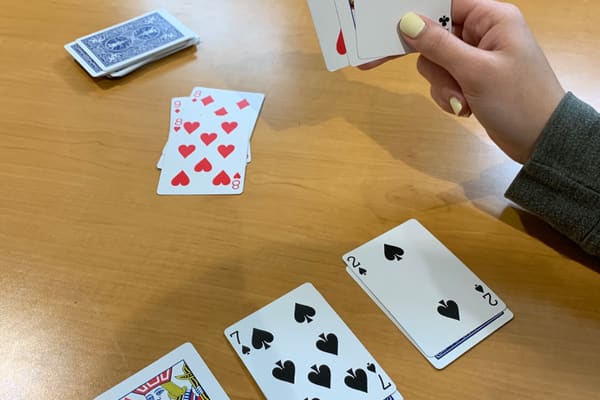
Palace (also called Shithead, Karma, or Shed) is a fast and chaotic 2-to-5-player shedding card game with a distinctive three-layer hand: each player has cards in a face-down row on the table, a face-up row stacked on top of those, and a private hand of 3 playable cards. On your turn you play a card that MATCHES OR EXCEEDS the rank of the top of the central discard pile, then draw back to 3 from the stock. Special cards break the normal rules: a 2 resets the pile to any rank, a 10 burns the pile out of the game, and four consecutive same-rank cards also burn the pile. Fail to play a legal card and you pick up the ENTIRE discard pile. The first player to shed their hand, face-up cards, AND face-down cards wins; the LAST player left holding cards is the loser.
Quick Reference
- Deal 3 cards face-down, then 6 cards to each player's hand.
- Players choose 3 cards from hand to place face-up on their face-down cards.
- Remaining cards form the draw pile.
- Play a card equal to or higher than the top of the discard pile.
- Draw back up to 3 cards from the draw pile after playing.
- If you cannot play, pick up the entire discard pile.
- 2 resets the pile; 10 clears it entirely.
- No point system; first to play all cards (hand, face-up, face-down) wins.
- Last player with cards remaining loses.
Players
2 to 5 players; 3-4 is the sweet spot. With 6+ players shuffle two 52-card decks together. Play proceeds clockwise. A game takes 10-25 minutes depending on how often the pile is cleared. Turn order rotates clockwise; the winner of each game typically deals the next (since the loser is slow to hand over the deck). The loser of a session is sometimes given a light penalty forfeit (hence the 'Shithead' name); this is optional and should be friendly.
Card Deck
- One standard 52-card deck for up to 5 players; shuffle two together for 6+.
- No jokers in the base game (some house rules add them as universal wild cards).
- Rank order (low to high): 3, 4, 5, 6, 7, 8, 9, J, Q, K, A.
- Special cards (breaking the rank rules): 2 = RESET (plays on anything; next card must match or beat a 2, so effectively any card may be played next). 10 = BURN (pile is removed from the game; player plays again). A 7 sometimes acts as 'next player must play 7 or LOWER' in some house rule sets.
- Suits are ignored; only ranks drive the game.
Objective
Be the FIRST player to shed every card you hold: first your 3-card hand, then your 3 face-up palace cards, then your 3 face-down cards (flipped one blind per play). The LAST player still holding cards is the loser (traditionally the 'shithead'). There is no running score between games; play best-of-3 or a match of agreed length.
Setup and Deal
- Shuffle the 52-card deck. Any player may deal the first game; winners usually pass the deal to the previous loser.
- Deal 3 cards face-down to each player in a row in front of them; these are the face-down 'palace' cards and may NOT be looked at.
- Deal 3 more cards face-down to each player; these are the starting hand. Each player looks at them privately.
- Deal 3 more cards face-down to each player as ANOTHER private stash; combined with the starting hand this gives 6 private cards.
- Arrange your palace: each player chooses 3 cards from their 6-card hand to place FACE-UP on top of their face-down row (their 'palace'); the remaining 3 cards become their active hand. Place high cards face-up (A, K, 10, 2) or combo cards that survive being stuck.
- Place the remaining 16 cards (52 - 334 = 16 with 4 players) face-down as the stock (draw pile) in the centre. Smaller games have more stock cards.
- The player holding the lowest 3 in their hand plays first (or if none, the lowest 4, and so on). In some house rules, the player to the dealer's left simply goes first.
Gameplay
- Your turn: play a card from your hand onto the discard pile that matches the rank OR exceeds the rank of the current top card. You may play multiple cards of the same rank at once. After playing, draw from the stock to refill your hand back to 3 cards (as long as the stock has cards).
- Cannot play a legal card: you must pick up the ENTIRE discard pile and add it to your hand; play passes to the next player.
- Special card effects: resets the pile — plays on anything, and the next player may play any card (a 2 effectively clears the rank requirement). BURNS the pile: the entire discard pile is removed from the game, and the player who played the 10 plays again immediately. Any FOUR cards of the SAME RANK played consecutively (by one player or across players) also burn the pile with the same effect.
- Stock exhausted: once the stock runs out, you no longer draw; play continues using only whatever is in your hand. The game now depends on emptying your full inventory (hand -> palace -> face-down cards).
- Playing the palace (face-up): when your hand is empty AND the stock is empty, you start playing your face-up palace cards. You may play any face-up card that matches or exceeds the discard's top rank.
- Playing face-down cards: when hand AND palace are empty, you play your face-down cards BLIND. Each turn, pick ONE face-down card without looking and flip it onto the pile; if its rank is legal, the play counts. If not, pick up the entire discard pile along with the flipped card and keep playing.
- Seven (house rule): a 7 reverses the direction of the 'match-or-exceed' rule; the next player must play 7 or LOWER. Not part of the original game; used in some schoolyard and British variants.
Scoring (Match Play)
- Single game: no points; simply rank the players by order of finishing. First out = winner; last holding cards = loser.
- Best-of-3 or best-of-5: agree the match length before play.
- Loser penalty: many groups apply a light penalty (deal next game; loser fetches drinks) to the match's final loser; strictly optional.
- Session tally: track wins per player across a session; most wins = session champion.
Winning
The first player to shed their hand, palace, and face-down cards wins that game. Because the loser is the LAST player with cards remaining, the interesting race is usually between the second-to-last and last player near the end of the game. A player who gets stuck picking up a huge pile mid-game often cannot come back, but a well-timed 10 (burn) or four-of-a-kind can reset everything. Match play is commonly best-of-3 or best-of-5 with the most wins taking the session.
Common Variations
- Shithead (original name): rules identical; name used mostly in British student culture.
- Karma: identical rules; mainstream name in the US and Canada.
- Seven-down house rule: a 7 forces the next player to play 7 or lower; adds a clever chokepoint.
- Eight-skip: an 8 skips the next player's turn.
- Jacks reverse: a Jack reverses the direction of play (useful with 3+ players).
- Pick-up-the-four: house rule where a 4 forces the next player to pick up the top 4 cards.
- Chainable 2s: allow any number of 2s to be played in sequence before play passes.
- Face-down forgiveness: some rules allow a player who flipped a too-low face-down card to ONLY pick up that card + 2 more, rather than the whole pile. Softens the endgame.
- Palace swap: before the first play, allow each player to swap cards between their hand and face-up palace.
- Aces-always-clear: an Ace burns the pile in addition to the 10 (super-aggressive variant).
- Chinese Ten (distinct game): a fishing game, unrelated despite the shared alternative-name list; avoid confusion.
Tips and Strategy
- Place high cards face-up in your palace. 10s, Aces, and 2s are the best palace cards because they either burn, reset, or dominate the pile when you finally play them.
- Conserve your 2s and 10s for when stuck. A 2 is your universal reset and a 10 is a free pile-burn; hoarding them saves you from massive pickups.
- Play low early, high late. Dump your 3s and 4s early to avoid being stuck with them; they can't match or exceed much once the pile climbs.
- Pile-counting: keep rough track of how many of each rank have been played, especially 2s and 10s. A 10 that has been played once means only 3 burn cards remain in the deck.
- Four-of-a-kind hunts: try to play the third of a rank when you can; this sets up any opponent to play the fourth and burn the pile (they might not want to, creating a subtle stand-off).
- Face-down risk: face-down cards are pure luck. Dump high cards BEFORE you reach them so you are not playing face-downs while the discard top is a King.
- Do not always pick up. Sometimes strategically picking up a small pile beats playing your last 2 (which you need for the endgame). The long-term value of a reset card often outweighs a short-term pickup.
- Watch the last opponent. As other players go out, count remaining cards to figure out which opponent is most likely to lose. Strategic burns in the endgame matter more than volume of cards played.
Glossary
- Palace / palace row: the 3 face-up cards stacked on top of each player's 3 face-down cards; playable after hand is empty.
- Face-down cards: the bottom row of 3 cards; played blind, one at a time.
- Discard pile: the central face-up pile onto which all played cards go.
- Burn: removing the discard pile entirely from the game, via a 10 or four-of-a-kind.
- Reset: playing a 2; allows any rank to be played next.
- Pick up: the penalty for failing to play a legal card; the player takes the entire discard pile into their hand.
- Shithead: the last player holding cards; the loser (origin of one of the game's common names).
- Face-up arrangement: the pre-play step where each player chooses which 3 of their 6 cards to show face-up on their palace.
Tips & Strategy
Manage your card levels carefully and strategically use powerful cards. Adapt your strategy based on the evolving state of the game.
Palace involves strategic card play and adapting to the changing landscape of the game. Plan your moves carefully and anticipate your opponents' strategies.
Trivia & Fun Facts
Palace is also known by various names, including Shed, Karma, and Chinese Ten.
In Palace, what is the term for the pile of cards in the center that players contribute to during the game?
History & Culture
Palace has origins in traditional shedding-type card games and has evolved into a popular modern card game.
Palace holds cultural significance as a modern shedding-type card game enjoyed in various social settings. It is known for its engaging gameplay and strategic depth.
Variations & House Rules
Variations include different starting conditions, special abilities for certain cards, and alternative win conditions.
Experiment with different variations and house rules to find the most enjoyable version of Palace for your group.