
How to Play
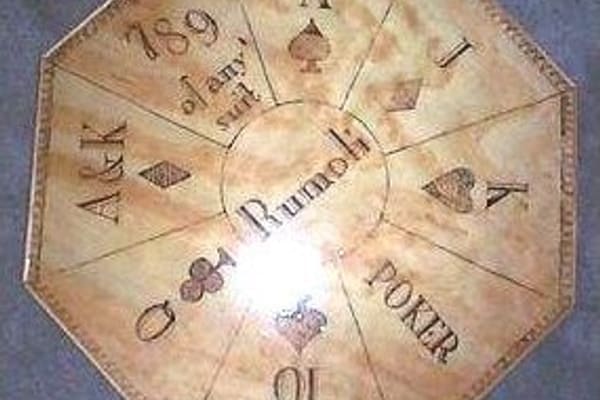
Michigan Rummy (also called Michigan, Boodle, or commercially Tripoley/Rummoli) is a 3-8 player stops-family card game played on a labelled board. Players ante chips onto four boodle compartments and a Kitty, then play ascending single-suit sequences; matching a boodle card sweeps its chips, and emptying your hand first wins the Kitty.
Michigan Rummy (also known simply as Michigan, Boodle, or Stops, and sold commercially as Tripoley and Rummoli) is a classic 20th-century American stops-family card game for 3 to 8 players, played on a special layout (a board or a tablecloth with painted compartments) that displays four boodle cards (the Ace of Hearts, King of Clubs or Spades, Queen of Diamonds, and Jack of Spades or Clubs) plus a central pot called the Kitty (or Game). At the start of each deal every player places chips onto each boodle compartment and the Kitty. One face-down 'widow' hand is dealt alongside the players' hands, and then, starting with the player to the dealer's left, each player plays the lowest card of a chosen suit and every subsequent player must play the next-higher card of that same suit in turn. When the sequence 'stops' (because the next card is in the widow or has already been played), the last player to play starts a new sequence with a new suit. Anyone who plays a card matching a boodle card during play sweeps the chips on that compartment; whoever plays their last card first empties their hand and collects one chip from every opponent for each card still held.
Quick Reference
- 3-8 players; standard 52-card deck plus a boodle board labelled A♥, K♣, Q♦, J♠, Kitty.
- Each player antes chips onto the boodle compartments and Kitty; deal out all cards plus one extra widow hand face-down.
- Optionally auction the widow; otherwise leave it face-down as a source of hidden stoppers.
- Eldest leads the lowest card of any suit; each player in turn plays the next higher card of that suit.
- At an Ace or at a stop (missing next card), the last player to play leads a new suit.
- Playing a boodle card sweeps all chips on that compartment; emptying your hand first wins the Kitty.
- Boodle sweep = all chips on that compartment when the matching card is played.
- Going out = Kitty + 1 chip per remaining card from each opponent.
- Unswept boodle chips carry to the next deal; ante chips replenish the compartments.
Players
3 to 8 players. All players play for themselves; there are no partnerships. The first dealer is chosen by cutting the deck (high card deals); the deal rotates clockwise each hand.
Card Deck and Layout
One standard 52-card deck, no jokers, plus a layout that shows four labelled boodle compartments and a central Kitty. Traditional boodle cards are Ace of Hearts, King of Clubs, Queen of Diamonds, and Jack of Spades (different 'Michigan' boards substitute different same-coloured cards; Cadaco's Michigan Rummy uses 10♥, J♠, Q♦, K♣, A♥ labelled 8-2-10-5-10 respectively). Card ranks within each suit run low to high: 2, 3, 4, 5, 6, 7, 8, 9, 10, Jack, Queen, King, Ace. Aces are always the highest card of a suit. Suits do not interact; a sequence runs only within one suit.
Objective
Win chips in three distinct ways during each deal: (1) sweep boodle chips by playing a card matching one of the four boodle compartments, (2) empty your hand first to collect the Kitty plus one chip per card remaining in every opponent's hand, and (3) benefit from stops (playing a card that locks a suit sequence from progressing) to force other players to start fresh on your terms. The player with the most chips at the end of the session wins.
Setup and Deal
- Each player receives a fair number of chips (commonly 25-50) at the start of the session.
- Before each deal, every player places chips onto the layout: typically one chip on each boodle compartment (A♥, K♣, Q♦, J♠) and two chips on the Kitty. The dealer may pay double on the Kitty as a house convention.
- Shuffle the deck; the player to the dealer's right cuts.
- Deal the entire deck clockwise one card at a time as though there were one extra player. The extra hand is the widow (also called 'dead hand') and is placed face-down in front of the dealer; it does not belong to any player.
- If the deck does not divide evenly, some players will hold one more card than others; this is accepted without adjustment.
- Before play, the dealer may offer the widow for auction: any player (starting with the dealer's left) may buy it sight-unseen for an agreed price in chips, discarding their current hand and taking the widow instead. If no one buys, the dealer may discard their own hand and take the widow in exchange for paying the full agreed price into the Kitty; otherwise the widow stays face-down and will act as a 'stopper' throughout the play.
Gameplay
- The player to the dealer's left leads the first sequence by playing, face-up to the centre, the lowest-ranked card of any suit they choose. For example, if they wish to play Clubs and hold 3♣ 6♣ J♣, they must lead the 3♣.
- Clockwise, each subsequent player must play the next higher card of the same suit (4♣, 5♣, 6♣, 7♣, and so on up to the Ace), if they hold it. Play continues in this ascending single-suit sequence until either (a) an Ace is reached, or (b) the required next card is in the widow or has already been played (a stop).
- A player who cannot continue the sequence says 'stop' (or simply taps the table); the player who most recently played a card then starts a new sequence by playing the lowest card of any different suit in their hand.
- Sweeping boodle chips: If during normal play a player plays a card that matches one of the four boodle compartments (say they play Q♦), they immediately sweep all chips sitting on that compartment into their own stack. Empty compartments are not refilled until the next deal.
- Stopper cards: Aces are absolute stops (nothing beats an Ace of a suit, so every sequence ends when the Ace is played and the Ace-player starts a new suit). The four cards sitting in the widow are hidden stoppers; a player who plays a card whose next-higher card is in the widow forces a stop.
- Going out: The first player to empty their hand wins the Kitty and collects one chip from each opponent for every card still held by that opponent. Unswept boodle chips remain on the layout and carry into the next deal.
Ending the Hand
- The hand ends when one player plays their last card, regardless of how many cards other players still hold.
- Distributions: The hand-ender collects the Kitty and one chip per remaining card from each other player. Each boodle compartment's chips are already swept by whoever played the matching card during the hand; compartments whose card sat in the widow are not swept this deal, and those chips carry forward.
- Collect and reshuffle the entire deck for the next deal. The deal rotates clockwise.
Scoring
- All scoring is in chips, not card points. Total chips held at the end of the agreed session length decides the winner.
- Ante chips (on the Kitty and boodle compartments) are put in at the start of every deal.
- Boodle rewards = chips on that compartment at the moment the matching card is played.
- Kitty reward = full Kitty pile to the first player out, plus 1 chip per leftover card from every other player.
- No penalty beyond the per-card payment to the hand-ender; players who did not go out simply keep fewer chips than before.
Winning
- Per-hand winner: The first player to empty their hand; collects the biggest single pile of chips per deal.
- Session winner: The player with the most chips at the agreed endpoint (most groups play for a fixed time or until one player is broke).
- Tie-breaker: Play one more deal at the agreed stake to break a chip tie.
- Misdeal: If the deck is not divided as it should be, or an exposed card is dealt in error, reshuffle and redeal.
Common Variations
- Tripoley (1930s Cadaco commercial version): Adds a poker round and a rummy round before and after the Michigan stops round, played on a printed cloth board. Every deal plays all three phases. The boodle cards are K♣, Q♥, J♠, 10♦, A♥ with payouts onto a five-segment layout.
- Rummoli (Canadian commercial version): Nearly identical to Tripoley with minor chip payout differences; the board typically labels 10♠, J♣, Q♥, K♦, A♠ as the boodle cards.
- Newmarket: The British parent game, with a simpler single-phase stops structure and four boodle cards taken from an extra 'dummy' pack.
- Pope Joan: An 18th-century English ancestor game of the same stops family, played with a special board and the 8 of Diamonds (the 'Pope') as a high-value stopper.
- Pay-the-widow: House rule that the dealer must always ante for the widow (making it valuable) and that if the widow is unsold the dealer may still look at its contents and decide whether to trade.
- Variable boodle cards: Instead of fixed A♥, K♣, Q♦, J♠, players may randomly draw four cards from a second deck at the start of each session to set that session's boodle cards.
- Stops for chips: Some variants pay out a small chip bonus to the player who 'creates' a stop (plays the card that locks the sequence), in addition to the boodle and Kitty rewards.
Tips and Strategy
- Plan your sequence leads around the boodle cards. If you hold Q♦, don't lead the 2♦ unless you are confident no one will force a stop before the sequence reaches the Queen; you want to claim the Diamonds pot yourself.
- Count cards already played. When the 7♣ is reached and you hold the 9♣, remember that the 8♣ is probably in the widow (if it has not yet appeared); playing the 9♣ next will create a stop and let you lead a fresh suit.
- Lead short suits first. Emptying your 3-card off-suit early gives you more flexibility later; 8-card long suits tend to finish themselves once started.
- Get out first. The Kitty reward is usually the biggest per-hand payment. If you can see a path to emptying your hand in three moves, prioritise that over a speculative boodle sweep.
- Buy the widow rarely. Paying the agreed purchase price without seeing the widow is usually a losing expected value: you might trade a mediocre hand for a worse one. Buy only when your hand has no boodle cards and no long suit.
- As dealer, consider paying double to the Kitty yourself: it makes you more likely to be aggressive with your own hand and incentivises going out first.
Glossary
- Boodle cards: The four named cards (traditionally A♥, K♣, Q♦, J♠) whose matching compartments pay chip rewards when the card is played.
- Kitty: The central pot collected by the first player to empty their hand.
- Stop: A point in the sequence where no player can supply the next higher card; the most recent player starts a new sequence in a new suit.
- Widow (dead hand): The face-down extra hand dealt as though for an additional player; acts as a source of hidden stopper cards.
- Sequence: An ascending single-suit run played around the table starting from the lowest card in the leader's hand.
- Sweep: Collect all chips from a boodle compartment by playing that compartment's card.
- Going out: Playing your final card; wins the Kitty and one chip per remaining card from each opponent.
- Tripoley / Rummoli: Commercial three-phase boards combining poker, Michigan, and rummy into a single hand.
- Newmarket / Pope Joan: English ancestor games of the stops family; Michigan is the American adaptation.
Tips & Strategy
Plan each sequence lead around the boodle cards. Leading a suit with the 2 is usually wasteful; lead a mid-rank card if you can, so that the sequence runs up past your boodle card before a stop can occur. Going out first is worth more than most boodle sweeps because the Kitty plus per-card payouts from opponents tends to dwarf any single compartment.
Michigan is a hidden-information game (the face-down widow creates unknown stops) with chip-management incentives. The best players track which cards have been played, notice which cards in the widow would stop a sequence from reaching a boodle compartment, and steer leads to force their opponents to start new sequences on the players' own terms.
Trivia & Fun Facts
The 1939 Cadaco game Tripoley was one of the first commercial card-game boards ever marketed, and is still in continuous production today, making it among the longest-running card-game products in American history. The name 'Tripoley' is a portmanteau of 'tri-' (for three phases: poker, Michigan, and rummy) plus 'Poley' from Monopoly, riding on that game's 1930s fame.
-
01What are the four traditional boodle cards in Michigan Rummy, and how does a player sweep the chips sitting on their compartments?Answer The Ace of Hearts, King of Clubs, Queen of Diamonds, and Jack of Spades. A player sweeps a compartment's chips by playing the matching card during the normal ascending-sequence play.
History & Culture
Michigan is the American adaptation of the English 'Newmarket' and 18th-century 'Pope Joan' stops games, brought to the US by English and Scottish immigrants in the 19th century. Commercial boards branded 'Michigan Rummy' (Cadaco, 1950s), 'Tripoley' (Cadaco, 1930s-onward), and 'Rummoli' (Canada Games, 1940s-onward) each added poker and rummy rounds, stretching the pure stops game into a three-phase family-board format.
Michigan Rummy, along with its commercial forms Tripoley and Rummoli, is a classic North American family game-night staple of the mid-20th century, synonymous with the post-war card-game boom. It crosses easily between age groups and has been the first chip-betting game for generations of American and Canadian children.
Variations & House Rules
The main variants are Tripoley (poker + Michigan + rummy on a commercial board), Rummoli (Canadian equivalent), the British parent game Newmarket, the ancestor Pope Joan (with the 8 of Diamonds as the Pope), and house-rule variants like randomly chosen boodle cards, pay-the-widow conventions, and chip bonuses for creating stops.
For a family-friendly night, drop the widow auction and just play the standard Michigan rules; this keeps the game moving. For a chipless informal version, track scores on paper: 1 point per boodle sweep, 5 points for going out, and 1 point per leftover card from each opponent. For a more dramatic session, play only two boodle cards instead of four so each individual sweep is bigger.


