
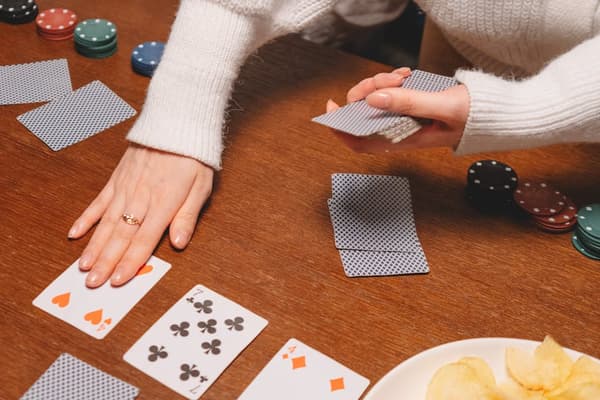
How to Play
Beggar-My-Neighbor is a classic British children's card game of pure chance for 2 to 6 players. Flip cards onto a central pile; when an Ace or face card appears, the next player must pay tribute (A=4, K=3, Q=2, J=1 cards). The last player holding cards wins.
Beggar-My-Neighbor (also called Strip Jack Naked or Beat Your Neighbour Out of Doors) is a classic British children's card game documented since at least the early 1800s, most famously referenced by Charles Dickens in Great Expectations and by Rudyard Kipling. Two to six players flip cards one at a time onto a central pile; when an Ace, King, Queen, or Jack is played, the next player must pay a fixed number of tribute cards (4 for Ace, 3 for King, 2 for Queen, 1 for Jack). If none of those tribute cards are themselves face cards or Aces, the player who played the original face card or Ace wins the entire pile. If a face card or Ace appears during tribute payment, the tribute obligation passes to the next player instead, creating dramatic chain reactions. The game is completely deterministic after the deal (no decisions are made during play), and whether it can ever loop infinitely remains a famous open problem in combinatorial mathematics.
Quick Reference
- Deal the whole 52-card deck face-down as evenly as possible to 2-6 players.
- Players stack cards in a pile, face-down, without looking.
- Player to dealer's left flips first.
- Flip your top card to the central pile.
- If the previous flip was A/K/Q/J, you must pay tribute: 4/3/2/1 cards respectively.
- Face card during tribute chains it to the next player; otherwise the original face-card player wins the whole pile.
- No points; the last player still holding cards wins the round.
- A player who runs out of cards during tribute is eliminated.
Players
2 to 6 players, each playing individually. The game is best with 3 or 4 players; with 2 the game is often long, and with 6 the initial hands become small. The first dealer is chosen by high-card draw; the deal rotates clockwise after each round. Players do not look at their hands at any point.
Card Deck
One standard 52-card French deck, no Jokers. Only whether a card is a penalty card (Ace, King, Queen, Jack) or a plain number card (2 through 10) matters for play; suits and numeric values are ignored. Tribute amounts: Ace = 4 cards, King = 3, Queen = 2, Jack = 1.
Objective
Be the last player holding cards. You win by collecting the entire 52-card deck into your own personal pile through successive captures of the central pile.
Setup and Deal
- Shuffle the 52-card deck thoroughly. The player to the dealer's right cuts.
- Deal the entire deck face-down, one card at a time clockwise, until the deck is empty. With 3 or 5 players, some players receive one more card than others.
- Each player stacks their face-down cards in a single pile in front of them. Do not look at the cards at any time.
- The player to the dealer's left flips their top card face-up into the centre of the table to start the central pile and begin play.
Gameplay
- Play passes clockwise. On each player's turn they do one of two things:
- A. Normal play: If the top card of the central pile is a plain number card (2-10), flip the top card of your own pile onto the central pile and pass the turn to the next player.
- B. Paying tribute: If the previous player just played an Ace or face card, you must pay the tribute (A = 4 cards, K = 3, Q = 2, J = 1). Flip cards from your pile one at a time onto the central pile:
- Tribute all number cards: If every tribute card is a plain 2-10, the original face-card player collects the entire central pile and places it face-down at the bottom of their own pile. They then start a new central pile by flipping their next card.
- Tribute hits a face card or Ace: If a face card or Ace appears while paying tribute, tribute payment halts immediately and responsibility passes to the next player, who must now pay tribute to this new face card (A = 4, K = 3, Q = 2, J = 1). The chain can continue many times in a single pile.
- If you run out of cards during tribute, you are eliminated (your remaining tribute is lost and the next player continues the sequence).
- When a player has no cards to flip on their normal turn, they are eliminated from the round. The game ends the moment only one player holds cards.
Winning
The player holding all cards (or the only player still holding any cards after opponents are eliminated) wins the round. There is no secondary scoring; a single round determines the winner, though families often play 'best of three' or 'first to win three rounds' for a longer evening.
Common Variations
- Strip Jack Naked: The same game under another name common in northern England and Scotland.
- Beat Your Neighbour: The American name for the same game.
- Jokers-as-Super: Add one or two Jokers as 'super face cards' requiring 5 tribute cards; speeds play and raises the stakes.
- Face-Up Deal: Deal cards face-up and allow players to see their whole deck before play; removes all suspense but useful for young children learning card flipping.
- Plus-One Joker: Use a single Joker worth 5 tribute cards as a 'Beggar' that immediately awards the pile without counter-chains.
- Shuffle-In Pile: If the central pile is won, the winner must shuffle it before placing it under their hand; helps prevent deterministic loops and speeds convergence.
- Speed Beggar: Turn cards at a fast fixed tempo so no one can stop the game to think; a playground favourite.
Tips and Strategy
- There is no decision-making in Beggar-My-Neighbor. Once the deck is dealt and the order of flips is fixed, the entire game plays out deterministically. This makes it ideal for very young children.
- Enjoy the swings. A player on the brink of losing can suddenly win the entire deck by turning up one more face card mid-tribute; the drama of reversals is the point.
- Count penalty cards. If you are playing with older children, ask them to keep a mental tally of how many Aces/face cards have appeared. This helps their arithmetic and pacing.
- Agree on the tie-break for very short hands. Occasionally a round finishes before every opponent is eliminated (for example in rare loops); decide in advance whether it is a draw or the player with most cards wins.
- Break potential loops by shuffling. If you find the same sequence of captures repeating, shuffle the central pile when it is won to keep the game moving.
Glossary
- Central pile: The shared stack of face-up cards played to the middle of the table.
- Tribute: The cards the next player must pay after an Ace or face card is played (A = 4, K = 3, Q = 2, J = 1).
- Penalty / Face card: Ace, King, Queen, or Jack; these trigger tribute obligations.
- Chain / Counter: When a face card appears during tribute payment, pushing the tribute onto the next player.
- Eliminated: A player who has run out of cards and can no longer flip; they are out of the round.
- Strip Jack Naked: Alternate British name for the same game, especially common in northern England.
Tips & Strategy
Beggar-My-Neighbor has no meaningful strategy once the deal is set: every flip is pre-determined by the shuffle. Instead, use the game as a way to teach young children card recognition, tribute counting, and the thrill of dramatic mid-tribute reversals when an opponent's Ace or face card chains onto yours.
The entire play of Beggar-My-Neighbor is mechanically deterministic after the deal; every flip follows automatically from the shuffle. This makes the game a pleasant lesson in how chance alone, without a single decision, can still produce dramatic narrative swings.
Trivia & Fun Facts
It is unknown whether Beggar-My-Neighbor can loop forever with some shuffles of the deck. Computer searches of all possible two-player hands have so far found termination every time, but no mathematical proof exists, making this one of the few unsolved problems in combinatorial game theory that anyone can pose to a six-year-old.
-
01In Beggar-My-Neighbor, how many tribute cards must be paid when an Ace is played by the previous player?Answer Four cards; the Ace is the most severe tribute, followed by King (3), Queen (2), and Jack (1).
History & Culture
Beggar-My-Neighbor has been played in Britain since at least the early 1800s and is referenced by Charles Dickens in Great Expectations (1861), where the young Pip mentions it as part of everyday childhood. It spread throughout the Commonwealth and North America under various regional names (Strip Jack Naked, Beat Your Neighbour).
Beggar-My-Neighbor is one of the archetypal British children's card games, alongside Snap, Pairs, and War. It has endured for two centuries largely because it requires no strategy, no reading, and almost no instruction, making it accessible to children as young as four and a staple of Victorian and modern family life alike.
Variations & House Rules
Strip Jack Naked and Beat Your Neighbour are regional British and American names for the same rules. Jokers-as-Super adds 5-tribute wilds; Shuffle-In Pile breaks determinism by shuffling every won pile.
For very young children, remove about a third of the number cards (for example all 3s and 5s) to increase the frequency of face-card tributes and dramatically shorten the round. Add Jokers as 5-tribute 'Beggar' cards for a longer, more chaotic family game.


