
How to Play
Authors is a 1861 American card-asking game for 2-6 players using a 44-card deck of 11 famous writers. Ask opponents for specific titles, collect complete 4-card author sets, and win with the most sets.
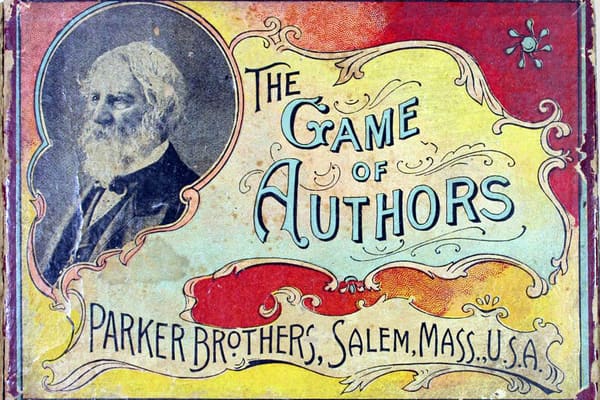
Authors (sometimes subtitled 'The Game of Authors') is a classic American card-asking game first published in 1861 by G. M. Whipple & A. A. Smith of Salem, Massachusetts, and republished by Parker Brothers in 1897. It is the direct ancestor of Go Fish and a sibling to Happy Families and Quartets. Played with a dedicated 44-card Authors deck featuring 11 famous writers with 4 cards per writer (typically one card per major work), the object is to collect complete 4-card author sets by asking opponents for specific cards. A correct ask scores the card and another turn; a wrong ask ends your turn. The game rewards memory, deduction, and cautious information management, since every failed ask leaks public information about what you need and what other players do not have. Authors is considered one of the earliest commercially sold dedicated card games in the United States and was originally designed to be both entertaining and lightly educational (children would learn the names and works of major literary figures through play). It can also be played with a standard 52-card deck using ranks instead of authors.
Quick Reference
- 2-6 players; 44-card Authors deck (or 52-card standard deck).
- Deal all cards as evenly as possible; the dealer takes any short hand.
- Lay down any complete author families dealt.
- Ask a named opponent for a specific named card from an author family you hold.
- If they have it: they hand it over and you ask again.
- If not: turn ends; play passes left.
- Complete sets of 4 and lay them face-up.
- 1 point per completed author set.
- 11 sets available (13 with a 52-card deck).
- Most sets at the end wins the round.
Players
Authors is played by 2 to 6 players, best at 3 to 5. Two players makes the deduction straightforward; five is the classic number for the original Parker Brothers rule book. Each player plays for themselves. The first dealer is chosen at random; thereafter the deal rotates clockwise.
Card Deck
A traditional 44-card Authors deck consists of 11 author families × 4 cards each. The classic Parker Brothers line-up includes Charles Dickens, William Shakespeare, Henry Wadsworth Longfellow, Sir Walter Scott, Washington Irving, Lord Byron, James Fenimore Cooper, Edgar Allan Poe, Nathaniel Hawthorne, Alfred Lord Tennyson, and Mark Twain. Each card names the author and one of their major works (for example, 'Charles Dickens: A Tale of Two Cities'). For households without a dedicated deck, a standard 52-card French-suited deck can be used with each rank (Aces, 2s, ..., Kings) acting as a set of four; 13 sets total.
Objective
Collect the most complete author sets (4 cards of the same writer) by asking opponents for specific cards. The player with the most completed sets at the end of the game wins.
Setup and Deal
- Shuffle the Authors deck thoroughly. Cut to determine the first dealer.
- Deal all 44 cards as evenly as possible, clockwise, one at a time. With 3 players, each receives 14 or 15; with 4 players, 11; with 5, 8 or 9; with 6, 7 or 8. The dealer takes the short hand when the deal does not divide evenly.
- Each player sorts their hand privately, grouping by author family. Announce and lay face-up any complete authors dealt to you; those score immediately.
- The player to the dealer's left takes the first turn.
Gameplay
- On your turn, select one opponent and ask them for one specific card: name both the author and the book. Example: 'Mark Twain, do you have Tom Sawyer?' or, in shortened form, 'Laura, do you have Dickens: A Tale of Two Cities?'.
- You must already hold at least one card of that author family. You cannot ask for a card of an author you have no cards of.
- Success: If the asked player holds the named card, they hand it over face-up and you take another turn. You may again ask any opponent for any qualifying card.
- Failure: If the asked player does not hold the named card, they reply 'No, I don't have that' (or, in some rule books, 'Go fish') and your turn ends. Play passes clockwise.
- Completing a family: When you gather all 4 cards of one author, lay them face-up in front of you as a scored set. If you completed the set on a successful ask, you may continue your turn.
- Out of cards: If your hand becomes empty during play (for example, after handing over your last card to an asker), you are out of the round; play continues among the remaining players until all 11 sets are collected.
- End of round: The round ends when every author has been completed and laid face-up. Count each player's collected sets.
Scoring
- Completed author set: 1 point per set.
- Total per round: 11 points available (13 with a standard 52-card deck).
- Round winner: The player with the most sets at the end.
- Ties: Tied players share the round win, or play a sudden-death single-set round with a fresh deal to settle it.
- Match format: A single round is a complete game by the classic rules. For longer play, use multiple rounds and declare the cumulative-highest the winner, or play 'first to 20 sets' across multiple rounds.
Winning
The player with the most completed author sets wins the game. With 11 sets available, a majority result (6 or more sets) is a common clean win; in tight games the leader may have just 3 or 4 sets. In multi-round matches, the winner is whoever reaches the agreed cumulative target (20 or 25 sets) first, or has the highest cumulative total after a fixed number of rounds.
Common Variations
- Draw-pile Authors (Go Fish crossover): Only some cards are dealt; the rest form a face-down pool. A failed ask makes the asker draw one card from the pool. This is the direct variant known in American homes as Go Fish.
- Author-only ask: Players ask for any card in an author's family without naming the book (for example, 'Do you have any Dickens?'). The asked player surrenders all matching cards. Faster and less precise.
- Themed author decks: Modern editions replace writers with scientists, musicians, painters, or historical figures. Mechanics identical.
- Double-deck Authors: Combine two Authors decks for 7-11 players; 22 sets total.
- Standard 52-card Authors: Use a regular deck; treat each rank as an author family. 13 sets total.
- Educational Authors: In classroom settings, require the asker to name the work correctly when receiving it; correct naming scores a 1-point educational bonus.
Tips and Strategy
- Track every ask at the table. A failed ask tells everyone that the asker wanted that card and the asked player does not have it. A successful ask tells everyone the asked player had it. Information compounds; by the time your fourth turn comes around, you can often predict 40% of the remaining distribution.
- Ask for cards you know are held. If Player B just received Emma from Player C on a successful ask, Player B now holds Emma; on your turn, ask Player B directly if you hold any other Jane Austen card.
- Do not burn information on wild guesses. An ask with no supporting evidence usually fails, and the failed ask tells everyone what you are missing. Save a turn by passing rather than guessing.
- Prefer close-to-complete families. If you hold 3 cards of one author, prioritize the missing fourth; the set is worth the same as a family you started with one card in, but it locks in immediately.
- Vary your targets. Asking the same player repeatedly tips them off about your collection; distribute your asks to gather intelligence on multiple opponents.
- Endgame counts favour the late-leader. If another player has multiple unlocked families, wait to ask them last so you inherit the maximum number of cards when you strike.
- When asked, answer precisely. If someone asks for 'Mark Twain: Tom Sawyer' and you have only 'Mark Twain: Huckleberry Finn', say 'No'. Do not volunteer the existence of another Twain card.
Glossary
- Author family / set: A group of 4 cards all by the same writer.
- Ask: A request for a specific named card from a named opponent on your turn.
- Go fish / No, I don't have that: The traditional reply when you do not hold the requested card; ends the asker's turn.
- Completed set: A 4-card author family collected by one player, scored 1 point.
- Hand: The cards you hold face-down; sorted privately by family.
- Parker Brothers deck: The classic 44-card 11-author edition, the dominant commercial version of Authors for over a century.
- Go Fish crossover: The draw-pile variant where failed asks force drawing from a centre pool.
Tips & Strategy
Authors is fundamentally an information-tracking game. Every failed ask leaks data about who wants what and who does not have it. Ask precisely for cards you know (or strongly suspect) an opponent holds; avoid wild guesses because the information cost of a failed ask usually exceeds the benefit of one more turn.
Information is the real currency of Authors. A skilled player tracks not just which specific cards have been requested, but also the pattern of requests: a player who repeatedly asks for Dickens cards is building Dickens, so your Dickens cards become valuable asks for them (and high-value targets once you finish your own sets). Late-game, when most families are partially distributed, memory separates the winner from the rest of the table.
Trivia & Fun Facts
The 1861 original Authors deck is widely credited as the progenitor of Go Fish; both games share the same core ask-or-fish mechanic, but Authors predates Go Fish's recorded appearance by at least half a century. The original editions featured engravings of the authors' portraits and their major works on each card, making each complete set a miniature literary reading list.
-
01In what year was Authors first commercially published in the United States, and which Massachusetts city produced both the original and the Parker Brothers republication?Answer 1861; both the original (G. M. Whipple & A. A. Smith) and the later Parker Brothers editions were published in Salem, Massachusetts.
History & Culture
Authors was first published in 1861 by G. M. Whipple & A. A. Smith of Salem, Massachusetts, making it one of the earliest dedicated card games sold commercially in the United States. Parker Brothers, also of Salem, acquired the title and republished it in 1897, after which the game became a fixture of American parlour life and classroom entertainment. The original educational intent was to familiarise children with classic American and British literature; the classic line-up included Dickens, Twain, Shakespeare, Hawthorne, and Longfellow.
Authors holds a unique place in American cultural history as one of the earliest commercially published dedicated card games. It was a fixture of Victorian-era American parlours and a common teaching tool in 19th-century American primary schools, introducing generations of children to the names and works of major writers. Modern Authors decks continue to appear in classrooms, museum gift shops, and literary-themed game collections.
Variations & House Rules
Draw-pile Authors is Go Fish. Author-only ask variant allows asking by author name alone for all matching cards. Themed decks swap writers for scientists or musicians. Double-deck supports up to 11 players. Standard 52-card Authors uses ranks instead of authors. Educational Authors adds a classroom scoring rule.
For a classroom, print custom cards with any four works-per-creator families (composers, filmmakers, poets) to suit the curriculum. For competitive adult play, use the draw-pile variant with a 52-card deck and add a 2-point penalty for asking for a card you do not hold a family member of (which classic rules technically forbid anyway).


