
How to Play
War is the classic two-player, luck-only card game: each player gets half the shuffled deck, both flip their top card each round, the higher rank takes both cards, and tied flips trigger an escalating 'war' in which extra face-down cards are committed before a tiebreak.
War is the universal children's card game of pure chance: a standard 52-card deck is divided evenly between two players, who each hold their cards face-down as a personal stock. On every round, both players simultaneously flip their top card onto the table; the higher rank wins both cards and adds them to the bottom of their stock. When the two revealed cards are equal in rank, a 'war' is triggered: each player adds a number of face-down cards and then a new face-up card, and the higher new face-up card wins all the cards on the table; if the new face-ups also tie, another war follows. The game ends when one player has captured every card, or in timed play, when one player has been reduced below an agreed card count. War has no strategic decisions: every round is decided entirely by the order of the shuffled deck, which is why it is a staple of very young children's card-play and of long family car journeys.
Quick Reference
- 2 players; shuffle a standard 52-card deck.
- Deal the entire deck face-down evenly (26 cards each).
- Ace is high, suits do not matter, no strategy is involved.
- Both players simultaneously turn over the top card of their stock.
- Higher rank takes both cards; loser places face-down at the bottom of winner's stock.
- Tied rank = War: 3 face-down + 1 face-up each, higher face-up takes the whole pile.
- No points; winner is the first to hold all the cards (or, in time-limited play, the most cards when time runs out).
- A chained war occurs when the tiebreak face-ups also tie; repeat until one is higher.
- If a player runs out of cards mid-war, they lose immediately.
Players
Classic two-player War: exactly 2 players using one 52-card deck. Three- and four-player variants exist (see Variations) with all players flipping a card simultaneously on each round. No partnerships; each player plays for themselves. No dealer role persists once the deck is split; after the split, the 'dealer' becomes irrelevant.
Card Deck
One standard 52-card deck, no jokers. Ranking (high to low): Ace, King, Queen, Jack, 10, 9, 8, 7, 6, 5, 4, 3, 2. Aces are high and suits do not matter at all for comparing cards; suits are used only to help players tell tied cards apart. For three- or four-player variants, use one full deck and deal it evenly, discarding the unreasonable 1 or 2 remainder cards before play.
Objective
Capture every card in play. A single player holding all 52 (or holding the last unresolved card) is the winner. In time-limited versions, the goal is to have the most cards in hand when time expires.
Setup and Deal
- Shuffle the 52-card deck thoroughly.
- Deal all 52 cards evenly, one at a time, face-down between the two players so each ends with exactly 26 cards in a personal stock.
- Each player holds their cards as a face-down pile they do not look at; only the very top card is ever consulted.
- No cut or further preparation is needed; the game begins immediately.
Gameplay
- Round: On each round, both players simultaneously turn over the top card of their stock and place it face-up in the centre of the table.
- Winning a round: The higher-ranked card wins. The winner takes both face-up cards and places them face-down at the bottom of their own stock. If a player's stock has run out and they need to take cards to the bottom, they simply restart it with the captured cards.
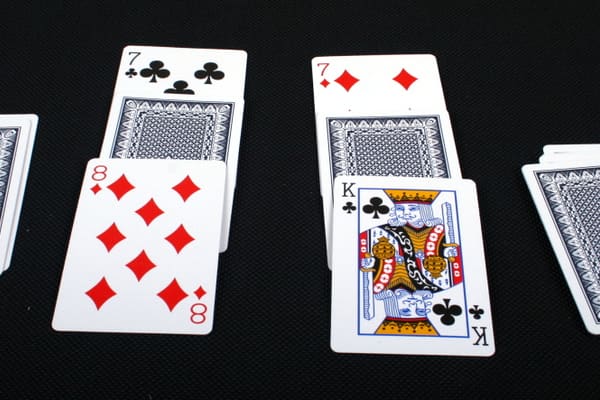
- Tied rank (War!): If the two face-up cards are of equal rank, a war is declared. Each player places three cards face-down on top of their own first face-up card, then places a fourth card face-up beside it. The higher new face-up card wins the entire pile on the table (both opening cards, both face-down sets of three, and both new face-ups, ten cards in total for a standard war).
- Chained wars: If the new face-up cards also tie, another war is declared immediately. Each player repeats the 3-face-down + 1-face-up move. This can chain several times in a single round.
- Running out of cards in a war: If a player does not have enough cards to perform the full 'three face-down + one face-up' move, they commit as many cards as they still hold, leaving at least one for the new face-up card if possible. If they cannot even produce the final face-up card, they lose the war and the game immediately.
- Re-shuffle rule: Most house rules say that when a player's face-down stock runs out, they simply shuffle their face-down capture pile (if any) and continue. Some groups instead forbid reshuffling and let an empty stock mean immediate loss; agree before play.
Winning
- Standard win: A player wins the moment the other player cannot produce a card for the next round (all their cards are already on the table or in the winner's stock).
- Time-limited win: For long games, agree a time limit or card-count target (for example, 'first to hold 40 cards', or 'whoever has more after 15 minutes'). This is the usual way to end a War game, because an unlucky reshuffle cycle can otherwise last for an hour.
- Tie-breaker (extremely rare): If both players run out of cards simultaneously on the same round and cannot settle a war, the game is a draw. In club play a single new round from a freshly shuffled deck settles it.
- Misdeal: If a card is accidentally exposed during the deal, reshuffle and redeal; the game is too short to matter.
Common Variations
- Three-player War: Deal 17 cards each (one card set aside); all three flip simultaneously. The highest card wins all three; tied highest cards between two players trigger war between those two while the third watches; tied triple wars are rare but resolved identically with three cards each.
- Four-player War: Deal 13 cards each; all four flip simultaneously. Highest rank wins; tied top ranks between two players trigger a mini-war between those two only.
- Double War: Agree that the top of the discarded capture pile is always a 'prize' in the centre; losing the next round loses the prize as well. Slightly accelerates the game.
- Casino War: A commercial casino version played against the house; player bets on each flip, ties allow a 'surrender' of half-bet or double-up for a war, and aces are the highest rank. Formally a gambling game rather than a children's game.
- Aces Low: A variant where Aces are the lowest rank and 2s beat everything except Aces; sometimes called 'peasant war'.
- Speed War: Both players keep flipping as fast as they can without taking turns; the faster reader may scoop the cards before the slower player notices. Popular with older children.
- Joker War: Include both jokers as the highest rank of all; 54-card deck.
- War with multiple decks: For longer or larger-group games, shuffle two decks together; agree in advance what happens when identical cards (same rank, same suit) both appear (usually treated as a tie).
Tips and Strategy
- There is no legitimate strategy in War; the outcome of every round is fixed by the order of the shuffled deck at the start of the game.
- The most common teaching point is rank-recognition for young children; use the game to rehearse 'King beats Queen, Queen beats Jack' and so on.
- When a war triggers, make sure both players place exactly the agreed number of face-down cards before the final face-up card; miscounting is the most common source of disputes.
- Set a time limit or card-count target at the start of longer sessions to prevent infinite reshuffle loops.
- The game demonstrates concepts of probability and randomness cleanly; parents and teachers can use it to introduce the idea that shuffled card orders produce fully deterministic but unpredictable outcomes.
Glossary
- Battle / Round: A single simultaneous flip by both players; the higher card wins both cards.
- War: The state triggered by a tied flip; each player commits extra cards and the prize pile grows.
- Face-down / Face-up: The orientation of a card; the capture pile is face-down, the central flip is face-up.
- Stock / Pile: Each player's personal face-down pile of cards; the top card is the only one consulted per round.
- Prize pile: All the cards sitting face-up and face-down in the centre during a war; the war's winner takes the whole pile.
- Reshuffle rule: Whether an emptied face-down stock may be rebuilt by shuffling the capture pile; a house-rule choice.
- Casino War: The commercial casino-floor adaptation with banker bets; not the traditional game.
- Chained war: A war that ties again on the new face-ups, triggering another war in immediate succession.
Tips & Strategy
War has no real strategy; it is a pure-chance game, and all decisions are mechanical. To make sessions manageable, agree a time or card-count limit before dealing so an unlucky shuffle pattern does not produce a 30-minute game that never ends. Use War to teach young children card-rank ordering; after a single session most children can cleanly compare A-K-Q-J-10 without prompting.
War illustrates the mathematical principle that a fully-deterministic but unpredictable game can be produced by a single random act (the shuffle). After the shuffle, every move is forced, so the result is a pure function of the deck order. Children who grasp this often make the leap to other shuffle-driven card games with little difficulty.
Trivia & Fun Facts
Because War involves no choices at all, a game between two players is already fully determined by the shuffle before the first card is flipped. Simulation studies by mathematicians have shown that around 10% of randomly shuffled two-player games would, under strict no-reshuffle rules, never terminate, entering infinite loops; this is why the 'reshuffle capture pile' convention is almost universally adopted.
-
01In War, what is the special term for the situation when two players simultaneously flip cards of equal rank, and what happens next?Answer The tied flip triggers a 'war'; each player adds three face-down cards plus one new face-up card, and the higher new face-up card wins the whole pile on the table.
History & Culture
War is a descendant of the French 18th-century game La Bataille, recorded from at least the 1720s, and travelled to the English-speaking world during the 19th century. It is now ubiquitous in Western children's play and is often the very first card game a child learns, long before Go Fish or Old Maid.
War is a universal card game of early childhood in most Western countries and is one of the first games published in children's card-game books, illustrated primers, and educational apps. It is a staple family game for long trips, waiting rooms, and rainy afternoons, and it crosses language and cultural boundaries effortlessly because there are no spoken rules to translate.
Variations & House Rules
The main variants are three- and four-player War (with the deck divided three or four ways), Casino War (a commercial banking version), Double War (escalating side prizes), Speed War (play as fast as possible), and Aces-Low or Joker-inclusive rank variants.
For younger children, play to 'first to hold 30 cards' so the game ends before boredom sets in. For a household car-journey version, use a time limit such as 'most cards after 15 minutes wins' so that no game can drag on indefinitely. For a party variant, add two jokers as the ultimate high cards and a Casino War payout where the loser of a war pays a forfeit.


