
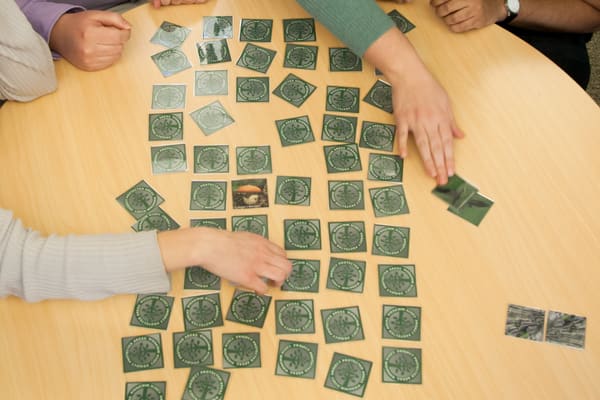
How to Play
Concentration (Memory, Pelmanism, Pairs) is a classic memory game for any number of players from 1 up. The whole deck is shuffled and laid face-down in a grid; on each turn a player flips two cards, scoring a pair and a bonus turn if they match, or flipping them back for the next player if they do not. Most pairs wins.
Concentration (also Memory, Pelmanism, Pairs, Pexeso) is a classic round game of pure memory for 1 or more players. The entire deck is shuffled and laid face-down in a grid; on each turn a player flips two cards face-up, scoring a pair and another turn if they match, or flipping them back down for the next player if they do not. Games take 10 to 20 minutes and are a staple of children's teaching and family play; children often outperform adults because of their fresher visual memory.
Quick Reference
- Shuffle the deck; lay all cards face-down in a regular grid (4 rows of 13 is standard for 52 cards).
- Choose a matching rule before starting (default: same rank and same colour).
- Flip any two cards face-up in place so every player sees them.
- If they satisfy the matching rule, collect the pair and take another turn.
- Otherwise, flip both back face-down in their original positions; turn passes clockwise.
- Each pair captured = 1 point; 26 pairs in a standard 52-card deck.
- Game ends when every card is captured; highest count wins (ties share or pair-off).
Players
1 or more players (no strict maximum; 2 to 6 is practical). Played individually (no partnerships), though cooperative variants exist for very young players. The first player is chosen by agreement (commonly the youngest) or by cutting for high card; play proceeds clockwise.
Card Deck
One standard 52-card deck, or 54 with two jokers added, or a subset for shorter games (for example 20 to 30 cards for toddlers). All four suits (clubs, diamonds, hearts, spades) are used. Suits matter only when the chosen matching rule requires it; the default matching rule uses same rank and same colour (for example the matches but not ).
Objective
Collect more matching pairs than any other player by remembering where cards lie face-down in the grid. When all pairs have been collected, the game ends; the player who captured the most pairs wins.
Setup and Deal
- Shuffle the deck thoroughly, then lay every card face-down on a flat surface in a regular grid. With a 52-card deck, 4 rows of 13, or any equivalent rectangle that fits the play area. With 54 cards and two jokers, 6 rows of 9 is common.
- Cards should not overlap; you need to be able to touch and flip any single card without disturbing its neighbours.
- No cards are dealt to hands; every card stays in the grid until it is part of a captured pair.
- Choose the first player (typically the youngest) and a matching rule before the first turn: standard rule is 'same rank and same colour'; easier rules are 'same rank, any suit' or 'any matching'. Stick to the chosen rule for the whole game.
Gameplay
- Flip two cards: On your turn, select any two cards from the grid and turn them face-up in place, one after the other, so every player can see both. Name the ranks and suits as you flip so everyone can remember.
- Match: If the two cards satisfy the agreed matching rule (for example both are Queens of a red suit), you collect the pair and place them in front of you face-up. You then take another turn; continue flipping pairs as long as you keep matching.
- No match: If the two cards do not match, turn them face-down in the same positions. Your turn ends and play passes to the next player (clockwise).
- Attention during other players' turns: You may watch every card flipped by every other player and remember them for later. Outside your own turn, you cannot touch any card.
- Illegal play: Flipping a card that is already face-up (for example one you captured earlier) or moving a face-down card from its position is illegal; the move is undone and your turn ends.
- End of game: The game ends when every card has been collected. No cards remain on the table; each player has their pile of captured pairs.
Scoring
- Per pair: Each captured pair scores 1 point for the capturing player. With a 52-card deck there are 26 pairs in play.
- Session scoring: Play a series of games and track cumulative pairs; highest total across the session wins.
- Solitaire scoring: In solo Concentration, count the number of unsuccessful flip-pairs (flips that did not match) across the whole game; the lowest count is the best score. A perfect game would have exactly 0 unsuccessful pairs: every flip matches.
Winning
- Game winner: The player with the most captured pairs when the grid is empty.
- Ties: Two or more players with the most pairs share the victory; some groups play a one-pair-off tie-break (lay two face-down rows of 4 from the already-captured pairs, shuffled among the tied players' piles, and repeat the rules until one tied player takes more in the tie-break).
- Session winner: In multi-game sessions, highest running total wins; ties broken by head-to-head pairs across the session.
Common Variations
- Any Colour (easy): Matching requires only same rank; suit and colour are ignored. Roughly doubles match opportunities and suits very young players.
- Zebra (opposite colour): A match must be same rank but opposite colour (for example a red 6 with a black 6); harder than standard because only two of the four cards of each rank pair up.
- Two Decks: Shuffle two 52-card packs together (104 cards); identical matching requires the same rank and same suit, so a matches only another . Much harder.
- One-Flip: Matching pairs do not grant an extra turn; play rotates after every turn regardless. Speeds up the game.
- Memory Tournament: Time how long each game takes and keep a leaderboard; fastest win is best.
- Picture Variants: Use a children's Memory set with animal or object pictures instead of cards; rules identical.
Tips and Strategy
- Build a mental map of the grid: associate columns and rows with cardinal directions, and rehearse card positions silently as cards are flipped.
- Watch every flip, not just your own. Information gathered on other players' turns is as valuable as your own.
- Early in a game, random guessing is unavoidable (you have no information). Once a few cards are known, prioritise matches you can already see; do not waste a known card by gambling on a second unknown.
- Re-visit cards you have seen several times. Repetition cements the position in memory.
- Keep a consistent grid layout (a rectangle, not a ragged shape) so your mental map is grid-aligned.
Glossary
- Grid: The flat rectangular arrangement of face-down cards on the table at the start of the game.
- Flip: Turning a face-down card face-up in place, without moving it; how you reveal a card.
- Pair / match: Two cards that satisfy the agreed matching rule (typically same rank and same colour).
- Capture: To take a matched pair off the grid into your own pile of scored cards; scores 1 point per pair.
- Go again (extra turn): After a successful match, the capturing player takes another turn in the standard rules.
- Unsuccessful pair (solo scoring): A flip of two cards that do not match; the metric to minimise in solitaire Concentration.
Tips & Strategy
Build a mental map of the grid: associate rows and columns with cardinal directions, and silently rehearse card positions as they are revealed. Watch every flip, not just your own; information from other turns is as valuable as yours.
Once a few cards are known, avoid random guessing; every turn should include at least one known card. Late-game, re-visit previously seen cards to cement positions before reaching for unseen ones.
Trivia & Fun Facts
Studies show children often outperform adults at Concentration, possibly because their memory formation is more visual and less cluttered by verbal-encoding interference.
-
01What happens in Concentration when you successfully match a pair on your turn?Answer You collect the pair and take another turn; you keep going as long as you keep matching.
History & Culture
The game dates to the late 19th century as 'Pelmanism' (named after the Pelman Institute, a memory-training school) and became a global television game-show format in the mid-20th century; children's picture-card versions remain a common early-childhood activity.
A global early-childhood classic used in homes, schools, and cognitive-therapy settings worldwide; transcends language barriers because the mechanic requires only visual matching.
Variations & House Rules
Any-Colour matches any rank regardless of suit or colour (easier). Zebra requires same rank but opposite colour (harder). Two-Decks uses 104 cards and exact rank-plus-suit matches. One-Flip removes the extra-turn rule after a match.
For toddlers use a 20- or 30-card subset; for adults use two decks or Zebra rules for a real challenge. Picture-card Memory sets teach pattern recognition before rank names.


