
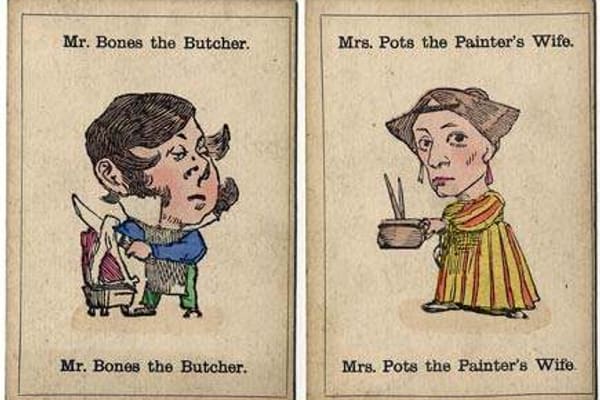
How to Play
Happy Families is the classic British 1851 children's card game for 2-6 players, using an illustrated 44-card deck of 11 occupational families (Mr Bun the Baker, and so on). Ask opponents politely for specific family members; collect the most complete families.
Happy Families is the classic British children's card game created by John Jaques Jr. and first sold at the 1851 Great Exhibition in London. It is the direct British cousin of Quartets and Go Fish, played with a specially illustrated 44-card deck consisting of 11 fictional occupational families (Mr, Mrs, Master, and Miss of each trade: Butcher, Baker, Bun, Brick, Bones, Chip, Dip, Dose, Dust, Grits, and Potts in the Jaques original). The object is to collect complete 4-card families by asking opponents politely for specific members (for example, 'Mr Bun the Baker, if you please'). A correct guess scores the card and another turn; a wrong guess ends your turn and often gifts information to the table. Completed families score 1 point; most families at the end wins. The game has been in continuous print for 175 years and taught generations of British children both basic deductive reasoning and the Victorian conventions of polite request. It is still frequently produced as branded decks with modern themed families (Disney characters, dinosaurs, celebrities) sold as travel or party games.
Quick Reference
- 2-6 players; deal the 44-card deck (or 52-card standard deck) evenly.
- Sort hands; announce any complete family you were dealt.
- Player left of dealer takes the first turn.
- Ask a named opponent for a specific named card you hold a family member of.
- Success: they hand it over and you go again.
- 'Not at home': your turn ends.
- Lay completed families face-up.
- 1 point per completed family.
- Most families at round end wins.
- Match format: fixed rounds or first to 10-15 families.
Players
Happy Families works for 2 to 6 players, best with 3 or 4. Two players is a quick deductive duel; five or six is more social but makes individual turns less frequent. The dealer for the first round is chosen at random; thereafter the dealer is the previous round's overall winner, or the deal rotates clockwise depending on local tradition.
Card Deck
The traditional Happy Families deck contains 44 cards: 11 families of 4 members each. Members are labelled and illustrated as: Mr (the father, the tradesman), Mrs (the mother), Master (the son), and Miss (the daughter). Family names are occupational puns: Mr Bun the Baker, Mr Chip the Carpenter, Mr Potts the Painter, Mrs Bones the Butcher's Wife, Miss Dose the Doctor's Daughter, and so on. For households without a dedicated deck, a standard 52-card deck can be used where each rank (Aces, 2s, 3s, and so on) is a family of four; all 13 ranks equal 52 cards, 13 families.
Objective
Collect as many complete families (sets of 4 cards sharing the same family name) as you can by asking opponents for their matching members. The player with the most completed families at the end wins the game.
Setup and Deal
- Shuffle the 44-card Happy Families deck thoroughly. Cut to decide who deals first; highest cut (Mr Bun the Baker is highest in the original deck) deals.
- Deal all 44 cards as evenly as possible, face-down, one at a time, clockwise. With 2 players, each receives 22; with 3 players, 14 or 15 (the dealer takes the short hand); with 4 players, 11; with 5 players, 8 or 9; with 6 players, 7 or 8. In versions where cards cannot be dealt evenly, the dealer takes the short hand.
- Each player sorts their hand privately, grouping by family name to see which families they have started and which are missing.
- If any player holds a complete family from the deal, they announce it, lay it face-up in front of them immediately, and mark it as scored.
- The player to the dealer's left takes the first turn. In the Jaques variant, the dealer goes first.
Gameplay
- On your turn, select one opponent (not yourself) and politely ask them for one specific card whose family you already hold at least one member of. The traditional phrasing is: 'Mr Bun the Baker, if you please' or 'Miss Dose the Doctor's Daughter, if you please'. You must ask by full name; vague rank requests are not allowed.
- You must already hold another member of that family. You may not ask for a card from a family in which you have no cards.
- Success: If the asked player holds the requested card, they must hand it over face-up, and you have another turn (you may again choose any opponent and any card).
- Failure ('Not at home'): If the asked player does not hold the requested card, they reply 'Not at home' (some groups say 'Pass' or 'Go fish'). Your turn ends immediately and passes clockwise to the next player.
- Completing a family: When you collect all four members of a family, lay them face-up in front of you as a completed score pile. You may continue your turn if you completed the family on a successful ask.
- When your hand is empty: If you run out of cards in hand during play (for example after giving away your last card on someone's successful ask), you are out of the round; play continues among the remaining players until all families are collected.
- End of round: The round ends when every family has been completed and laid face-up. Count each player's completed families.
- Polite penalty (strict Jaques rule): A player who asks rudely, mispronounces a name, or forgets to say 'if you please' forfeits their turn to the asked player. Rarely enforced outside formal play, but a historical quirk of the original game.
Scoring
- Completed family: 1 point per family.
- Total per round: 11 points available (one per family in the classic deck); 13 points in the 52-card variant.
- Round winner: The player with the most completed families. In case of a tie, the tied players share the win or play a sudden-death single family round with a fresh deal.
- Match format: A typical match is a single round. For longer sessions, play multiple rounds and total completed families; the first to an agreed total (often 10 or 15) wins the match.
Winning
Each round is won by the player with the most completed families. If the game is one-round, that player is the outright winner. In a multi-round match, play continues until one player reaches the agreed cumulative target, or for a fixed number of rounds, in which case the highest cumulative family count wins. Ties are broken by a single additional round with the tied players only.
Common Variations
- Ask by surname only: You may ask, for example, 'Do you have any Buns?' and receive all members of the Bun family from the asked player. Faster but removes the polite-request theme.
- Go Fish crossover: If the asked player does not have the card, you draw one card from a 'deck' of undealt cards. Only applicable if not all cards are dealt out at the start.
- Memory Happy Families: After dealing, lay some cards face-down in the centre; when you cannot find a match via asking, you may flip a centre card.
- Single-card request: Must name the exact card (including the named member, such as 'Miss Chip the Carpenter's Daughter'); the strictest form, matching the original Jaques rules.
- Themed decks: Modern versions replace the Jaques occupational families with Disney characters, dinosaurs, footballers, or any licensed IP. Rules are identical.
- Three-generation families: Some editions feature families of 6 members (adding Grandpa and Grandma); points per family are raised accordingly.
Tips and Strategy
- Track every request. The moment someone asks an opponent for Mrs Bun, you know two things: (a) the asker has at least one Bun, and (b) the asked player may or may not have Mrs Bun. Every failed ask is a piece of information for the entire table.
- Ask for cards you are sure an opponent has. If a player picked up Mr Chip last turn on someone's failed ask, and you also have a Chip, that player is now your best target for Mr Chip on your turn.
- Prefer to ask last player added. A player who just received a family member is more likely to be holding onto it than a player who has not touched that family all game.
- Watch what others ask each other. In 4 or 5 player games, you rarely are the person asking or being asked; the most information comes from listening to other pairs' exchanges.
- Complete easy families first. If you hold 3 of a 4-card family, prioritize finding the missing card; the 1-point score locks in and the family is no longer in anyone's hand.
- When asked, volunteer nothing extra. If you have two Buns and someone asks for Master Bun, hand over Master Bun only; do not mention you also have Mrs Bun.
Glossary
- Family: A set of 4 cards sharing an occupational surname (for example, all four Buns).
- Member: One of the 4 individual cards in a family (Mr, Mrs, Master, or Miss).
- Not at home: The traditional British reply when you do not have the requested card; ends the asker's turn.
- If you please: The polite phrasing expected on every ask in the traditional game.
- Completed family: A set of 4 members collected by one player, laid face-up for scoring.
- Jaques variant: The original John Jaques Jr. 11-family deck with Victorian occupational puns.
- Themed deck: Modern re-skinned editions using a different visual family theme; rules are identical.
Tips & Strategy
Happy Families is a memory game dressed as a polite conversation. Track every ask at the table: a failed ask for Mr Bun means someone wants Mr Bun but does not have him, and a successful ask tells you the asked player just became the Bun owner. Ask only for cards you can track to a specific opponent; random asks leak information without gaining any.
Happy Families is a subtle information-management exercise. Every public exchange of cards reveals something: which families each player is collecting, which they have already locked down, and which they are struggling to complete. Experienced players never ask for a card without a reason to believe it will be there, because a failed ask tells the rest of the table what they are missing and whom to target next.
Trivia & Fun Facts
The famous 'Mr Bun the Baker' family has been in continuous print since 1851, making it one of the longest-lived named card game characters in the English-speaking world; collectors prize first-edition Jaques decks for their Tenniel illustrations, and complete Victorian decks in good condition can sell for thousands of pounds at auction.
-
01Who drew the original Mr Bun the Baker and the rest of the Victorian occupational family illustrations in the 1851 Happy Families deck?Answer Sir John Tenniel, who three years later went on to illustrate Alice's Adventures in Wonderland.
History & Culture
Happy Families was created by John Jaques Jr. and first sold at the Great Exhibition of 1851 in London. The original grotesque caricatures of Victorian tradesmen were drawn by Sir John Tenniel, who three years later would illustrate Lewis Carroll's Alice's Adventures in Wonderland. Jaques & Son remained the dominant British publisher until the 20th century, when countless themed decks (especially from the 1960s onward) spread the game internationally.
Happy Families is a fixture of British childhood and a staple gift for grandchildren from aunts and grandparents. It has been continuously in print since the reign of Queen Victoria and has been adapted into countless themed editions, including official licensed versions for the British Royal Family, the Queen's Jubilees, the Harry Potter franchise, and numerous children's television programmes.
Variations & House Rules
Ask-by-surname speeds the game. Memory Happy Families adds a face-down central reservoir. Three-generation families extend sets to 6 members. Themed decks use Disney, footballers, or other licensed families; rules are identical. The Jaques variant enforces the strictest polite-request wording.
For young children, play with fewer families (6 or 7) to shorten the round. For competitive adult play, use the strict polite-request rule with the forfeit penalty and require full name pronunciation. Create your own deck with household themes (favourite books, bands, local celebrities) using 11 groups of 4 images.


