
How to Play
Casino War is the casino table version of the children's card game War. You and the dealer each get one card, and the higher card wins: beat the dealer and you are paid even money, lose and the dealer takes your bet. Suits do not matter and Aces are high. If the two cards tie, you choose: surrender and lose half your bet, or go to war by adding a second bet equal to the first. The dealer then burns three cards and deals one more card to you and one to themselves. If your war card is equal or higher, your second bet wins even money and your original bet is returned; if the dealer's war card is higher, you lose both bets. There are no other decisions. With six decks the house edge is about 2.88% if you always go to war and 3.70% if you always surrender.
Quick Reference
- Up to 7 players, each against the dealer; usually a 6-deck shoe (312 cards).
- Place a bet (and an optional tie bet) before the cards are dealt.
- You and the dealer each get one card face up.
- Higher card wins 1:1; lower card loses.
- On a tie: surrender (lose half) or go to war (add an equal bet; 3 cards burned, 1 new card each).
- Win: 1:1. Loss: bet lost. Surrender: half lost.
- War, your card equal or higher: second bet wins 1:1, original bet pushes.
- War, dealer higher: both bets lost. Tie bet: 10:1.
 Poker Chip Set (with dealer button)Amazon
 Standard 52-Card Playing CardsAmazon
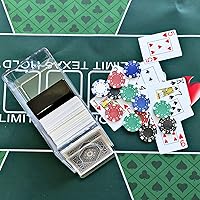 Card Dealing ShoeAmazon
Show 3 moreShow less


As an Amazon Associate, CardRules+ earns from qualifying purchases.
Players
Up to 7 players sit at the table, but each player plays only against the dealer. Players do not compete with each other, and every bet is settled on its own. The dealer turns over one card per round, which every player at the table compares their card against.
Card Deck
Casinos usually deal Casino War from a shoe of 6 standard 52-card decks (312 cards) with no jokers. Ranks from high to low: A K Q J 10 9 8 7 6 5 4 3 2. Aces are always high, and suits play no part. At home you can play with a single 52-card deck.
Objective
Get a higher card than the dealer. If your first cards tie, either surrender half your bet or go to war and try to draw a card equal to or higher than the dealer's war card.
Setup and Deal
- Each player places a bet in their betting circle. An optional tie bet can also be placed in its own circle.
- The dealer deals one card face up to each player, then one card face up to themselves.
- Each player's card is compared with the dealer's card.
Gameplay
- Your card is higher: you win even money (1:1) on your bet.
- The dealer's card is higher: you lose your bet.
- The cards tie (same rank): you must choose to surrender or go to war.
- Surrender: you give up half your bet, get the other half back, and your hand is over.
- Go to war: you place a second bet equal to your original bet. The dealer burns three cards face down, then deals one card face up to you and one to themselves.
- You win the war if your war card is equal to or higher than the dealer's: the second bet is paid 1:1 and the original bet is returned without winnings (a push). For example, with a 10 bet you put out 20 in total and finish 10 ahead.
- You lose the war if the dealer's war card is higher: you lose both bets (20 on a 10 bet).
- Tie after a tie: some casinos pay a bonus equal to your original bet when the war cards also tie. Wizard of Odds lists the Mirage and Casino Niagara as examples. Check the table sign.
- Tie bet: if you made this side bet, it pays 10:1 when your first card ties the dealer's. It is settled separately from your main bet.
Scoring (Payouts)
- Your card higher: win 1:1 (even money).
- Dealer's card higher: lose your bet.
- Tie, then surrender: lose half your bet.
- Tie, then war, your card equal or higher: win 1:1 on the second bet; the original bet pushes.
- Tie, then war, dealer's card higher: lose both bets.
- Tie after a tie (bonus casinos only): a bonus equal to your original bet.
- Tie bet: pays 10:1 when the first two cards tie.
Winning
- Each round: every bet wins, loses or pushes as shown in the payouts.
- No overall winner: there is no match score; you play as many rounds as you like.
- House edge (6 decks, Wizard of Odds): 2.88% if you always go to war, 2.33% at casinos that pay the tie-after-tie bonus, and 3.70% if you always surrender. The tie bet has an 18.65% house edge.
Common Variations
- Tie-after-tie bonus: a bonus equal to the original bet when the war cards tie again, which lowers the house edge to 2.33% with six decks.
- Fewer decks: with one deck, ties happen less often and the house edge for always going to war falls to 2.42% (Wizard of Odds).
- Higher tie-bet payout: some online casinos pay 11:1 on the tie bet, which lowers its house edge to 11.25% with six decks.
- Online versions: some online casinos pay three times the bet for a tie after a tie, which lowers the house edge further. Read the game's paytable.
Tips and Strategy
- Always go to war on a tie. Going to war costs less over time than surrendering (2.88% against 3.70% with six decks).
- Skip the tie bet. At 10:1 its house edge is 18.65%, many times that of the main bet.
- Look for tables that pay a bonus for a tie after a tie; it lowers the house edge to 2.33%.
- Rounds are very fast, so set a budget before you sit down. No strategy changes the long-run edge.
Glossary
- Rank order: Ace highest, 2 lowest; suits do not matter.
- Tie: your first card and the dealer's first card have the same rank.
- Surrender: after a tie, give up half your bet and end the hand.
- Go to war: after a tie, add a second bet equal to the first and play one more card each.
- Burn: cards discarded face down without being used.
- Push: a bet returned with no win and no loss.
- Tie bet: an optional side bet that pays 10:1 if the first cards tie.
- Shoe: the box that holds the shuffled decks at a casino table.
Tips & Strategy
The only decision in Casino War comes after a tie, and the answer is always the same: go to war. With six decks this keeps the house edge at 2.88%, against 3.70% for surrendering. Avoid the tie bet (18.65% house edge) and prefer tables that pay a bonus for a tie after a tie.
Casino War has a single strategy question: surrender or go to war after a tie. Going to war is always better. The house edge comes from ties: when you go to war you risk two bets but can only win one, so tables with fewer decks, which produce fewer ties, have a slightly lower edge.
Trivia & Fun Facts
Casino War is one of the few casino games most people already know before they arrive, because it works like the children's game War. In the casino version, 'going to war' after a tie can only ever win you one extra bet's worth, even though you put two bets on the table.
-
01How many cards does the dealer burn before dealing the war cards in Casino War?Answer Three cards are burned face down before one war card is dealt to each side.
-
02If you go to war and your war card ties the dealer's again, do you win or lose?Answer You win: a tie in the war counts for the player, so the second bet is paid even money, and some casinos also pay a bonus.
History & Culture
Casino War adapts the children's game War, in which two players turn over cards and the higher card takes both, for a casino table: the dealer plays every hand against each player, and a tie becomes a betting decision instead of a pile-up of cards.
Casino War's appeal is familiarity: players who have never sat at a blackjack or baccarat table already know how War works, which makes it an easy first table game.
Variations & House Rules
Casinos differ mainly in whether they pay a bonus for a tie after a tie (house edge 2.33% instead of 2.88% with six decks), how many decks they use, and the payout on the tie bet (10:1 or 11:1).
At home, use a single deck and take turns as the dealer. Play with chips or counters, and agree in advance whether a tie after a tie pays a bonus.
More War Variants
| Game | Players | Difficulty | Length | Deck |
|---|---|---|---|---|
| War | 2–4 | Easy | Short | 52 cards |
| Slapjack | 2–8 | Easy | Short | 52 cards |
| Egyptian Ratscrew | 2–6 | Easy | Medium | 52 cards |
| Beggar-My-Neighbor | 2–6 | Easy | Medium | 52 cards |
| Casino War This game | 2–7 | Easy | Short | 52 cards |


