
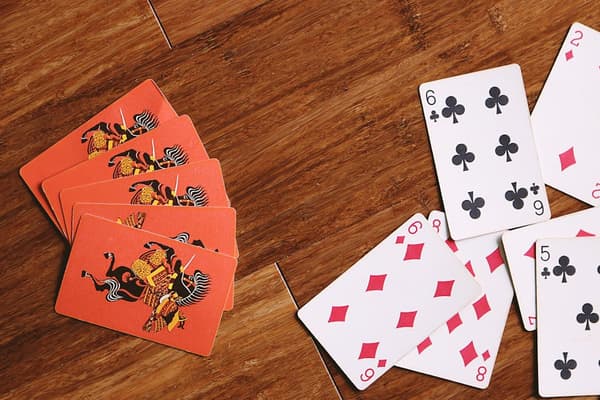
How to Play
A Crazy-Eights-family shedding card game played with a standard 52-card deck in which 9s are wild cards. Match the top discard by rank or suit to play; first out scores 0 and others score penalties for remaining cards. First player to 100 cumulative points ends the match.
Nines is a folk Crazy-Eights-family shedding card game in which the rank 9 plays the wild role that the 8 plays in Crazy Eights or the Wild card plays in Uno. Each player is dealt a hand from a standard 52-card deck, and on each turn plays one card that matches the top of the discard pile by rank or by suit. A 9 may be played on any card regardless of suit or rank, and the player of a 9 declares the new active suit for the next player to match. If a player cannot play, they draw one card from the stock; if that card is playable they may play it immediately. First player to shed all their cards ends the round and scores 0; the other players score penalty points for cards still in hand. Match play usually runs to a cumulative 100 penalty points, with the lowest total at that point the overall winner.
Quick Reference
- 2-6 players, standard 52-card deck. 9s are wild.
- Deal 7 cards each (5 for 5-6 players); turn top card face up as discard.
- Player left of dealer plays first.
- Play one card matching the top discard by rank or suit.
- A 9 may be played on anything; declare the new active suit.
- Cannot play: draw one card; if playable, you may play it immediately.
- Round winner (empty hand) scores 0.
- Others score face value (A=1, numbers = face, J/Q/K=10, 9=15) for cards left in hand.
- Match ends when any total reaches 100; lowest total wins.
Players
2 to 6 players, best with 3 to 5. Play proceeds clockwise starting with the player to the dealer's left. Deal rotates clockwise after each round. A single round typically lasts 3 to 7 minutes; a full 100-point-cutoff match runs 15 to 35 minutes.
Card Deck
One standard 52-card French-suited pack with jokers removed. All 9s (four of them) are wild cards; all other cards are ordinary.
Objective
For each round, be the first player to play every card from your hand (to 'go out'). For the match, accumulate the fewest penalty points from cards left in your hand at the end of rounds you do not win; first player to cross the 100-point threshold triggers the match end, and the lowest score at that moment wins.
Setup and Deal
- Cut for dealer (lowest card deals); deal rotates clockwise after each round.
- Shuffle the full 52-card pack. Deal face down to each player: 7 cards (for 2-4 players) or 5 cards (for 5-6 players).
- Place the remaining cards face down in the centre as the stock pile. Turn over the top card of the stock face up next to it to start the discard pile.
- If the first flipped card is a 9, the dealer declares the active suit themselves before the first player acts.
- The player to the dealer's left plays first.
Gameplay
- Legal plays: On your turn, play one card from your hand onto the discard pile that matches the top card by either rank or suit. For example, if the top card is the 7 of Hearts, you may play any Heart or any 7.
- Wild 9: A 9 of any suit may be played on top of any card regardless of match. When playing a 9, announce the new active suit for the next player. The suit you declare does not have to match the 9's own suit.
- Cannot play: If you hold no legal card (including no 9s), draw one card from the stock. If that drawn card is playable you may (but are not required to) play it immediately; otherwise your turn ends.
- Empty stock: If the stock runs out during a round, set aside the top discard card, shuffle the rest of the discard pile to form a new stock, and continue. If no cards remain to form a new stock, players simply skip their draw when unable to play.
- Going out: The first player to play their last card ends the round. That player must play their final card legally (matching by rank, suit, or a 9 wild).
Scoring
- Round winner (first to empty hand): 0 penalty points for the round.
- Card penalty values for cards left in hand: number cards (2, 3, 4, 5, 6, 7, 8, 10) = face value; Ace = 1 point; face cards (Jack, Queen, King) = 10 points each; 9 = 15 points (wild-card penalty).
- Round end: Each non-winner totals the penalty value of cards left in their hand and adds it to their running score.
- Match end: When any player's cumulative score reaches or exceeds 100 points, the match ends. The player with the LOWEST cumulative score wins (not the player who crossed 100).
- Optional: fixed-round matches: Instead of a 100-point cutoff, play a fixed number of rounds (5, 7, or 10); lowest cumulative score wins.
Winning
At match end (when any cumulative score crosses 100 or when the agreed round count is complete), the player with the lowest cumulative penalty total is the match winner. Ties are broken by a single-round playoff between the tied players.
Common Variations
- Draw until playable: Instead of drawing one card on an unplayable turn, draw cards continuously until you get a playable card; then you must play it. Makes the game faster but rougher.
- Skip and Reverse: Add Uno-style powers to other ranks. Common assignments: Jack skips the next player, Queen reverses direction, Ace forces the next player to draw 2.
- Double Nines: Use two decks (104 cards) for 5-6 players. Playing two 9s together lets you change the suit AND skip the next player.
- Hard Nines: A 9 penalty is increased to 25 points, making wild cards even more dangerous to hold.
- No-9-out: You may not play a 9 as your last card; you must end on a naturally matching card. Prevents cheap wild-card finishes.
- Stacking 9s: A player who is about to be the target of a 9's suit declaration may play their own 9 to cancel and redirect.
Tips and Strategy
- Hold onto one or two 9s for critical late-hand moments, but do not carry them to the round end: the 15-point penalty is the highest in the game.
- Watch which suits each opponent plays. If an opponent has skipped their turn or drawn when a specific suit was active, they are likely short in that suit.
- Dump high-value cards (Kings, Queens, Jacks at 10 each) early when you can; holding a face card at round end is a big penalty.
- When you do play a 9, declare the suit you hold most heavily (you want to play again next turn) rather than a suit you dislike.
- In longer matches (100-point cutoff), a conservative play style (small dumps, avoid big-stake risks) often wins because a single 30+ point round is very hard to recover from.
- Pay attention to card counts. A player with 1 or 2 cards left is one move from winning; play a suit they cannot match, or force them to draw with your 9.
Glossary
- Wild card (9): A card that may be played on any top card regardless of suit or rank; the player of a 9 declares the new active suit.
- Discard pile: The face-up pile of played cards; the top card determines what the next player must match.
- Stock: The face-down draw pile from which players pick cards when unable to play legally.
- Go out: Play your last card; ends the round.
- Active suit: The suit the next player must match, either by following suit on a normal card or by being declared by the player of a 9.
- Crazy Eights family: The broader category of shedding games (Crazy Eights, Uno, Mau Mau, Switch, Nines) that use a wild card and a match-by-rank-or-suit rule.
Tips & Strategy
Hold one or two 9s for key late-hand moments, but never carry them to round end; the 15-point penalty is the highest in the game. Dump Kings, Queens, and Jacks (10 points each) as soon as you can legally. When playing a 9, declare the suit you hold most heavily so you can follow with another card next turn.
Nines rewards disciplined card tracking and suit management more than long-range planning. Watch which suits opponents skip (they are likely short), dump high-penalty face cards early to reduce round-end exposure, and deploy your 9s in the last third of the hand rather than the first to maximise their tempo impact. The most common beginner mistake is saving 9s too long and being caught with them; the most common expert mistake is playing a 9 carelessly when a matching suit would have worked.
Trivia & Fun Facts
Holding a 9 at the end of a round costs you 15 penalty points, the highest single-card penalty in the game and higher even than the 10-point face cards. This creates a classic Nines dilemma: save your wild card for a critical suit-switch, or play it early to avoid the possibility of being caught with it in hand. Some regional variants (Hard Nines) raise the penalty even higher to 25 to intensify this dilemma.
-
01In the game of Nines, how many penalty points does a 9 cost if you are caught holding one at the end of a round?Answer 15 points, the highest single-card penalty in the game (higher than a face card's 10 points).
-
02When a 9 is played as a wild card, what decision does the player make?Answer They declare the new active suit the next player must match; the declared suit does not have to match the 9's own suit.
History & Culture
Nines is a 20th-century folk-game cousin of Crazy Eights (first described in the 1930s in America) and Mau Mau (German, 1930s-1940s), in which the wild-card rank was shifted from 8 to 9 by unknown family tradition and spread regionally through North America and parts of Europe. The game is not attached to any specific inventor, commercial publisher, or founding city, and it is passed primarily by oral tradition among families and game groups. Its shedding-game structure makes it a clear relative of the commercial Uno (1971) and of the Swiss Tschau Sepp (1960s).
Nines belongs to the large informal category of family shedding card games that serves as an early-childhood introduction to turn-based trick play, card tracking, and elementary hand-management decisions. Alongside Crazy Eights and Uno, Nines is often one of the first card games taught to children in households where it is a local tradition. Its accessibility (a standard deck, no special equipment) contrasts with commercial alternatives like Uno while preserving similar gameplay.
Variations & House Rules
Draw-until-playable makes the game sharper and more variable. Skip-and-Reverse adds Uno-style special-power cards to other ranks (Jack skips, Queen reverses, Ace draw-2). Double Nines uses two decks for 5-6 players. Hard Nines raises the 9 penalty to 25. No-9-out forbids ending on a wild card. Stacking 9s allows a 9 to cancel a 9.
Tune the hand size to the group: 5 cards for 5-6 players, 7 for 2-4, or 10 for longer individual rounds. Add special powers (Jack skip, Queen reverse) for an Uno-like feel with a kid-friendly group. Use the 100-point cutoff for a competitive match or a fixed 7-round count for a predictable session length. For very young players, remove the face-card penalty and score only 9s for a simplified version.


