
How to Play
A classic family card game for 2 to 6 players where you ask opponents for ranks you already hold, racing to collect books of four same-rank cards.
Go Fish is a classic children's and family card game in which players collect complete sets of four same-rank cards, called books. On your turn you ask one opponent for all their cards of a specific rank that you already hold. They must give you every card of that rank if they have any; otherwise they tell you to 'Go Fish' and you draw from the stock. Completed books are laid down as points, and when the deck and all hands are empty the player with the most books wins.
Quick Reference
- Deal 7 cards each to 2 or 3 players, or 5 cards each to 4 to 6 players.
- Remaining deck face down in the centre as the stock.
- Ask one opponent for a rank you already hold.
- If they have any cards of that rank, they give all of them and you go again.
- If not, they say 'Go Fish' and you draw from the stock; another turn only if you drew the asked rank.
- Lay down any four-of-a-kind as a completed book.
- Each book counts as 1 point.
- Most books when all thirteen are done or all hands and the stock are empty wins.
Players
Works for 2 to 6 players individually. 3 to 5 is the sweet spot: enough opponents to make asking interesting, few enough that each player's hand remains informative. A 2-player game is tightly memory-based; 6 is looser because many turns pass between yours.
Card Deck
- Standard 52-card deck with jokers removed.
- Suits are irrelevant; only ranks matter.
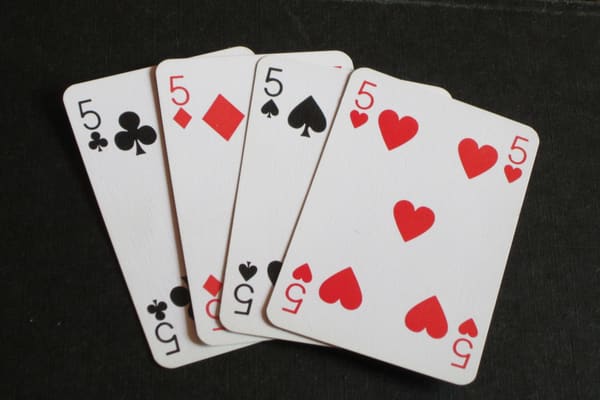
- A book is four cards of the same rank, for example .
- There are thirteen possible books (Ace through King); the deal of all thirteen books ends the game.
Objective
Collect as many books (sets of four same-rank cards) as possible. The game ends when all thirteen books have been laid down or when the stock runs out and no hand cards remain; the player with the most books at that point wins.
Setup and Deal
- Pick any player to shuffle and deal; the deal rotates left after each game.
- Deal cards face down, one at a time, clockwise. With 2 or 3 players deal 7 cards to each; with 4 to 6 players deal 5 cards to each.
- Place the remaining cards face down in the centre as the stock (sometimes called the 'ocean' or 'pool').
- Each player sorts their hand privately by rank; sorting is essential because you can only ask for ranks you already hold.
- The player to the dealer's left takes the first turn.
Gameplay
- Step 1 (ask): On your turn, choose one other player and ask them for all their cards of a single rank. You must already hold at least one card of that rank in your own hand. Example: 'Priya, do you have any Jacks?'
- Step 2 (yes): If the asked player holds any cards of that rank, they must hand over every one of them. You place the received cards in your hand and take another turn (ask again of the same or a different player).
- Step 3 (no, go fish): If the asked player has no cards of that rank, they say 'Go Fish.' You draw the top card of the stock. If the drawn card is the rank you asked for, show it to the table and take another turn; otherwise keep it hidden and your turn ends, passing left.
- Step 4 (book it): Any time you hold four cards of the same rank, lay them face up in front of you as a completed book. This can happen mid-turn; booking does not consume your turn.
- Step 5 (empty hand): If you run out of cards mid-game, draw five cards from the stock (or whatever remains) to refill your hand. If the stock is also empty, you are out of play for the remainder of the game.
- Step 6 (end of game): The game ends either when all thirteen books have been completed, or when the stock is empty and no active player holds any cards.
Scoring
- Each completed book counts as 1 point.
- Thirteen books exist in a standard game (Ace through King).
- In the common variant Point Fish, Aces and face cards score 2 points each and numerals 1 point each, making 20 points in total.
- Keep completed books face up in a personal pile so they are easy to count at the end.
Winning
When play ends, each player counts their completed books. The player with the most books wins. Ties are split (or broken by a single sudden-death round with a 5-card redeal, depending on house preference). In a session, play a fixed number of games (say, 5) and declare the player with the most cumulative book wins the session champion.
Common Variations
- Authors / Literature (Canadian Fish): Players ask for specific cards (for example 'the 5 of hearts') rather than a rank. If the target player has that card they must hand it over; otherwise 'Go Fish'.
- Play to pair: Younger children may collect pairs (two of a kind) instead of full books, making games much quicker.
- Continuous fishing: After the stock runs out, play continues with just the hands until everyone is empty; this adds endgame deduction.
- No Peeking: Players leave their cards face down and only look at them on their own turn, turning the game into a pure memory exercise.
- Point Fish: Books of Aces or face cards score 2 points each, numerals 1 point each.
Tips and Strategy
- Listen before you ask. When an opponent successfully collects a rank from another player, you have just learned two people could be holding that rank; ask from the same source before they book it.
- Ask the weakest hand last. The player who has drawn the most Go Fish replies has the least information about their cards, so strong deductions come from asking likely holders first.
- Don't hoard. Laying down books immediately removes cards from your hand (good for privacy) and bumps up your score visibly so opponents can see what is still in play.
- After a Go Fish draw, re-plan. Drawing a card from the stock means opponents now know you hold one fewer card of a rank they saw you ask for; rotate through different ranks to keep them guessing.
Glossary
- Book: Four cards of the same rank, laid face up as a completed set.
- Go Fish: The reply given when a player does not hold the requested rank; prompts the asker to draw from the stock.
- Stock (Ocean, Pool): The face-down draw pile in the centre of the table.
- Ask: A request for all cards of a single rank from one specified opponent.
- Draw: Taking the top card of the stock after a Go Fish reply.
Tips & Strategy
Remember every rank anyone asks for, and ask the same source immediately after they successfully take a rank. Laying down completed books quickly keeps your hand safer and your score visible.
Go Fish is primarily a memory game. Observant players win by tracking every rank asked, every rank replied yes, and every card visibly transferred across the table; the randomness of the stock matters less than attention.
Trivia & Fun Facts
In some regions Go Fish is called Authors or Canadian Fish. The call 'Go Fish' is echoed in the name of the draw pile, usually called the ocean or the pool; in some children's editions the pool is drawn as a fishbowl on the table mat.
-
01What is a 'book' in Go Fish and how many of them exist in a standard deck?Answer A book is a set of four cards of the same rank; thirteen books exist in a standard 52-card deck (Ace through King).
History & Culture
Go Fish is thought to descend from the 19th-century European fishing-family game Quartets, which reached the English-speaking world as Authors. The modern children's version, with ranks instead of named-card requests, was standardised in American game books by the early 20th century and has been a first-card-game staple ever since.
Go Fish is one of the world's most widely taught children's card games, part of almost every family's first card-game memories in the English-speaking world. It doubles as a gentle introduction to deduction, turn order, and card-counting for young players.
Variations & House Rules
Variants include Authors (ask for a specific card rather than a rank), Point Fish (weighted scoring by rank), collecting pairs instead of books, and memory-focused 'No Peeking' variants.
For younger players, use cards Ace through 7 only (28 cards, 7 books) for quicker games. For a strategic adult version, combine Authors-style specific-card asks with Point Fish weighted scoring.


