
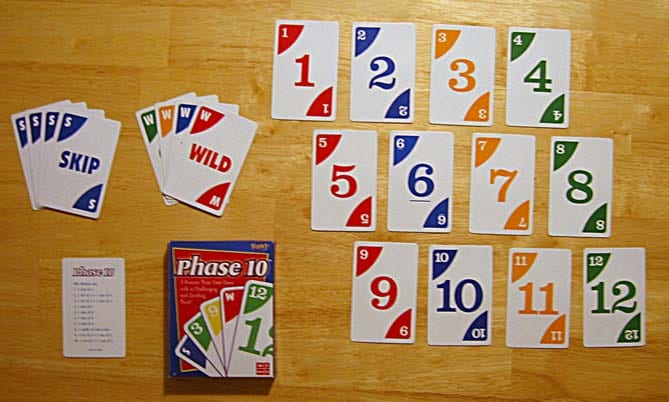
How to Play
Phase 10 is a commercial rummy-style card game for 2 to 6 players in which everyone races through the same ten fixed combinations of sets and runs in order, using a dedicated 108-card pack of numbered, Wild, and Skip cards, with the first player to complete all ten phases and the lowest cumulative score winning.
Phase 10 is a commercial rummy-family card game published by Mattel in which every player races through the same fixed sequence of ten increasingly demanding phases, each one a specific combination of sets and runs such as two sets of three or a run of seven cards. Players use a dedicated 108-card pack of numbered and special cards rather than a standard deck, and on each turn they draw one card and discard one, trying to lay down that round's required phase before going out. A player who completes their current phase in a round advances to the next phase for the following round, while a player who fails simply replays the same phase again; the winner is whoever completes all ten phases first, and the overall standings are decided by the lowest cumulative card-point total among the players who reach phase 10.
Quick Reference
- Deal 10 cards face-down to each of the 2 to 6 players from the 108-card Phase 10 deck.
- Place the remaining cards face-down as the draw pile and flip the top card face-up to start the discard pile.
- Give each player a scorecard listing phases 1 through 10 to track progress and running points.
- Draw one card from either the draw pile or the discard pile.
- Lay down your current phase if your hand now completes it, then optionally hit extra cards onto any laid-down phase.
- Discard one card to end your turn; discarding your last card after completing your phase ends the round immediately.
- Players who did not go out total the point value of every card left in hand: 5 for numbers 1-9, 10 for numbers 10-12, 15 for Skip cards, 25 for Wild cards.
- The player who went out scores zero for that round and advances to the next phase; everyone else repeats their current phase next round.
- The first player to complete phase 10 wins; among players who reach phase 10, the lowest cumulative score is the tiebreaker.
Players
Phase 10 is designed for 2 to 6 players, and works well at any table size within that range since every player plays independently for themselves with no partnerships or teams. A single round, one deal of the hand followed by play until someone goes out, usually takes about 10 to 15 minutes, and a full game running through all ten phases for the fastest player typically takes 60 to 90 minutes depending on table size and how quickly players complete their phases.
Card Deck
- Phase 10 uses its own dedicated 108-card pack rather than a standard 52-card deck: two full sets of cards numbered 1 through 12 in four colors, red, blue, green, and yellow, with two copies of each number in each color (96 numbered cards total), plus 8 Skip cards, 4 Wild cards, and 4 Skip Wild cards depending on the printing (deck composition can vary slightly by edition).
- Wild cards can stand in for any number in any color when building a set or a run, making them the most valuable cards to hold onto until a phase is ready to be laid down.
- Skip cards are action cards: playing one forces a chosen opponent to lose their next turn entirely, and they cannot be used to help complete a phase.
- There is no card ranking or suit hierarchy the way a standard-deck game like high or trump suits would use; every numbered card only matters for the phase combinations it can help build.
Objective
The objective is to be the first player to complete all ten fixed phases, one phase per round in strict numerical order, by laying the exact combination of sets, runs, or colored groups that phase requires down onto the table before running out of cards in your hand. A player who cannot complete the current round's phase must attempt that same phase again in the next round rather than moving on, so consistent play across rounds matters as much as any single big hand.
Setup
- Shuffle the full 108-card Phase 10 deck and deal 10 cards face-down to each player.
- Place the remaining cards face-down in the middle as the draw pile, and turn the top card face-up beside it to start the discard pile.
- Give every player a scorecard (or use a shared score pad) listing phases 1 through 10 so completed phases can be tracked round by round.
- All players begin round one attempting Phase 1; nobody is ahead or behind before the first round starts.
Gameplay
- On your turn, draw one card, either the top card of the face-down draw pile or the top card of the face-up discard pile, then optionally lay down your current phase if your hand now contains everything needed for it.
- Once you have laid down your phase for the round, you may also hit, adding extra matching cards from your hand onto your own completed phase or onto any other player's already-laid phase of the same type, as long as the addition still fits that phase's requirements.
- If a Skip card is drawn or held, playing it targets one opponent, who must discard that Skip card immediately without taking a turn; a Skip card in hand cannot be used toward completing a phase.
- End your turn by discarding one card face-up onto the discard pile; if you have completed your phase and laid off every other card in your hand this way, the round ends immediately.
- Play continues clockwise, with every player taking a turn even after one player has gone out, so the round only truly ends once the going-out player's turn is complete and everyone else's remaining hand cards are scored.
Scoring
- When a round ends, every player who did not go out adds up the point value of every card remaining in their hand: 5 points for each numbered card 1 through 9, 10 points for each numbered card 10 through 12, 15 points for each Skip card, and 25 points for each Wild card.
- The player who went out that round scores zero for the round and advances to the next phase in sequence; every other player stays on their current phase for the following round regardless of how many cards they were holding.
- Scores accumulate across all rounds played, so a full scorecard tracks both each player's current phase number and their running point total simultaneously.
- If two or more players complete phase 10 in the same final round, the tiebreaker is whoever has the lower cumulative point total across the whole game; if that is also equal, the tied players share the win.
Winning
The game ends the moment a player completes phase 10 and goes out in that same round; every other player finishes their turn in that final round so hands can be scored, but no further rounds are dealt. Among the players who reached phase 10, the one with the lowest cumulative point total across the entire game is declared the winner; a player who never caught up to phase 10 cannot win outright regardless of how low their score is, since finishing all ten phases first takes priority over the point total.
Common Variations
- Phase 10 Twist: an official Mattel spin-off deck that adds a Twist card forcing the direction of play to reverse, layered on top of the standard Skip and Wild mechanics.
- Phase 10 Masters Edition: a higher-stakes home variant with a poker-chip-style ante and side-betting layer added around the standard phase sequence.
- House phase order: some groups let each player choose their own next phase from the full list of ten instead of following the fixed numerical order, which speeds up the game for experienced players but changes its balance significantly.
- Team play: an unofficial but common adaptation seats players in partnerships who pool their combined phase progress and scores, turning the usual free-for-all into a 2-vs-2 or 3-vs-3 contest.
Tips and Strategy
- Hold Wild cards until your phase is actually ready. Wilds are worth 25 points if caught in your hand at round's end, so using one too early on a phase you might not finish is a costly risk.
- Track which phases your opponents are stuck on. A player replaying the same phase for several rounds in a row is a clear signal you can safely discard cards that would help that specific combination without feeding their comeback.
- Prioritize going out over hitting once your own phase is down. Laying off extra cards onto other players' phases looks productive, but discarding down to zero cards ends the round in your favor before anyone else can react.
- Watch the discard pile for what opponents are collecting. A player repeatedly passing on cards of one particular color is often building toward a same-color phase like Phase 7 or Phase 8, so holding those colors back can slow them down.
- Don't hoard Skip cards defensively. Playing a Skip early on the opponent closest to completing phase 10 is usually worth more than saving it to protect your own turn later in the round.
Glossary
- Phase: one of the ten fixed combinations of sets, runs, and colored groups that must be completed in order across the ten rounds of a full game.
- Wild card: a card that can substitute for any number in any color when building a set or run; worth 25 points if left in hand when a round ends.
- Skip card: an action card that forces a chosen opponent to lose their next turn; worth 15 points if left in hand when a round ends.
- Hit: adding extra cards from your hand onto your own laid-down phase or another player's laid-down phase after your own phase has already been completed for the round.
- Go out: discarding the last card from your hand after completing your phase, which immediately ends the round for every player.
Tips & Strategy
Hold Wild cards in reserve until your current phase is genuinely one card away from complete, since an unused Wild caught in your hand at round's end costs a heavy 25 points. Pay attention to which phase each opponent is stuck replaying; a player repeating the same phase for multiple rounds is a strong sign you can safely discard cards that would otherwise help them catch up. Once your own phase is laid down, going out by discarding your last card usually beats spending extra turns hitting cards onto other players' phases, since ending the round immediately denies everyone else a chance to complete their own phase that round. Keep an eye on the discard pile for the colors and numbers opponents are passing on, since that often reveals which same-color or same-number phase they are quietly building toward.
Because every player is chasing the exact same ten phases in the exact same order, Phase 10 rewards tracking your opponents' progress almost as much as managing your own hand, since knowing that a rival is stuck replaying a same-color phase tells you precisely which discards are safe to make. The 25-point cost of an unused Wild card creates a constant tension between holding it in reserve for flexibility and the risk of being caught with it if an opponent goes out unexpectedly, so skilled players reassess that trade-off every single turn rather than committing to a plan early. Skip cards function as tempo tools as much as blocking tools: using one on the single opponent closest to phase 10 is almost always a better return than saving it defensively, since slowing down the leader benefits every other player at the table simultaneously.
Trivia & Fun Facts
Phase 10 has sold well over 25 million copies since its 1982 release, making it one of the most commercially successful card games ever published outside the traditional public-domain canon. The game has been adapted into board game, dice game, and electronic handheld formats, plus themed editions tied to popular franchises, all while keeping the same ten-phase structure as the core rule. Unlike most traditional rummy games, Phase 10 fixes every player's target combination in advance and in the same order for everyone, so no player can strategically choose an easier phase to chase, which is part of what distinguishes it from its open-ended rummy ancestors.
-
01Who created Phase 10, and in what year was it first published?Answer Kenneth Johnson created Phase 10, which was first published by Fundex Games in 1982 before Mattel later acquired the game in 2010.
History & Culture
Phase 10 was created by Kenneth Johnson and first published in 1982 by Fundex Games, growing out of the same broad family of contract-style rummy games as Contract Rummy and Liverpool Rummy, which require players to complete a changing combination requirement each round rather than simply melding freely. Mattel acquired the rights to Phase 10 in 2010 and has since expanded it into a wide product line including electronic handheld versions, dice versions, and a dedicated Phase 10 mobile app alongside the original card game. Its ten-phase progression structure, borrowed from the older 'contract' rummy tradition, gave it a distinct identity that helped it become one of the best-selling proprietary card games of the last several decades.
Phase 10 occupies a distinctive place among modern commercial card games as a proprietary rummy variant that became a genuine household staple alongside older public-domain classics, frequently cited next to Uno and Skip-Bo as one of the defining family card games of the late 20th century. Its ten-phase structure popularized the 'contract rummy' style of play for a mass audience that had never encountered its older relatives like Contract Rummy or Liverpool Rummy. The game's continued expansion into apps, dice spin-offs, and themed editions reflects how thoroughly it has been absorbed into everyday family game night culture across North America and beyond.
Variations & House Rules
Phase 10 Twist adds an official Twist action card that reverses the direction of play on top of the standard Skip and Wild cards, giving experienced groups an extra layer of disruption to plan around. Phase 10 Masters Edition layers a poker-chip-style betting structure onto the base rules for players who want stakes attached to their phase progress. Casual house variants sometimes let players pick their own next phase from the full list of ten instead of following the fixed numerical order, which speeds up games among experienced players but changes the game's careful balance between easy early phases and difficult late ones. An unofficial partnership variant seats players in two- or three-person teams that pool their combined phase completions and scores for a team-based version of the race.
Shortening a session by stopping the game after phase 5 or 6 instead of playing all the way to phase 10 works well for a quicker family game night while keeping the core phase-completion tension intact. Groups new to the game often play with all hands visible or with hints allowed on which cards help a given phase, which speeds up learning the ten combinations before switching to standard closed-hand play. Adding a house rule that caps how many times a player can be skipped in a row prevents one unlucky player from being locked out of several consecutive turns in a large 5 or 6 player game.


