
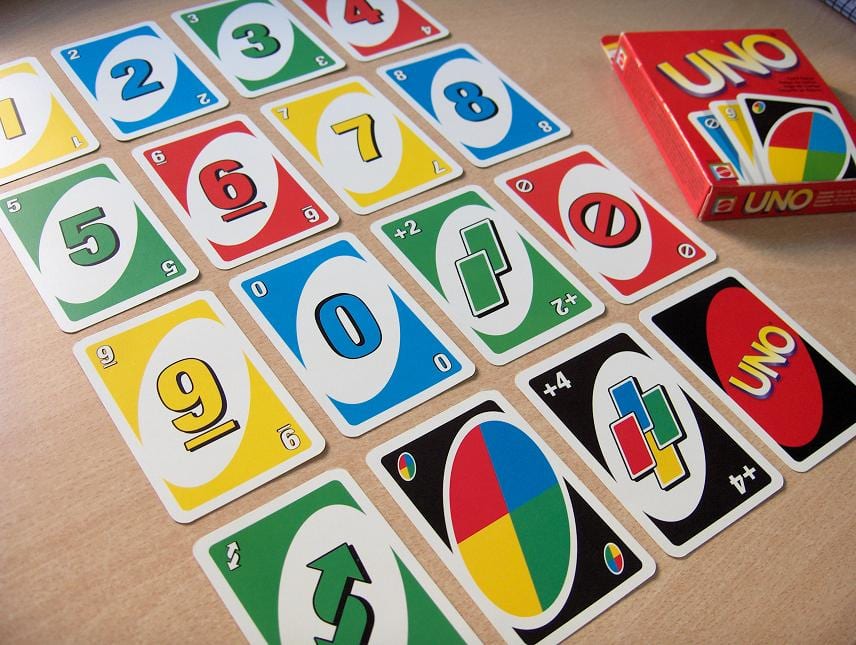
How to Play
Uno is a fast, family-friendly shedding game played with a dedicated 108-card deck of four colors and action cards. Players match by color or number, use Skips, Reverses, and Draw cards to slow opponents down, and race to be the first to empty their hand.
Uno is a shedding-type game for 2 to 10 players, played with its own 108-card deck of four colors (red, yellow, green, blue) instead of a standard pack. On your turn you play one card that matches the color OR the number/symbol of the card on top of the discard pile; special action cards let you skip an opponent, reverse the order of play, or force the next player to draw extra cards, and Wild cards let you change the active color outright. The moment you are down to a single card you must call out 'Uno' or risk a penalty draw. The first player to play their last card wins the round and scores points for every card left in the other players' hands; matches are usually played to a target of 500 points.
Quick Reference
- Deal 7 cards to each player from the 108-card Uno deck.
- Place the rest face-down as the draw pile and flip the top card to start the discard pile.
- If the starter is a Wild Draw Four, reshuffle it back in and flip a new starter card.
- Play a card matching the current color, number, or symbol, or play a Wild at any time.
- Action cards skip, reverse, or force the next player to draw extra cards.
- If you cannot play, draw one card from the draw pile; play it immediately if it fits.
- Say 'Uno' the moment you have one card left, or draw two penalty cards if caught.
- Going out first ends the round; add up opponents' remaining card values and credit them to your match score.
- First player to reach the agreed match target (commonly 500 points) wins the match.
Players
Uno is designed for 2 to 10 players, with 3 to 6 generally regarded as the sweet spot for keeping the discard pile moving briskly. All players compete individually; there are no fixed partnerships in the base rules, although some groups play a team variant for larger tables. Play begins to the dealer's left and moves clockwise unless a Reverse card changes that. A single round typically takes 10 to 15 minutes, while a full match to 500 points can run 45 to 90 minutes depending on player count.
Card Deck
- One 108-card Uno deck: four colors (red, yellow, green, blue), each with a single 0, two each of 1 through 9, and two each of the three colored action cards, Draw Two, Skip, and Reverse. That is 19 number cards plus 6 action cards per color, 25 cards times 4 colors, for 100 colored cards.
- 8 wild cards: four plain Wild cards (choose the new color, no other effect) and four Wild Draw Four cards (choose the new color and force the next player to draw four cards and lose their turn). 100 colored cards plus 8 wilds equals the full 108-card deck.
- There is no rank order between colors: only exact number matches, exact symbol matches, or a shared color connect two cards on the discard pile.
- Card values for end-of-round scoring: number cards score their face value (0 to 9), each Draw Two, Skip, or Reverse scores 20, each plain Wild scores 40, and each Wild Draw Four scores 50.
Objective
Be the first player to play every card in your hand. Once a player goes out, the round ends immediately and every other player counts the point value of the cards remaining in their own hand; that total is added to the winner's running match score. A full match is normally played to a target of 500 cumulative points, and the first player to reach or exceed that total wins the match.
Setup and Deal
- Shuffle the full 108-card deck thoroughly. Each player is dealt 7 cards, one at a time, face-down.
- Place the remaining cards face-down in the center as the draw pile.
- Turn the top card of the draw pile face-up beside it to start the discard pile. If that starter card is a Wild Draw Four, shuffle it back into the deck and flip a new starter, since no color has been declared yet for the first player to match.
- If the starter is a plain Wild, the first player chooses the starting color before playing. If it is a Draw Two, Skip, or Reverse, its effect applies immediately to the first player in turn order.
- The player to the dealer's left plays first (unless the starter card was a Reverse, which flips the direction before anyone has played), and turn order proceeds clockwise from there.
Gameplay
- On your turn, play one card from your hand face-up onto the discard pile that matches the current color, the current number, or the current symbol (a Draw Two must match another Draw Two's symbol or the active color, for example).
- Wild cards may be played at any time regardless of the current color or number; announce the new color immediately after playing one.
- Draw Two: the next player draws two cards from the draw pile and loses their turn entirely; they do not get to play a card first.
- Wild Draw Four: the next player draws four cards and loses their turn. Officially you may only play it when you have no card of the current color in hand; if an opponent suspects otherwise, they may challenge it (see Winning).
- Skip: the next player's turn is skipped entirely and play passes to the player after them.
- Reverse: the direction of play flips (clockwise becomes counter-clockwise or vice versa). In a two-player game, a Reverse instead acts as a Skip, since reversing direction with only one opponent simply gives the same player another turn.
- Unable to play: if you hold no card that matches the current color, number, or symbol, and no Wild, you must draw one card from the draw pile. If that card can be played, you may play it immediately; otherwise your turn ends.
- Calling Uno: the instant you play a card that leaves you with exactly one card left, you must say 'Uno' out loud before your turn ends. If another player catches you before the next player takes their turn, you must draw two penalty cards.
- Draw pile exhausted: if the draw pile runs out, shuffle the discard pile (except its top card) to form a new draw pile and continue play without interruption.
Scoring
- Only the player who goes out first scores in a round; everyone else scores nothing that round.
- Add up the point value of every card left in each opponent's hand (numbers at face value, 20 for each Draw Two, Skip, or Reverse, 40 for each plain Wild, 50 for each Wild Draw Four) and credit the entire total to the round winner's cumulative match score.
- Continue dealing new rounds, with the deal passing to the left each time, until one player's cumulative score reaches or passes the agreed match target, usually 500.
- For a quicker game night, many groups instead play a single round win-only match with no cumulative scoring at all; this drops the scoring step entirely and simply ends the match the moment somebody goes out.
Winning
A round ends the instant a player plays their final card, provided they correctly called 'Uno' the turn before. That player's opponents count the cards left in their hands and add the total to the winner's cumulative score for the match. A Wild Draw Four can be challenged by the player forced to draw: if the accused player is shown to have held a matching-color card and played the Wild Draw Four illegally, they must draw the four cards themselves instead; if the challenge fails, the challenger draws six cards (the original four plus two more) rather than four. The match itself is won by the first player whose cumulative score reaches or exceeds the agreed target, commonly 500 points; if two players would cross the target in the very same round (only possible when playing team variants with shared scoring), the higher of the two cumulative totals wins.
Common Variations
- Stacking (widespread house rule, not official): a Draw Two can be answered with another Draw Two, or a Wild Draw Four with another Wild Draw Four, passing an escalating draw penalty down the line until somebody cannot or will not stack, at which point they draw the accumulated total.
- 7-0 rule: playing a 7 lets you swap hands with any other player of your choice; playing a 0 passes every player's entire hand one seat in the current direction of play.
- Jump-in rule: if you hold a card that is an exact match (same color AND number AND symbol) to the current discard, you may play it out of turn, immediately redirecting play as if it had been played normally.
- No-bluffing Wild Draw Four: a stricter tournament reading of the challenge rule that removes the two-card penalty for a failed challenge, so a losing challenger only draws the original four.
- Team Uno: partners sit alternately around the table and combine their scores; a player may deliberately feed a partner a useful card via the 7-0 rule where that variant is also in use.
Tips and Strategy
- Hold onto Wild cards for emergencies. A Wild lets you play regardless of your other cards, so save at least one for a moment when you are stuck holding only mismatched colors and numbers.
- Empty your most awkward color first. If your hand is lopsided toward one color, unload that color early while the discard pile still favors it, rather than holding those cards and hoping for a later match.
- Track the visible color trend. Watching which colors and numbers opponents play and draw helps you predict how likely your own cards are to stay playable, and when to switch the active color with a Wild.
- Time your Draw Two and Draw Four cards for maximum damage. Playing them against a player who just picked up a card, and is therefore likely low on immediate options, does more to slow them down than playing them early.
- Watch hand sizes, not just your own cards. An opponent sitting on one or two cards is your priority target for a Draw Two, Draw Four, or Skip, since delaying them even one turn can change the outcome of the round.
Glossary
- Draw pile: the face-down stack of cards players draw from when they cannot play or choose not to.
- Discard pile: the face-up pile of played cards; only its top card matters for matching.
- Wild: a card playable on anything, letting its player declare the new active color.
- Going out: playing your final card and ending the round.
- Calling Uno: the mandatory announcement made when a player is left with exactly one card.
- Stacking: an unofficial house rule allowing Draw Two or Wild Draw Four cards to be chained onto each other.
- Challenge: contesting whether a Wild Draw Four was played legally, with a penalty for whichever side is wrong.
Tips & Strategy
Save at least one Wild card for moments when your hand has no other legal play, unload your most lopsided color early while the discard pile still matches it, and time Draw Two or Wild Draw Four cards against opponents who are already low on cards or who just drew, since that is when the extra cards hurt most.
Because Uno's matching rule (color, number, or symbol) gives most hands several legal plays each turn, the real decisions center on hand shape and timing rather than raw card ranking: which color to keep flexible, when to burn a Wild instead of hoarding it, and which opponent to target with a Draw Two, Skip, or Wild Draw Four based on their visible hand size. Skilled players also read the discard pile's recent color history to judge how soon a Wild-declared color is likely to run dry again.
Trivia & Fun Facts
Mattel has released hundreds of licensed and themed Uno decks over the decades, from movie and TV tie-ins to a wordless 'Uno Minimalista' redesign, while keeping the underlying 108-card structure unchanged. The official rule that a failed Wild Draw Four challenge costs the challenger six cards rather than four is one of the most commonly misapplied rules in home play, since many casual groups only ever use the simpler four-card penalty.
-
01In official Uno rules, how many cards does a player draw if they challenge a Wild Draw Four and lose the challenge?Answer Six cards, the original four-card penalty plus two additional cards for the failed challenge.
History & Culture
Uno was created in 1971 by Merle Robbins, an Ohio barber, who developed it as a family card game and printed the first copies himself before selling the rights to a local funeral director for a small share of future royalties. The International Games company acquired it in 1992, and Mattel later bought that company, turning Uno into one of the best-selling card games in the world. Its wild-card-and-color-matching design descends from the much older shedding-game family that also produced Crazy Eights, though Uno's dedicated deck and official penalty rules give it a distinct identity as a stand-alone commercial game rather than a variant of any single traditional ancestor.
Uno is one of the most recognizable card games in the world, translated and sold in dozens of countries and frequently a child's first introduction to matching-and-shedding card play. Its catchphrase, shouting 'Uno' at one card remaining, has become a piece of shared pop culture well beyond the tabletop, referenced constantly in television, memes, and casual conversation as shorthand for a dramatic last-second turn of events.
Variations & House Rules
The widely house-ruled 7-0 variant adds hand-swapping (on a 7) and full-table hand rotation (on a 0) to speed up dramatic swings. Stacking lets Draw Two and Wild Draw Four cards chain onto each other for an escalating penalty, though Mattel's official rules explicitly disallow it. The jump-in rule allows an exact color-number-symbol match to be played out of turn, and team variants pair up alternating seats to combine scores across a match.
For a faster game night, play single rounds with no cumulative scoring and simply reset for a new round after each win. For younger players, drop the Wild Draw Four challenge rule so nobody has to memorize the six-card penalty, and consider allowing the 7-0 house rule for extra table energy without changing the core matching logic.


