
How to Play
An inductive-logic card game where one player invents a secret rule and the others must deduce it through experiments, rewarding careful observation over luck. A favourite of philosophy-of-science classrooms.
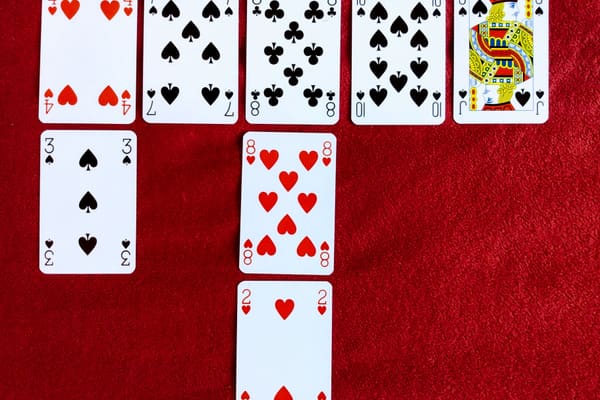
Eleusis is an inductive-logic card game invented by Robert Abbott in 1956, famously updated as New Eleusis in 1977. One player; the Dealer, sometimes called God or Nature; invents a secret rule that determines which cards may legally be played in sequence. The other players must deduce the rule by experimenting, watching which cards are accepted and which are rejected. It is less a card game than a card-based simulation of the scientific method, and has been used in philosophy-of-science classrooms worldwide.
Quick Reference
- 4-8 players, 2 decks shuffled (104 cards), 14 cards each except the Dealer.
- Dealer writes a secret rule and plays one starter card face-up.
- Player to Dealer's left goes first.
- Play 1-4 cards as an experiment; Dealer judges each.
- Correct cards join the main line; rejected cards go to a sideline.
- Wrong plays cost 2x cards drawn as penalty (min 2, max 8).
- Declare Prophet once 20+ cards are in the main line, if confident.
- Each player scores highest-hand-size minus their own hand size.
- Empty hand = +4 bonus; Prophet earns extra points while judging.
- Dealer scores the top player score, capped.
Players
Eleusis is for 4 to 8 players. One of them serves as the Dealer (God), and the remaining players are the scientists trying to deduce the rule. With 5 to 6 players the pace and scoring feel best; fewer than 4 leaves too few hypotheses in play.
Card Deck
Use two standard 52-card decks shuffled together for 104 cards total. No Jokers. Card rank, suit, colour, and parity may all matter in the Dealer's secret rule. A pen and paper for tracking plays and penalties are essential.
Objective
Players try to deduce the Dealer's secret rule and play cards that satisfy it, earning points for successful plays and for emptying their hand. The Dealer tries to invent a rule that is neither too easy nor too hard; the best rules are discoverable through careful experimentation but are not obvious from the first few cards.
Setup and Deal
- Choose a Dealer. The Dealer privately writes down the secret rule on a slip of paper, folded and set aside for later verification.
- A good rule mentions only the most recently played card(s) on the main line and uses attributes any player can observe: suit, colour, rank, parity, divisibility. Example: 'the next card must be higher than the previous card unless the previous card is a face card, in which case any numeric card is legal.'
- Shuffle both decks together. Deal 14 cards face down to each non-Dealer player. Deal no cards to the Dealer.
- The Dealer plays one starter card face-up to begin the main line of the layout. The starter card is always a legal play by definition.
- The player to the Dealer's left plays first.
Gameplay
- On your turn, you may play 1 to 4 cards in sequence as an experiment. Each card is judged in order by the Dealer.
- Correct play: If a card satisfies the secret rule, it joins the main line to the right of the previous card. If you played multiple cards and all of them are correct, all join the main line.
- Incorrect play: If a card violates the rule, the Dealer announces 'wrong' and sidelines that card below the preceding main-line card, along with any remaining experimental cards from that same turn. You then draw twice as many penalty cards from the stock as the number of cards you attempted to play (minimum 2, maximum 8).
- No-play declaration: If you believe no card in your hand could possibly be legal, you may declare 'no play' and reveal your hand. If the Dealer confirms no card is legal, you discard your whole hand and the Dealer redeals you four fewer cards than you had. If any card in your hand was legal, the Dealer points to one and you take 5 penalty cards.
- Prophet (New Eleusis only): Once the main line has 20 or more cards, a player may declare themselves the Prophet by placing a token. The Prophet then judges plays instead of the Dealer for the remainder of the round. If the Prophet judges a play wrongly, they are 'deposed,' take 5 penalty cards, and forfeit the Prophet role; a later player may try.
- Round end: A round ends when a non-Prophet player empties their hand, when the Dealer's deck is exhausted, or when all players but the Prophet have been eliminated.
Scoring
- At round end, count the cards in each player's hand. The player holding the most cards is noted; call that count H.
- Each non-Prophet player scores H minus their own hand size. A player who emptied their hand scores H + 4 bonus points.
- Prophet scoring: The Prophet scores an extra point per card added to the main line and per card sidelined while they were Prophet. This rewards a correct declaration of the Prophet role.
- Dealer scoring: The Dealer scores the highest player score from that round, but capped so they cannot out-score a Prophet by too much. This forces the Dealer to make the rule genuinely solvable.
- In a match, play several rounds rotating the Dealer and sum the scores.
Winning
In a single-round game, the player with the highest score wins. In a multi-round match, the player with the highest total across all rounds wins. The Prophet role, an empty hand, and a deduced rule are the three big-ticket ways to build a lead.
Common Variations
- Original Eleusis (1956): No Prophet role, simpler penalty scheme, and a Dealer who mostly just confirms cards. The 1977 New Eleusis redesign is the standard today.
- Eleusis Express (2006): Compact 12-card hands, no Prophet role, players openly guess the rule after the round, and the first player to guess wins the round. Designed for classroom use.
- Cooperative Eleusis: All non-Dealer players share hypotheses aloud and work together to deduce the rule within a fixed number of turns.
- Number-line-only rules: For beginner rounds, restrict the Dealer's rule to only use the numeric value of the most recent card. Keeps the search space shallow.
Tips and Strategy
- Treat each play as an experiment. Do not play a card 'just to get rid of it'; choose a card that distinguishes between two live hypotheses.
- Watch rejected cards as carefully as accepted ones. A single rejection often rules out several candidate rules at once.
- After every new card joins the main line, jot down the (previous card, played card) pair in a table. Patterns emerge quickly on paper.
- Avoid declaring Prophet too early. If you are wrong, the 5-card penalty and loss of role will crater your score. Wait until you can explain every single card on both lines.
- As Dealer, never write a rule that references cards more than one step back. Deep-history rules frustrate players and usually earn a Dealer a poor score because no one can deduce them.
- Playing 3 or 4 cards at once is high-risk, high-reward: you confirm more of your hypothesis at the cost of a bigger penalty if you are wrong.
Glossary
- Dealer (God, Nature): The player who invents and enforces the secret rule.
- Main line: The horizontal row of correctly played cards, read left to right.
- Sideline: Cards placed below a main-line card to indicate they were rejected after that state.
- Experiment: A play of 1 to 4 cards on a single turn to test a hypothesis.
- Prophet: A player who takes over judging duty once enough evidence is on the table; loses the role if they err.
- No-play declaration: A claim that none of your cards can legally be played; verified by the Dealer.
- Penalty cards: Extra cards drawn from the stock after an incorrect play.
- Rule: The secret predicate the Dealer wrote down that determines legal plays.
Tips & Strategy
Every play is an experiment. Choose cards that distinguish between two live hypotheses, and keep a written record of accepted and rejected pairs; patterns emerge quickly on paper.
The trick is picking cards that bisect your remaining hypothesis space. If rule A and rule B both explain the main line so far, play a card that would be legal under A but illegal under B; the Dealer's answer halves your candidate rules.
Trivia & Fun Facts
The game is named after the Eleusinian Mysteries of ancient Greece, where initiates were sworn to secrecy about the rites. Universities from MIT to Oxford have used Eleusis to teach the scientific method, hypothesis generation, and Popperian falsificationism.
-
01What role may a player assume in New Eleusis if they believe they have deduced the Dealer's secret rule, and what happens if they judge a play incorrectly?Answer The Prophet; if they judge incorrectly they are deposed, receive 5 penalty cards, and forfeit the role.
History & Culture
Eleusis was invented in 1956 by American game designer Robert Abbott. Martin Gardner popularised it in his Scientific American column. Abbott redesigned it in 1977 as New Eleusis, adding the Prophet role and a refined scoring system that made the game fairer and more widely played.
Eleusis sits at the crossroads of recreational gaming and science education. Its central mechanic is recognisably the hypothesis-testing process, and it has been cited in philosophy-of-science literature as a living simulation of inductive reasoning.
Variations & House Rules
New Eleusis (1977) is the standard form with the Prophet role. Eleusis Express (2006) is a faster classroom-friendly variant. Cooperative Eleusis has all players deduce the rule together. Number-line rules keep the hypothesis space small for beginners.
For novices, agree in advance that rules may only reference the most recent card. For experts, allow rules referencing the previous two cards or simple arithmetic (e.g., sums divisible by 3).


