
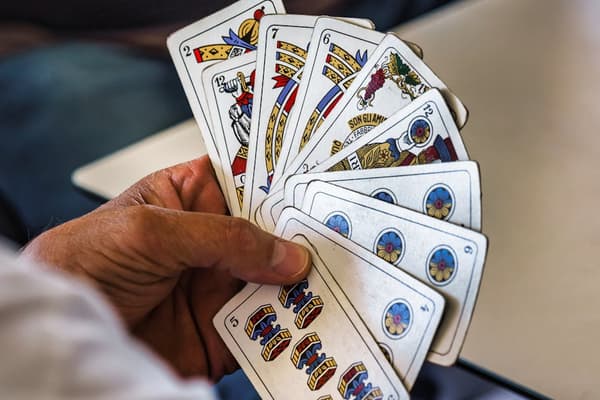
How to Play
Seven-Card Stud is the classic American poker variant where each player receives 7 of their own cards (2 down, 4 up, 1 down) across 5 betting rounds; the best 5-card poker hand at showdown wins. Card memory and live-out tracking are core skills.
Seven-Card Stud was the most popular form of poker in North America from the 1930s through the 1990s, before Texas Hold'em came to dominate. Unlike Hold'em there are no community cards; every player is dealt seven cards of their own over the course of the deal: two face down, then four face up (one at a time with betting rounds between), and finally one more face down. Players form the best five-card poker hand from their seven cards at showdown. Stud rewards card memory (opponents' up-cards are public information), patient starting-hand selection, and precise pot-odds calculation against live outs. A full deal involves an ante from every player, a forced bring-in from the lowest door card on third street, and five betting rounds (one per street from third through seventh). Seven-Card Stud remains a fixture of competitive poker, particularly in the H.O.R.S.E. mixed-game tournament format.
Quick Reference
- 2-8 players with a 52-card deck.
- All players ante; lowest door card posts the bring-in.
- Deal: 2 down + 1 up = third street.
- Third-Sixth streets: one more up-card each; betting rounds after each.
- Seventh street: one more down-card; final betting.
- Player with highest up-combo acts first on fourth street onward.
- Standard poker hand rankings (Royal Flush highest, High Card lowest).
- Best 5-card hand at showdown takes the pot.
- Ties split the pot evenly.
Players
2 to 8 players. With a full 8-player table, the 52-card deck is nearly exhausted (8 × 7 = 56 cards needed), so in the rare case it runs out the dealer exposes a single community card on seventh street for all remaining players to share. Dealer button rotates clockwise, but the dealer is notional; all players ante and play equivalently. Each player plays for themselves.
Card Deck
One standard 52-card deck, no jokers, no wild cards in standard play. Card ranks, high to low: A, K, Q, J, 10, 9, 8, 7, 6, 5, 4, 3, 2. Aces play high or low for straights (A-2-3-4-5 is the lowest straight, the 'wheel'). Suits have no inherent rank but determine flushes; a tie in straight-rank is broken by suit in some European home games (spades highest) but not in American casino play. Hand rankings high to low: Royal Flush > Straight Flush > Four of a Kind > Full House > Flush > Straight > Three of a Kind > Two Pair > One Pair > High Card.
Objective
Win chips or cash by (1) making every opponent fold during one of the five betting rounds, or (2) showing down the best 5-card poker hand from your 7 individual cards. A full session is played as a cash game (chips represent money) or tournament (chips are scoring tokens and elimination-based).
Setup and Deal
- Each player posts an ante to the pot (typically 10% of the small bet size).
- The dealer shuffles the 52-card deck and deals each player 2 cards face down (the hole cards) followed by 1 card face up (the door card, or third street).
- Bring-in determination: The player with the lowest door card (by rank, with ties broken by suit order: clubs, diamonds, hearts, spades) is required to post the bring-in bet, a forced partial bet smaller than the minimum bet.
- Betting limits: Stud is traditionally a limit game with fixed small and big bet sizes. Small-bet rounds apply to third and fourth streets; big-bet rounds (double the small bet) apply to fifth, sixth, and seventh streets.
- The bring-in player acts first on third street; action proceeds clockwise from there. Subsequent streets' action starts with the player showing the highest face-up combination.
Gameplay
- Third Street (the deal): 2 down + 1 up (the door card). Bring-in player acts first, must bet at least the bring-in amount. Players in clockwise order may fold, call, or raise. If the bring-in player wishes to bet more than the forced amount, they may 'complete' the bet up to the small-bet size.
- Fourth Street: One more card is dealt face up to each remaining player. Action begins with the player showing the highest-ranking 2-card up-combination. Player may check or bet at the small-bet size. If any player has an open pair, all bets this round may double to the big-bet size.
- Fifth Street: A third up-card is dealt. Betting rounds now use the big-bet size (double the small bet). Action begins with the highest up-combination.
- Sixth Street: A fourth up-card is dealt (total: 2 down + 4 up = 6 cards per player). Big-bet betting continues; highest up-combination acts first.
- Seventh Street (the River): The final card is dealt face down (total 3 down + 4 up = 7 cards per player). Final big-bet betting round. Highest up-combination acts first.
- Showdown: If 2 or more players remain after the river bet, they reveal their hole cards; the best 5-card poker hand wins the pot. If only one player remains (all others folded), they win the pot without showing.
- Raise cap: Most limit Stud structures cap raises at 3 or 4 per betting round (one bet + three raises).
- Running out of cards: With 8 players at showdown you may need 56 cards; if the deck runs out, the dealer exposes a single community card face up on seventh street that all remaining players share as their seventh card.
Scoring
- Hand rankings (high to low): Royal Flush > Straight Flush > Four of a Kind > Full House > Flush > Straight > Three of a Kind > Two Pair > One Pair > High Card.
- Pot contributions: Ante + bring-in + called bets each street.
- Winning the pot: The best 5-card hand at showdown, or the last player standing after a fold-out round.
- Tie (split pot): If two or more players have identical 5-card hands, the pot is split evenly among them.
- Cash-game scoring: Chips represent money; winnings and losses are tracked per session.
- Tournament scoring: Each buy-in gives a fixed chip stack; players eliminated when chipless; payouts distributed by final-table finish.
Winning
A hand is won by whoever takes the pot via showdown (best 5-card hand) or by being the last player standing after all others fold. A session (cash game) ends on whatever schedule players agree. A tournament ends when one player holds all the chips; payouts distribute to a percentage of finishers based on the structure.
Common Variations
- Seven-Card Stud Hi-Lo (Eight or Better): The pot is split between the best high hand and the best qualifying low hand (an 8-low or better, meaning 5 unpaired cards each 8 or lower with Ace counting low). The same 7 cards can be used for both high and low separately.
- Razz: The lowball variant where the lowest 5-card hand wins (see separate Razz entry). No flushes or straights affect the low; A-2-3-4-5 is the best hand.
- Mississippi Stud: Two cards dealt together on sixth/seventh street; removes one betting round.
- Stud Eight or Better with Declaration: Players must declare (before showdown) whether they are going for high, low, or both; adds a bluffing dimension.
- London Lowball (A-5 Stud): A lowball variant where straights and flushes do not count against the low; wheel A-2-3-4-5 is always best.
- No-Limit Stud: Rare modern variant where bets are not capped; creates very different strategic dynamics.
- Chicago: Split-pot variant where the high spade in the hole also wins half the pot.
Tips and Strategy
- Starting hand selection is everything. Fold most third-street hands: only play if you have (1) a hidden pair or better, (2) three cards to a strong draw (three of a suit, three cards of a straight), or (3) a pair with a high kicker. Weak third-street hands cost money over time.
- Memorise every up-card that folds. The key Stud skill is tracking which cards are dead (in folded hands) and which are live (still in opponents' hands or the deck). Drawing to a flush when 3 of your suit are dead gives you only 6 outs instead of 9; the odds change enormously.
- Position is fluid: act on what opponents have shown. Unlike Hold'em, the player with the best visible hand acts first each street. Use this to gauge opponents' strength; a player bet by someone showing a pair of Aces is legitimately strong.
- Pairs are more powerful than in Hold'em. Three-of-a-kind is the typical winning hand in Stud; hands that start with a pair have a real shot at trips by seventh street.
- The door card tells a story. If your opponent's door card is an Ace and they bet aggressively, they likely have Aces; if it is a low card and they called, they probably have a hidden pair.
- Fold on sixth street if you cannot beat your opponent's visible cards. By sixth street the visible 4 cards reveal most of an opponent's hand; if their visible cards already beat your best possible made hand, fold regardless of how much is in the pot.
Glossary
- Hole cards: The two initial face-down cards.
- Door card: The first face-up card (third street).
- Street: One betting round; named after the total number of cards dealt (third street = 3 cards, seventh street = 7 cards).
- Bring-in: The forced partial bet posted by the player with the lowest door card on third street.
- Ante: A small forced contribution to the pot from every player before dealing.
- Up-card: A face-up card visible to all players.
- Down-card: A face-down card visible only to its holder.
- Live out: A card that could improve your hand and is not visible in any opponent's up-cards or the discarded folded hands.
- Dead card: A card that could have improved your hand but is already shown in a folded or opponent's visible hand; effectively removed from your draw odds.
- Showdown: The final stage where remaining players reveal their hole cards to determine the winner.
- Small bet / big bet: The two fixed bet sizes in limit Stud; small bet applies on third and fourth streets, big bet on fifth, sixth, and seventh streets.
- H.O.R.S.E.: The mixed-game rotation (Hold'em, Omaha Hi-Lo, Razz, Seven-Card Stud, Stud Hi-Lo Eight-or-Better) in which Stud is central.
Tips & Strategy
Track every folded and visible up-card to know your live outs; drawing to a flush with 3 of your suit already dead drops your outs from 9 to 6. Fold most third-street hands; only play hidden pairs or better, three-card draws to strong hands, or high-pair hands.
Expert Stud play blends starting-hand discipline with precise pot-odds calculation against live outs. The core analytical edge is tracking every visible card (including folded hands) to know exactly which of your drawing outs remain in play. Stud's asymmetry (visible vs. hidden cards) makes it a richer game-theoretic environment than Hold'em; computer solvers have significantly less solved play in Stud than in Hold'em, and human experts retain more edge against modern AI.
Trivia & Fun Facts
Stud is the central 'S' in the H.O.R.S.E. mixed-game rotation, considered by professional poker players the truest test of all-round card skill; world-class Hold'em players routinely lose at Stud unless they specifically practice it. Because 8 players × 7 cards = 56 cards but the deck only has 52, a full Stud table occasionally requires a community card on seventh street.
-
01Which player must post the bring-in bet on third street in Seven-Card Stud?Answer The player with the lowest door card (the face-up card), with ties broken by suit order (clubs lowest, then diamonds, hearts, spades highest).
-
02How many total cards does each player receive in a full hand of Seven-Card Stud?Answer Seven cards: 2 face down (hole cards), 4 face up (one per street from third to sixth), and 1 more face down (seventh street / the river).
History & Culture
Seven-Card Stud is a 20th-century evolution of earlier five-card stud poker, first documented in the 1930s and becoming the dominant American poker variant from the 1940s through the 1990s. It was the championship game of the World Series of Poker Main Event before Texas Hold'em replaced it in 1971. Classic Las Vegas and Atlantic City poker rooms built their reputations on Stud; the game's prominence waned in the 2000s but it remains a core discipline of mixed-game tournament poker.
Seven-Card Stud was the archetypal American poker variant for most of the 20th century, central to the mythos of classic Vegas card rooms, the characters of Texas Road Gambler lore, and Hollywood depictions of poker from The Cincinnati Kid (1965) to Rounders (1998). It remains the most technically demanding of the major poker variants and is treated by World Series mixed-game tournaments as the gold-standard test of all-around poker mastery.
Variations & House Rules
Seven-Card Stud Hi-Lo (Eight or Better) splits the pot between best high and best qualifying low. Razz inverts the rankings so low wins. Mississippi Stud condenses to 4 betting rounds. London Lowball ignores straights and flushes for low purposes. No-Limit Stud is rare but modern. Chicago adds a side-pot for high spade in the hole.
For home games, try Seven-Card Stud Hi-Lo for more action per deal. Consider adding a 'high spade in the hole' Chicago side pot to amplify drama. Wild-card home variants (deuces wild, one-eyed Jacks wild) dramatically change hand values and are popular in casual games but not tournament play.


