
How to Play
Eight Off is a one-player patience game closely related to FreeCell: the full 52-card deck deals openly across 8 tableau columns and 8 single-card free cells, and columns build downward by matching suit. Only Kings may fill an empty column, a restriction that offsets the extra free cells and gives the game its own distinct difficulty curve.
Eight Off is a one-player patience game and a direct sibling of FreeCell, using the same open, fully visible deal but doubling the number of free cells to eight while restricting empty tableau columns to Kings only. The extra storage from having eight free cells makes many positions easier to unblock than in FreeCell, even though the Kings-only rule closes off the single most powerful maneuver FreeCell offers, filling an empty column with any card. Cards build down the tableau in the same suit rather than by alternating colour, giving the game a distinct rhythm from most other open patience games. A full deal takes 10 to 20 minutes to play out and rewards the same forward planning that makes FreeCell popular, just applied to a different set of constraints.
Quick Reference
- Deal 48 cards face-up into 8 tableau columns of 6 cards each.
- Deal the remaining 4 cards into 4 of the 8 free cells, leaving the other 4 free cells and all 4 foundations empty.
- Move the bottom card of any column onto another column whose bottom card is one rank higher and the SAME suit.
- Or move any available card to an empty free cell (one card per cell) or to a foundation (next rank up in its suit).
- Fill an empty column only with a King, alone or leading a same-suit descending run.
- Win = all four foundations complete from Ace to King.
- A stuck position with any card not yet on a foundation is a loss; there is no partial score, only win or loss.
Players
1 player. Eight Off, like FreeCell, is a solitary open-information patience game with no multiplayer form; every card is dealt face-up from the very first move, so there is no hidden information to manage, only sequencing and planning.
Card Deck
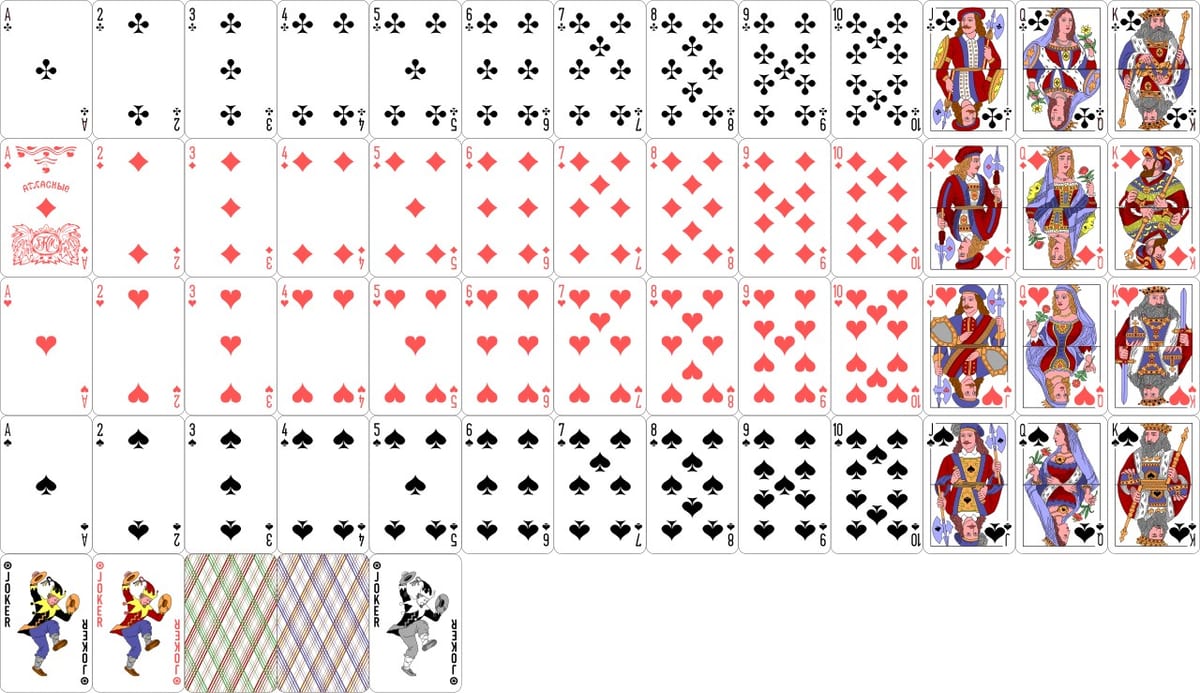
One standard 52-card deck, no jokers. All four suits, clubs, diamonds, hearts, and spades, are used, and within each suit cards rank from Ace, low, for starting a foundation, up through King, high, for example through in clubs. Because the tableau builds by matching suit rather than by colour, the exact suit of every card matters far more here than in FreeCell, where only colour needs tracking.
Objective
Move all 52 cards onto the four foundations, each built upward in a single suit from Ace to King: →, →, →, →. The deal is won only when every card sits on its foundation; any position with cards still in the tableau or free cells when no further moves are available is a loss.
Setup and Deal
- Shuffle the 52-card deck thoroughly.
- Deal 48 cards face-up into 8 tableau columns of 6 cards each, overlapping the cards downward so every card in every column is visible.
- Deal the remaining 4 cards into 4 of the 8 free cells, one card per cell; the other 4 free cells start empty.
- Leave 4 foundation slots empty, one per suit; the first card played to each must be its Ace.
Gameplay
- Available cards: the bottom-most card of each of the 8 tableau columns is available to move, as is the single card sitting in any occupied free cell.
- Tableau building (down, same suit): move the bottom card of any column onto another column whose bottom card is exactly one rank higher and of the SAME suit. Example: a may be placed only on an , never on an , , or .
- Free cell storage: move any available card into an empty free cell. Each of the 8 free cells holds exactly one card at a time, and a card parked in a free cell remains available for later use.
- Foundation play: an available card may move to a foundation once it is the next rank up in its own suit, starting with the Ace and continuing 2, 3, and onward up to King. Once placed, a card is normally locked on its foundation.
- Empty columns (Kings only): unlike FreeCell, an empty tableau column may be filled only by a King, either on its own or leading a same-suit descending sequence. No other rank may start a new column.
- Sequence moves: most implementations let a same-suit descending run move as a single action, provided enough empty free cells exist to have moved the cards one at a time; the usual formula is 1 plus the number of empty free cells. Because only a King-topped run can enter an empty column, empty columns do not multiply this capacity the way they do in FreeCell.
- Game end: the deal ends in a win once every card reaches a foundation, or in a loss once no legal move remains with at least one card still off a foundation.
Winning
- Win condition: all four foundations run complete from Ace to King in their suit, leaving the tableau and every free cell empty.
- Loss condition: a stuck position where no card can move to a foundation, a free cell, or a Kings-only empty column, while at least one card remains off a foundation.
- No score or tie-breakers: Eight Off is win-or-loss, exactly like FreeCell; move count and completion time are tracked by most digital versions purely as personal bests.
Common Variations
- FreeCell: the direct cousin; only 4 free cells but any card, not just a King, may fill an empty column, and the tableau builds by alternating colour instead of matching suit.
- Baker's Game: no free cells at all, same-suit tableau building like Eight Off, but any card may fill an empty column.
- Seahaven Towers: a smaller 10-column, 5-card tableau with only 2 free cells; also restricts empty columns to Kings, making it one of the hardest of the family.
- Relaxed Eight Off: a common house rule that allows any card, not only a King, to fill an empty column, bringing the difficulty closer to standard FreeCell while keeping the extra free cells.
- Uneven deal: some digital collections instead deal the full 52 cards straight into the 8 columns (four columns of 7, four of 6), leaving all 8 free cells empty at the start; the 48-plus-4 deal described above is the more common form.
Tips and Strategy
- Treat the 8 free cells as a large but temporary workspace, not a dumping ground; because only Kings can open a new column, a free cell holding a low card can sit there uselessly for a long time if you are not careful.
- Hunt for Kings early. Since only a King can start a new column, locating and freeing your four Kings as soon as possible determines how many extra columns you can eventually open.
- Build same-suit runs deliberately. A long same-suit sequence buried under the wrong card is harder to recover than in FreeCell, since you cannot break colour to make an emergency move; plan the suit order of each column before committing cards to it.
- Do not empty free cells onto the tableau just because you can. An open free cell is a resource; only use one when it clears a specific blocking card you need for a planned sequence.
- Send Aces and low cards to the foundations as soon as they are safely playable, but hold back cards that a same-suit tableau run will still need to receive later placements.
Glossary
- Tableau: the 8-column spread of face-up cards dealt at the start of the game.
- Free cell: one of 8 single-card reserve slots that can each hold exactly one card at a time.
- Foundation: one of the 4 suit piles built upward from Ace to King; filling all four wins the game.
- Available card: the bottom card of a tableau column, or the card sitting in an occupied free cell; only these may be moved.
- Same-suit building: the tableau rule requiring a descending sequence to stay within one suit, rather than alternating colour as in FreeCell.
- Kings-only empty column: the rule restricting any newly emptied tableau column to accept only a King, or a King-led sequence, as its first card.
Tips & Strategy
Hunt for your four Kings early since they are the only cards that can open a new column, and treat the 8 free cells as a planning workspace rather than a place to abandon awkward cards; because tableau runs build by matching suit, plan a column's intended suit before committing cards to it.
Because only a King can open a new tableau column, the effective value of digging out a King rises the moment you spot one buried in a column, even if freeing it costs two or three free cells in the process; those temporarily filled cells are a fair trade for the extra column gained. Weigh every same-suit run you start against the specific cards you still expect to need from the free cells, since a column built the wrong way round can trap useful cards behind ones you would rather have played to a foundation first.
Trivia & Fun Facts
Eight Off doubles FreeCell's free cell count from 4 to 8, yet many solitaire players find it no easier overall, because the same rule that grants all that extra storage, restricting empty columns to Kings, closes off the single move that makes FreeCell's endgame so flexible.
-
01How many free cells does Eight Off give the player, and how does that compare with FreeCell?Answer Eight Off provides 8 free cells, twice as many as the 4 free cells in standard FreeCell, though its Kings-only rule for empty columns offsets much of that extra flexibility.
History & Culture
Eight Off is generally credited to card game authority John Scarne, who described a same-suit, multiple-free-cell patience of this kind in his mid-20th-century writing on card games, around the same era that this open-tableau, free-cell family of patience games, later including Paul Alfille's 1978 FreeCell, took shape. Eight Off, FreeCell, and Baker's Game are commonly grouped together as siblings that share the same core mechanic of a fully visible tableau paired with single-card reserve cells.
As one of the best-known members of the FreeCell family of patience games, Eight Off is a fixture of major solitaire software collections such as Pretty Good Solitaire and has helped keep the same-suit, open-tableau style of patience alive alongside FreeCell's more famous alternating-colour version.
Variations & House Rules
FreeCell drops the Kings-only restriction and lets any card fill an empty column, while trading Eight Off's 8 free cells for just 4 and swapping same-suit tableau building for alternating colour. Baker's Game keeps the same-suit building and open columns but removes free cells entirely. Seahaven Towers shrinks the tableau to 10 columns of 5 and pairs its own Kings-only rule with only 2 free cells.
Relax the Kings-only rule to let any card fill an empty column for a gentler introduction to the same-suit tableau, or reduce the free cells from 8 to 6 for extra challenge once the standard game feels routine. Beginners can also deal the alternative uneven layout (four columns of 7, four of 6, all free cells empty) if their software offers it, since starting with cleared free cells can make the opening moves easier to read.


