
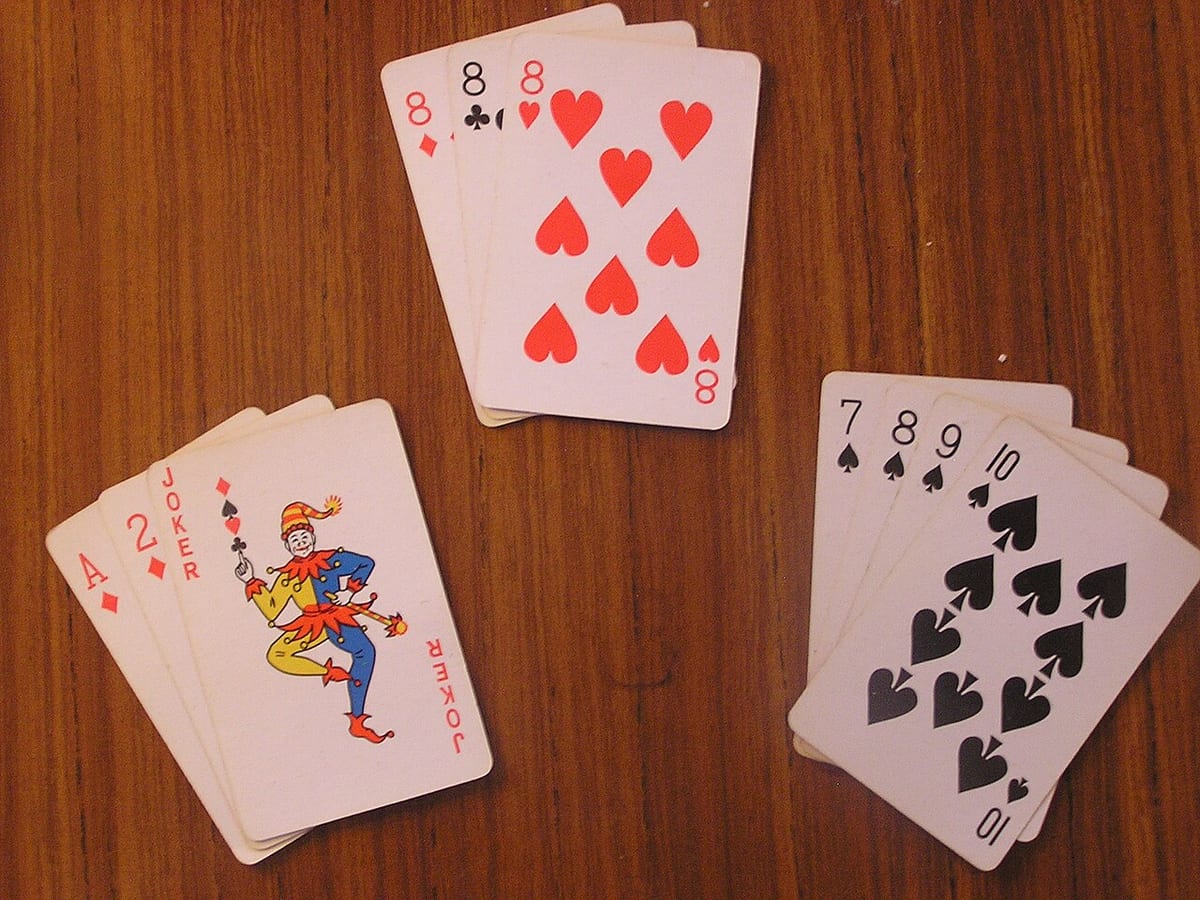
How to Play
Continental Rummy is a 3 to 8 player Rummy-family game from the 1930s social-club era, played with 2 standard decks plus 4 Jokers (108 cards). Players may only meld groups of the same rank, never runs, and nothing may be laid down until a player's entire hand is ready to go out in one turn. The lowest cumulative penalty score across a series of deals, one per player, wins the match.
Continental Rummy is a group-melding member of the Rummy family built for larger tables, popular in Europe and across the United States during the 1930s social-club card craze that also produced games like Canasta and Contract Rummy. Between 3 and 8 players each receive a hand dealt from a shuffled pack of two standard 52-card decks plus 4 Jokers, 108 cards total. Unlike ordinary Rummy, only groups (3 or more cards of the same rank) count as valid melds; runs of consecutive cards are never allowed, no matter the suit. The game's signature restriction is that no player may lay a single card face up on the table until they can arrange their ENTIRE hand into complete groups and discard their final card in that same turn, so a hand can look hopeless right up until the instant someone goes out. Jokers are wild and can stand in for any rank inside a group. When a player goes out, every other player is charged penalty points for the cards still sitting in their hand, and a full match is played as a series of deals, one for every player at the table, with the lowest cumulative score after the series declared the winner.
Quick Reference
- 3 to 8 players. Shuffle 2 standard 52-card decks with 4 Jokers (108 cards total).
- Deal 15 cards to each player; place the rest face down as the stock.
- Flip the top stock card face up beside it to start the discard pile.
- Draw 1 card from the stock or the top of the discard pile.
- Keep your hand private; nothing is melded until you can go out.
- Discard 1 card to end your turn, unless you are going out that turn.
- Going out: meld your whole hand as complete groups (3+ same rank) and discard your last card in the same turn.
- The player who goes out scores 0 for that deal.
- Everyone else totals their remaining cards: Ace = 1, 2-9 = face value, 10/J/Q/K = 10, Joker = 15.
- Scores accumulate across a series of deals, one per player.
- Lowest cumulative score after the series wins the match.
Players
3 to 8 players, with 5 or 6 giving the liveliest table since more hands in play means more competition for the ranks everyone needs. Every player competes individually; there are no partnerships. The deal rotates clockwise, and a full match is played as a series of deals equal to the number of players so that everybody deals exactly once. A single deal takes 10 to 20 minutes; a full series for 6 players runs 60 to 120 minutes.
Card Deck
- 108-card pack: two standard 52-card decks shuffled together with 4 Jokers (2 Jokers per deck). All 108 cards are mixed into one pack before dealing.
- Card values for scoring: Ace = 1, 2 through 9 = face value, 10, Jack, Queen, King = 10 each, Joker = 15.
- Wild cards: the 4 Jokers only. A Joker may substitute for any rank inside a group.
- Duplicate ranks are normal: because two decks are shuffled together, a completed group can include more than one card of identical rank and suit, for example two drawn from the 2 different decks; this never happens in single-deck Rummy.
- No runs allowed: Continental Rummy melds are groups only, 3 or more cards of one rank. Sequences of consecutive cards, even within a single suit, are never valid melds.
Objective
Be the player who empties their hand first in as many deals as possible, and finish the full series of deals with the lowest total penalty score at the table. A single deal ends the instant one player melds their whole hand into valid groups and discards their final card; every other player is then charged points for whatever remains in their own hand.
Setup
- Shuffle the 108-card pack (two 52-card decks plus 4 Jokers) thoroughly.
- Deal 15 cards face down to each player, one at a time clockwise from the dealer's left.
- Place the remaining cards face down in the center as the stock.
- Turn the top card of the stock face up beside it to start the discard pile.
- The player to the dealer's left takes the first turn.
Gameplay
- Draw: on your turn, take either the top card of the stock (face down, unseen) or the top card of the discard pile (face up, known).
- Arrange privately: sort the drawn card into your hand with your other cards. Nothing is placed on the table yet, even if you already hold one or more complete groups; groups stay hidden in hand until you go out.
- Discard: end your turn by placing exactly one card face up on top of the discard pile.
- Going out: the instant your hand, after drawing and before discarding, can be arranged entirely into 2 or more valid groups of 3 or more cards each of the same rank with nothing left over except your final discard, lay every group face up on the table, discard your last card, and the deal ends immediately.
- Restocking: if the stock runs out before anyone goes out, turn the discard pile face down, leaving only its top card in play, and reshuffle the rest to form a new stock.
Scoring
- Player who goes out: scores 0 penalty points for that deal.
- Every other player: totals the point value of the cards still in hand: Ace = 1, numeral cards 2 through 9 = face value, 10, Jack, Queen, King = 10 each, Joker = 15.
- Running score: each deal's penalty total adds to a player's cumulative score for the series.
- Match total: the cumulative score after every player has dealt exactly once decides the match.
Winning
Continental Rummy is scored as a series of deals, one for every player at the table, so each person deals exactly once. After each deal, the player who went out scores 0, and every other player adds the point value of their remaining cards to their running total. Once the series is complete, the player with the LOWEST cumulative penalty score wins the match. If 2 or more players tie for lowest, an extra decider deal is played among the tied players only.
Common Variations
- Larger tables: for 7 or 8 players, many hosts reduce the deal to 13 cards each instead of 15, or add a third 52-card deck with 2 more Jokers to keep enough cards circulating through the stock.
- Buying the discard: some house rules let a player take the top discard out of turn by drawing 2 penalty cards from the stock in exchange, speeding up the hunt for a needed rank.
- Fixed-deal length: casual groups sometimes cap the series at 4 deals regardless of table size rather than one deal per player, for a shorter session.
- No-Joker Continental: a stricter version removes all 4 Jokers from the pack (104 cards total) so every group must be formed from natural cards only, raising the difficulty of going out.
Tips and Strategy
- Track discarded ranks. With 2 decks in play, up to 8 cards of a given rank exist; watching which ones hit the discard pile tells you how close a group of that rank still is to completable.
- Hold back one-away groups. Because nothing may be melded until your whole hand is ready, resist the urge to draw for unrelated ranks once you are one card away from a full group; every unrelated card you pick up is dead weight you must still discard.
- Use the discard pile's visibility. Taking a known card from the discard pile is safer than gambling on the stock once you can see exactly how it completes a group, but it also tells opponents which rank you are collecting.
- Keep Jokers flexible. Since a Joker can complete any group, delay committing one to a specific rank until you can see whether going out is actually within reach that turn.
- Watch penalty exposure late in a deal. If your hand still contains 2 or more scattered high cards (10s, face cards) late in a deal, consider discarding them early rather than late, since being caught holding them when someone goes out costs 10 points each.
Glossary
- Group: a meld of 3 or more cards of the same rank; the only meld type Continental Rummy allows.
- Going out: melding your entire hand into complete groups and discarding your last card in a single turn, ending the deal immediately.
- Stock: the face-down draw pile in the center of the table.
- Series: the full match, made up of one deal per player so that everyone deals once.
- Wild card: a Joker, which may substitute for any rank inside a group.
- Deadwood: the cards remaining in a player's hand when another player goes out; their point total becomes that player's penalty for the deal.
Tips & Strategy
Because nothing can be melded until your whole hand is ready, Continental Rummy rewards patience over the instinct to lay down cards early that most other Rummy games encourage. Track which cards of a needed rank have already appeared in the discard pile; with 2 decks shuffled together there are up to 8 copies of any rank in play, so counting them tells you realistically how close a group still is to complete. Hold Jokers as flexible last resorts rather than mentally assigning one to a specific rank early, since you may discover a better use for it as your hand develops. Taking a card from the discard pile is safer than the stock once you can see it completes a group, but it also reveals to your opponents which rank you are chasing, so weigh that information leak against the certainty of the card. Late in a deal, unload stray high-value cards (10s and face cards) before someone else goes out, since getting caught holding them costs 10 penalty points each toward your running score.
Continental Rummy's all-or-nothing melding rule turns it into an information game as much as a card-collection game, since your opponents get no visible clues about your hand's progress until the instant you go out. This rewards players who quietly track which cards of the ranks they need have already surfaced in the discard pile, since with 2 decks in circulation there are twice as many copies of every rank to account for compared with single-deck Rummy. Because nothing can be melded early, there is no benefit to rushing toward the first available group the way there is in ordinary Rummy; a stronger approach is to work toward 2 or more groups roughly in parallel so that whichever completes first does not leave you holding unrelated deadwood cards that still need to be shed one at a time. Jokers are most valuable held in reserve, since committing one mentally to a specific rank too early can cost you the flexibility to slot it into whichever group turns out to be closest to complete.
Trivia & Fun Facts
Because 2 full decks are shuffled together, Continental Rummy is one of the few Rummy games where a completed group can legally contain 2 identical cards, for instance a group of [7♣][7♣][7♥][7♦] using both black sevens of clubs from the 2 different decks, something that is simply impossible in single-deck Rummy. The rule that nothing may be melded until the entire hand is ready means a Continental Rummy hand can sit completely silent, with no cards on the table at all, for the entire deal right up until someone abruptly lays down 3, 4, or even 5 complete groups in a single turn and goes out. Scoring a Joker at 15 penalty points, higher than any natural card, means being caught holding a Joker when an opponent goes out is the single costliest way to lose points in the whole game. The 108-card pack used in Continental Rummy is the exact same card count as a full Canasta pack, 2 standard decks plus 4 Jokers, even though the 2 games otherwise play nothing alike.
-
01Why can a completed group in Continental Rummy legally include 2 cards that look identical, such as 2 separate black sevens of clubs?Answer Because the pack is 2 full standard decks shuffled together rather than a single deck, every rank and suit combination exists twice, so a group of 4 sevens can legitimately include both copies of the [7♣] from the 2 different decks, something that never happens in single-deck Rummy.
-
02What is the single most distinctive rule that separates Continental Rummy from ordinary Rummy games?Answer In Continental Rummy, no player may lay any meld face up on the table during play; a player must wait until their entire hand can be arranged into complete groups and then meld everything and discard their final card in the very same turn to end the deal, whereas ordinary Rummy allows melds to be laid down gradually across many turns.
History & Culture
Continental Rummy emerged in the early 20th century as Rummy variants proliferated across Europe and the United States, and it became especially popular during the 1930s, a decade that also produced Contract Rummy and, by its end, Canasta in South America. Its defining feature, using 2 or more standard decks shuffled together with Jokers so that larger groups of players could all be dealt a full hand at once, made it a natural fit for the era's card-club and ladies' luncheon card parties, where tables of 6 or more players were common and games built for 4 players left too many people watching rather than playing. The requirement to complete an entire hand before melding anything set it apart from the more forgiving, lay-down-as-you-go Rummy played in most American households, giving it a reputation as a tenser, more calculating game suited to serious social clubs. Reference works on card games from the mid-20th century, including Hoyle-derived rulebooks, catalogued Continental Rummy alongside Michigan Rummy and Kalooki as one of the notable larger-group Rummy variants of the period, and it has remained a documented, if niche, entry in general card-game references ever since.
Continental Rummy represents a distinct branch of the Rummy family bred specifically for the social scale of the card-club era, when hosting 6, 7, or 8 players at a single table was the norm rather than the exception. Its 2-deck, group-only, all-at-once melding structure shows how the core Rummy idea, collect and complete sets before your opponents, could be reshaped to fit larger gatherings without simply splitting players into smaller separate games. Though it never reached the mainstream household status of Gin Rummy or the explosive popularity of its near-contemporary Canasta, Continental Rummy remains a well-documented part of the mid-20th-century card-game canon, and it illustrates the sheer inventive range that the Rummy family produced during the decades when new card games were still regularly being designed for the specific rhythms of home and club social life.
Variations & House Rules
Larger tables of 7 or 8 players commonly shrink the deal from 15 to 13 cards each, or add a third 52-card deck with 2 more Jokers so the stock does not run dry too quickly. A house rule called buying the discard lets a player take the top discard out of turn in exchange for drawing 2 penalty cards from the stock, giving hands stuck waiting for one specific rank a way to speed things along. Casual groups sometimes fix the series at 4 deals regardless of how many people are seated, trading the everyone-deals-once tradition for a shorter, more predictable session length. A stricter No-Joker Continental removes all 4 wild cards from the pack entirely, forcing every group to be built from natural cards only and noticeably raising the difficulty of ever going out.
New groups often find it easier to start with fewer than 8 players, since a 4 or 5-player table completes deals faster while everyone is still learning to judge when a hand is realistically close to going out. Lowering the initial deal from 15 to 12 cards shortens each deal for a quicker session without changing any other rule. Households that find the strict all-at-once melding rule too tense for casual play can relax it into ordinary Rummy-style lay-downs, where partial groups may be placed on the table each turn, turning Continental Rummy into a larger-group cousin of standard Rummy. For a scoring format that rewards consistency over one big win, some groups replace the lowest cumulative score format with a fixed target score, first out of the series to fall below it loses instead.


