
How to Play
A partnership Rummy-family game invented in 1939 Montevideo, Uruguay. 2 to 6 players use 108 cards (2 decks plus 4 jokers) to form melds; the signature goal is the 'canasta' (7-card meld) for a 300 or 500-point bonus. First partnership to 5000 wins.
Canasta (Spanish for 'basket') is a partnership Rummy-family game invented in Montevideo, Uruguay in 1939 by Segundo Santos and Alberto Serrato, and became the single most popular card game in the United States during the 1950s before settling into its enduring place alongside Bridge and Poker. Classic (4-player partnership) Canasta uses two standard 52-card decks plus 4 Jokers, totalling 108 cards. Four players sit in two fixed partnerships across the table. Each player is dealt 11 cards, and the remaining cards form a face-down stock with the discard pile starting face-up beside it. On each turn a player either draws one card from the stock or takes the entire discard pile (subject to strict conditions), then lays down melds (sets of 3 or more cards of the same rank, never runs) and discards one card. The signature goal is the canasta itself: a meld of 7 or more cards of the same rank, scoring 500 points natural (no wilds) or 300 mixed (with 1, 2, or 3 wild cards). Wild cards (Jokers and 2s) can substitute for any rank in a meld, but a meld must contain at least 2 natural cards and no more than 3 wilds. Red 3s (hearts and diamonds) are bonus cards worth 100 each (or 800 total if all 4 are collected by one partnership) that must be laid down immediately upon receipt. Going out requires a partnership to have completed at least one canasta, and yields a 100-point 'going out' bonus (200 if concealed: the player melds nothing until going out). Initial meld requirements scale with partnership score: 50 points if the partnership is below 1500, 90 points between 1500 and 2999, 120 points if 3000 or more. First partnership to 5000 wins. The blend of partnership communication, discard-pile freeze mechanics, and compounding score thresholds gives Canasta its distinctive strategic depth.
Quick Reference
- 4 players in 2 fixed partnerships. 108 cards (2 decks + 4 jokers).
- Deal 11 cards each; flip top of stock to start discard pile.
- Lay down red 3s immediately; replace from stock.
- Draw 1 from stock OR pick up the discard pile (if you can meld the top card).
- Lay down melds (3+ same rank) or add to existing partnership melds.
- Discard 1 card to end your turn.
- Going out requires your partnership to have completed at least one canasta.
- Natural canasta = 500 bonus; mixed canasta (1-3 wilds) = 300 bonus.
- Red 3s = +100 each (+800 for all 4 if partnership melds; -100 each if not).
- Going out = +100 bonus (+200 concealed); initial meld threshold 50/90/120 by partnership score.
- First partnership to 5000 wins the match.
Players
Classic Canasta is a 4-player partnership game with partners sitting opposite each other. Two-handed and three-handed variants exist (see Variations) with adjusted deal sizes, but the 4-player partnership form is the reference. Deal rotates clockwise. A full match to 5000 points takes 60 to 120 minutes across 3 to 6 hands. For 2, 3, 5, or 6 players, deal sizes are 15 (2p), 13 (3p), and alternating seating (6p, two teams of 3).
Card Deck
- 108-card deck: two standard 52-card decks plus 4 Jokers (2 Jokers per deck). All 108 cards are shuffled together.
- Card-point values for melds and penalties: Joker = 50, Ace = 20, 2 = 20, K = 10, Q = 10, J = 10, 10 = 10, 9 = 10, 8 = 10, 7 = 5, 6 = 5, 5 = 5, 4 = 5. 3s are special (red 3s = bonus, black 3s = stop cards).
- Wild cards: Jokers and 2s. Wilds may substitute for any rank in a meld.
- Red 3s (♥3, ♦3): bonus cards worth 100 points each; placed face-up immediately upon receipt and replaced with a draw from the stock. If a partnership holds all 4 red 3s, the bonus is 800 (not 400).
- Black 3s (♣3, ♠3): stop cards; can only be melded when going out, and their discard freezes the discard pile for exactly one turn (next player cannot take the pile).
Objective
Together with your partner, reach 5000 points first by forming melds and canastas. Going out (emptying one player's hand) ends the current hand, but requires the partnership to have made at least one canasta already. The 5000-point target is reached across multiple hands; initial-meld requirements scale with partnership score, making late-game hands harder to open.
Setup and Deal
- Shuffle the 108-card deck. Cut for first dealer (lowest card deals; in rematches, the dealer rotates clockwise from the previous hand).
- Deal 11 cards face down to each of the 4 players, one at a time clockwise from the dealer's left.
- Place the remaining deck face down as the stock. Flip the top card face up to start the discard pile beside the stock. If this turn-up is a wild card (Joker or 2), red 3, or black 3, flip the next card until a natural non-3 card is on top; the originally flipped specials go to the bottom of the stock.
- Red 3 exchange at deal: each player who holds any red 3 in their dealt hand immediately places it face-up in front of them and draws a replacement from the stock. Repeat until each player has no red 3s in hand.
- The player to the dealer's left takes the first turn.
A Turn
- Step 1 (draw or pick up): either (a) take the top card of the stock face-down, or (b) take the entire face-up discard pile, subject to the pick-up rules below.
- Step 2 (meld, optional): lay down new melds or add cards to melds already owned by your partnership. A meld must contain at least 3 same-rank cards. Wilds (Jokers and 2s) may substitute for any rank, but at most 3 wilds per meld and at least 2 natural cards per meld. A single rank on the table can form only ONE meld per partnership; adding more cards grows the same meld (toward a canasta).
- Step 3 (add to partner's melds, optional): you may add cards to your partner's melds. Partnerships share melds; there is no separate 'your' vs. 'partner's' meld.
- Step 4 (discard, required): place exactly one card face-up on top of the discard pile. This ends your turn.
- Cannot do: you may not rearrange melds already on the table, split them, or change wilds between melds.
Discard Pile Pick-up Rules
- Basic pickup: a player may take the ENTIRE discard pile ONLY if they can immediately meld the TOP card with cards from their hand. You must hold either (a) 2 natural cards matching the top card's rank, plus melding to a new set, or (b) a matching rank card already in one of your partnership's existing melds on the table (some rule sets forbid this).
- After pickup: add the top card to the meld it completes; the rest of the discard pile goes into your hand (often a large haul).
- Frozen pile restrictions: the discard pile is 'frozen against a partnership' if it contains a wild card (a Joker or 2 discarded into the pile). A frozen pile can be taken ONLY if you hold 2 natural cards of the top card's rank AND meld them immediately upon pick-up. Partnerships that have not made their initial meld have an additional freeze restriction.
- Black 3 freeze: discarding a black 3 temporarily stops the NEXT player from taking the pile. The next player must draw from the stock. The freeze lasts only that one turn.
- Cannot pick up: (a) top card is a wild (Joker or 2), (b) top card is a black 3, (c) top card cannot form a legal meld.
Initial Meld Requirement
- When a partnership first melds during a hand, the total card-point value of their first-turn melds must meet or exceed a minimum threshold:
- Partnership score below 0 (negative): minimum initial meld = 15 points.
- Partnership score 0 to 1495: minimum initial meld = 50 points.
- Partnership score 1500 to 2995: minimum initial meld = 90 points.
- Partnership score 3000+: minimum initial meld = 120 points.
- Red 3 bonuses count toward this minimum (if not already laid down).
- Once made: after the initial meld is laid, the partnership may meld freely in all subsequent turns that hand.
- Cannot pick up the discard pile for the initial meld in some strict rules: the initial meld must use cards from hand (and optionally cards added from the discard pile using the normal pickup rule).
Canastas and Going Out
- Canasta definition: a meld of 7 or more cards of the same rank.
- Natural canasta (pure): 7 natural cards of one rank, no wild cards. Marked with a red card on top when displayed. Scores 500 points.
- Mixed canasta: 7 cards including 1, 2, or 3 wild cards. Marked with a black card on top. Scores 300 points.
- Continuing a canasta: additional cards of the same rank may be added to a canasta (e.g., 8 or 9 cards); they add to the meld's card-point total but do not add another canasta bonus.
- Converting mixed to natural: a mixed canasta cannot be converted to natural after wilds are in it; once mixed, always mixed.
- Going out (ending the hand): a player empties their hand by melding and/or discarding their last card. A partnership may go out only if they have completed AT LEAST ONE CANASTA.
- Asking partner: before melding their final cards, a player may ask 'May I go out?' and their partner must say yes or no (binding). This prevents surprise go-outs that leave the partner holding high cards.
- Concealed hand bonus: if the player going out had never melded any cards during the hand (all their contribution came from the go-out play), the partnership scores a 200-point concealed-hand bonus INSTEAD of the normal 100-point go-out bonus. The concealing player must still have a canasta complete in the go-out play, which is hard.
Scoring
- Meld card-point values (as melded): 4, 5, 6, 7 = 5 each; 8, 9, 10, J, Q, K = 10 each; A = 20; 2 = 20; Joker = 50.
- Canasta bonuses: natural (pure) canasta = +500; mixed canasta = +300.
- Red 3 bonuses: 100 each if your partnership has made at least one meld during the hand. If a partnership holds all 4 red 3s, the bonus is 800 (not 400). If a partnership has not made any meld, red 3 points count NEGATIVE (-100 each, or -800 for all 4).
- Going-out bonus: +100 for going out normally. +200 for concealed hand (never melded anything before going out).
- Hand penalty (cards remaining in hand): subtract card-point value of every card still in players' hands at end of hand. Jokers cost -50 each, 2s and Aces -20 each, face cards -10, and so on.
- Hand total: sum meld card-points + canasta bonuses + red 3 bonuses + go-out bonus MINUS hand penalties. Each partnership's hand total adds to their running match score.
- Match end: first partnership to 5000 or more points at the end of a hand wins. If both partnerships exceed 5000 in the same hand, the higher total wins.
Winning
First partnership to a running total of 5000 points after a completed hand wins the match. If both partnerships cross 5000 in the same hand, the one with the higher total wins; ties play another hand with the 5000 threshold raised by 500. Competitive Canasta leagues use 5000 as the default target; casual and family play often uses 2000 or 3000 for shorter games.
Common Variations
- Classic Canasta (4-player partnership): the canonical form described above.
- Samba Canasta: uses 3 decks (162 cards) and allows runs (same-suit sequences) in addition to sets. Target 10,000 points. Bonus for 'Samba' = 7-card run = 1500 points.
- Hand and Foot: modern American variant. Each player holds a 'hand' (played first) and a 'foot' (second 11-card packet played after the hand is emptied). 5 or 6 decks used. Target 10,000 or 20,000 depending on group.
- Bolivia / Brazilian Canasta: adds special melds like 'Bolivia' (canasta of wilds) for 2500 points. Common in South American countries.
- Cuban / Pennies from Heaven: scored with additional money-card bonuses for certain ranks.
- Two-handed Canasta: 2 players deal 15 cards each; both players go out requires 2 canastas per person. Shorter and more tactical.
- Three-handed Canasta: each plays solo; 13 cards each; 2 canastas required to go out; 7500-point target.
- Modern Canasta (post-1950s reform): streamlined rules; simpler freeze mechanic. Common in online clients.
Tips and Strategy
- Always meld your red 3s immediately. They must be laid down; delaying is illegal AND costs a 100-point swing each when scored against an unmelded partnership.
- Freeze the discard pile when opponents have large hands. A wild in the discard pile (by deliberate wild-discard if safe) keeps opponents from taking a big pile haul.
- Partnership communication by meld. Melding 3 Queens tells your partner that you hold Queens or want Queens fed; melding wilds into a Queen set tells partner to chase naturals. There is no verbal signalling; melds are the shared language.
- Guard the initial meld. At 3000+ partnership score, the 120-point threshold is hard; typically you need an Ace-run or two Ks/Qs + wilds. Don't open a subpar initial meld that gives opponents the discard-pile advantage.
- Target natural canastas over mixed when you can. 500 - 300 = 200 extra points is huge over a session; a natural canasta is worth chasing even at the cost of a later-round mixed.
- Concealed go-out is a swing play. 200-point bonus is big, but the concealed-hand requirement (never melding any cards before the go-out move) means you typically must draw into a near-complete hand in stock. Only go for it when stock is deep and partner has NOT melded either.
- Count opponents' wilds. Wild cards are scarce (12 total: 8 twos + 4 jokers). If 8 of the 12 wilds have been played, the remaining 4 are in hands or on the discard; freeze becomes much harder for opponents.
- Black 3s are defensive weapons. Discard a black 3 when opponents threaten to take the pile; the 1-turn freeze disrupts their tempo.
Glossary
- Meld: a set of 3 or more cards of the same rank laid face-up on the table in front of the partnership.
- Canasta: a meld of 7 or more cards of the same rank. Pure (natural) = no wilds, 500 points. Mixed = 1-3 wilds, 300 points.
- Wild card: Joker (50 points) or 2 (20 points), usable as any rank in a meld.
- Red 3s (♥3, ♦3): bonus cards; lay down immediately for +100 each (+800 for all 4). -100 each if partnership never melds.
- Black 3s (♣3, ♠3): stop cards; discard freezes next player for 1 turn; can only be melded when going out.
- Freeze: restriction on the discard pile that blocks or limits pick-up.
- Going out: emptying your hand; requires at least one canasta. +100 bonus, +200 if concealed.
- Initial meld: the first meld a partnership lays in a hand; must meet a score-dependent minimum (50/90/120 points).
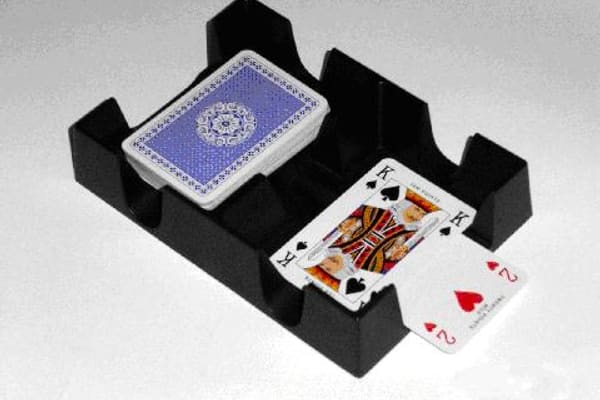
- Canasta: also the Spanish word for 'basket', referring to the round chip tray traditionally placed between the players.
Tips & Strategy
Lay down red 3s immediately; they score +100 each if your partnership melds and -100 each if not, a 200-point swing per 3. Chase natural canastas over mixed when possible: the 500-versus-300 gap compounds across multiple hands. Freeze the discard pile by discarding a wild (carefully) when opponents have large hands to prevent them from taking a big pile haul. Communicate with your partner via melds: laying 3 Queens signals you want Queen cards fed. Count wilds (12 total: 8 twos + 4 jokers); once 8 are gone, freezing is much weaker because opponents cannot easily thaw the pile. Concealed go-out (+200) is a swing play but requires never melding any cards before going out; reserve for hands where the stock is deep and partner has also not melded. Black 3s are defensive weapons: discard one when opponents threaten to pick up the pile to cost them a turn.
Canasta is a game of staged targets and information management. The initial-meld threshold scales with score, making late-game hands progressively harder to open; this is the central pacing mechanism. Winning partnerships tend to dominate the discard pile in the early hand (by meticulous control of what cards they discard versus hold for freezes), build a natural canasta in one rank before considering mixed canastas in others, and coordinate go-out timing with the partner's hand state. Going out prematurely with a partner holding 10+ cards is a major error; asking permission ('May I go out?') is the built-in protection against this.
Trivia & Fun Facts
The word 'canasta' is Spanish for 'basket', referring to the circular chip tray placed between the partnerships during historical play. At its peak in 1950, over 60 percent of American households owned a Canasta set, and the game's spread from Uruguay to the US took less than a decade. Canasta tournaments in 1952 drew crowds of thousands, and Canasta-themed cookbooks (for hosting Canasta parties) were bestsellers. The Nobel Prize-winning Argentine writer Jorge Luis Borges was an amateur Canasta player and mentioned the game in correspondence.
-
01In Canasta, what is the term for a meld of seven cards of the same rank, and how many bonus points does it score if all seven are natural (no wild cards)?Answer The meld is called a canasta; a natural (pure) canasta with no wild cards scores a bonus of 500 points, while a mixed canasta (containing 1 to 3 wild cards) scores a 300-point bonus.
-
02What is the bonus for laying down all four red 3s in Canasta, and what happens if a partnership holds red 3s but never makes any meld during a hand?Answer Holding all 4 red 3s scores an 800-point bonus (not 400); however, if a partnership has not made any meld during the hand, red 3s count as a PENALTY of 100 points each (or 800 total for all 4), reversing the bonus to a loss.
History & Culture
Canasta was invented in 1939 in Montevideo, Uruguay by the lawyer Segundo Santos and the architect Alberto Serrato, building on the older 2-player Rummy game Coon Can. It spread rapidly to Argentina (where it gained the alternate name 'Argentinian Rummy'), then to the United States via Miami in the late 1940s. By 1950 Canasta had become the most popular card game in the US, briefly displacing Bridge as the dominant partnership game; tournaments filled hotel ballrooms and Canasta-themed products (chip trays, scorecards, accessories) flooded the market. The 1950s Canasta craze peaked around 1952 and subsided into steady mid-level popularity thereafter; today Canasta remains a core game in North and South America, the UK, and much of Europe.
Canasta had perhaps the most explosive rise of any card game in history during the 1950s American Canasta craze, briefly displacing Bridge as the most-played partnership card game in the US. It remains a staple of family card-game nights in Latin America, the US, UK, and Israel, and competitive Canasta clubs exist in every major Western city. The game's Uruguayan origin is a matter of national pride in Uruguay and Argentina, and Buenos Aires still hosts Canasta championships.
Variations & House Rules
Classic Canasta (4-player partnership) is the reference version. Samba Canasta uses 3 decks and allows same-suit runs. Hand and Foot gives each player two 11-card packets to play in sequence. Bolivia and Brazilian Canasta add special wild-only canasta melds. Two-handed Canasta uses 15 cards each with 2 canasta requirement for going out. Three-handed cutthroat Canasta uses 13 cards each and 2 canasta requirement. Modern Canasta simplifies the freeze mechanic for casual play.
For a shorter session, play to 2000 or 3000 points instead of 5000. For family play, drop the initial-meld threshold entirely until players learn the flow. For competitive tournament play, follow the Classic 5000-point rules with strict red-3 and pile-freeze enforcement. New players benefit from open-hand practice rounds before attempting full-information play.


