
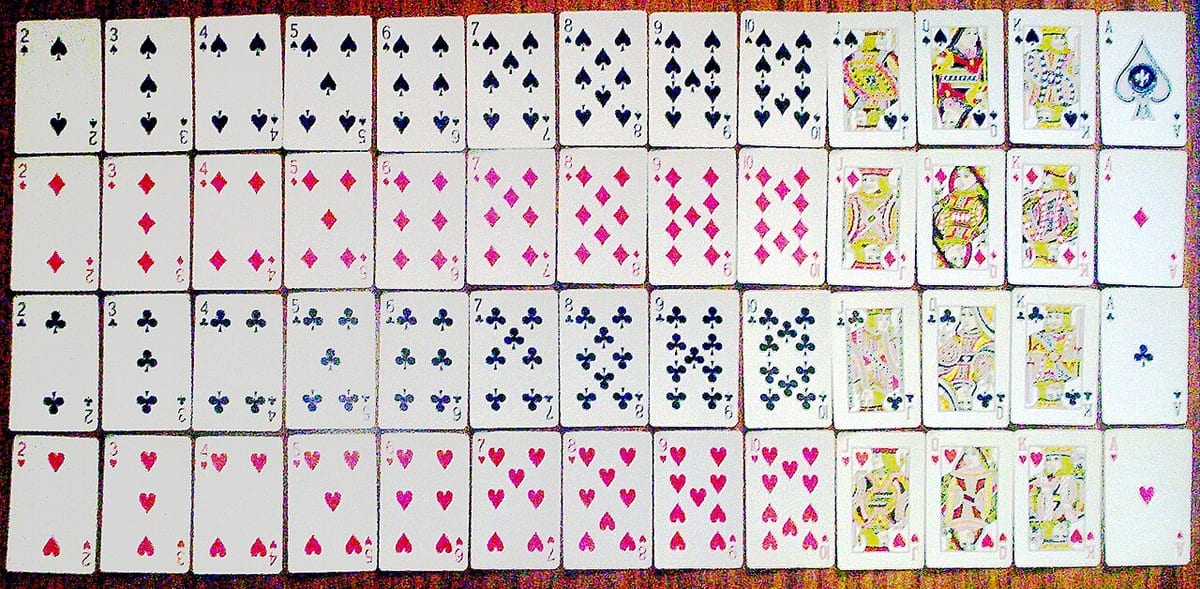
How to Play
Comet (French: Comète) is an 18th-century French stops game for 2 to 6 players and a direct ancestor of Newmarket and Pope Joan. Played with a 52-card pack minus the [8♦], its lone wild card, the [9♦] Comet, can be released at any moment to bridge a stalled run and collect an instant chip payment, while the first player to empty their hand sweeps the pool.
Comet (French: Comète) is an 18th-century French stops game for 2 to 6 players, a direct ancestor of the Pope Joan and Newmarket family of card games. It is played with a standard 52-card pack that has had the permanently removed, leaving 51 cards; the missing card leaves a fixed gap between the and the in the diamond suit. That surviving is nicknamed the Comet and acts as a wild card: whoever holds it may release it at any moment to fill whatever card a run currently needs, collecting a payment from every other player when they do. Like its descendants, Comet unfolds as a series of ascending same-suit card runs that pass from hand to hand without regard for turn order; a run halts, or stops, whenever the next needed card cannot be produced, and whoever played the last card before the stop opens a fresh run in a suit of their choosing. The first player to empty their hand ends the deal and is paid by every opponent for the cards still in their hands, while the Comet's holder can swing an entire deal simply by choosing when to cash it in.
Quick Reference
- 2 to 6 players (best with 3 or 4); remove the from a standard 52-card pack, leaving 51 cards.
- Every player antes an agreed number of chips into a central pool.
- Deal all 51 cards clockwise, one at a time, until the pack is exhausted; there is no dead hand.
- The leader plays their lowest card of any suit; whoever holds the next-higher card of that same suit plays it immediately, regardless of turn order.
- A run stops at the King of a suit, or at the gap left by the missing .
- The Comet can be played at any time to stand in for whatever card a run needs, paying its holder 1 chip from every other player.
- Whoever played the last card before a stop leads a fresh run in any suit.
- Playing the Comet earns an immediate 1-chip payment from every other player.
- The first player to empty their hand collects 1 chip from every opponent for each card still in that opponent's hand.
Players
2 to 6 players, each competing individually for the chip pool rather than in partnerships. The game plays best with 3 or 4, since the pack has only 51 cards and adding more players quickly shrinks everyone's hand to a handful of cards, which weakens the run-building and gives the Comet disproportionate power. Deal and lead rotate clockwise. Choose the first dealer by any agreed method, such as cutting the pack and giving the deal to whoever cuts the lowest card.
Card Deck
- Pack: one standard 52-card French-suited pack with the set aside and not used; only 51 cards are actually dealt and played.
- Rank order (for building runs): within each suit, cards rank from Ace (low) up to King (high): A, 2, 3, 4, 5, 6, 7, 8, 9, 10, J, Q, K.
- The Comet: the is the only card sitting immediately after the gap left by the missing eight. It is nicknamed the Comet and can be played by its holder at any time in place of whatever card a run needs next, in any suit, not only diamonds.
- Stakes: chips, counters, or coins for every player to ante with and to pay out with; a simple pool of 30 to 40 chips per player is enough for an evening.
Objective
Be the first player to play every card from your hand. The winner sweeps the central pool and collects an additional payment from each opponent for every card still left in that opponent's hand; anyone who plays the Comet also collects an immediate payment from every other player the moment they release it, so a single deal can be won either by racing to empty your hand or by timing the Comet well.
Setup
- Every player antes an agreed number of chips into a central pool before the cards are dealt; agree the ante amount and the per-card payment rate beforehand, for example 1 chip per player to the pool and 1 chip per remaining card at the end of a deal.
- Remove the from a standard 52-card pack and set it aside face down for the rest of the session; it plays no further part.
- Shuffle the remaining 51 cards and deal them out one at a time, clockwise, to every player until the pack is exhausted. Because 51 does not divide evenly among most player counts, some players receive one more card than others.
- There is no widow or dead hand in Comet, meaning every one of the 51 cards is in a player's hand for the whole deal; none are set aside unused.
- The player to the dealer's left leads the first run.
Gameplay
- The leader plays the lowest card they hold in any suit, announcing it, and places it face up on the table.
- Whoever holds the next-higher card in that SAME suit plays it immediately, no matter whose turn it would otherwise be; play then passes to whoever holds the card after that, and so on up the suit.
- A run halts, or stops, the moment nobody can continue it. In Comet there are only two causes: the next card needed is the missing and nobody plays the Comet to replace it, or the suit's King has already been played and there is no higher card to follow it with.
- When a run stops, the player who played the last card starts a brand new run, choosing any suit and leading the lowest card they still hold in it.
- The Comet is the one exception to normal turn order: at any moment, whether or not it is 'due' to be played next, its holder may lay it down to represent whatever card the current run needs, including standing in for the missing itself. Doing so immediately earns them a payment from every other player, and the run then continues normally from the card the Comet represented.
- A player holding the Comet may also simply keep it and let a run stop instead of rescuing it. Sitting on the Comet permanently blocks the diamond run at the , since only the Comet, not the missing eight, can bridge that gap, and keeps its payment in reserve for a moment when releasing it is worth more.
Scoring and Payments
- Ante: every player contributes an agreed number of chips to the pool before the deal, commonly 1 chip each.
- Comet payment: the instant a player lays down the Comet, every other player pays them 1 chip (or the agreed rate) immediately; this happens only once per deal, since the Comet is played a single time and then stays on the table as part of a completed run.
- Going-out payment: the player who empties their hand first collects 1 chip from every opponent for each card still remaining in that opponent's hand.
- No ties: because Comet is played from a single 51-card pack, no two players can ever hold the same card, so there is never a tie for who plays a given card or who empties their hand first.
Variations
- Comète à quatre: a common French four-handed arrangement that fixes the ante and Comet payment at equal small stakes, making it a light gambling game suitable for a full evening of repeated deals.
- Progressive Comet payment: some groups double the Comet payment every deal it goes unplayed, rewarding whoever finally releases it with a much larger prize.
- Ancestor of Newmarket and Pope Joan: later English stops games replaced the single wild Comet card with face-up 'boodle' cards or a dedicated board, but kept Comet's ascending, pass-out-of-turn run structure essentially unchanged.
- Two-player Comet: with only two players the game becomes a tighter, more calculable race, since each player holds roughly half the live cards and can deduce much of what their opponent still holds.
Strategy and Tips
- Holding the Comet is leverage. Releasing it the instant you draw it collects its payment quickly, but saving it to rescue your own biggest run, or to keep an opponent's suit permanently stopped at the , can be worth far more than the flat payment.
- Track the diamond suit specifically, since it is the only suit with a guaranteed stop built into the pack; once a run has stopped at the and nobody has released the Comet, the rest of that suit above the gap is dead until someone finally plays the .
- Lead your longest suit when you get a fresh lead. Because a run passes to whoever holds the next card regardless of turn order, holding several consecutive cards in one suit lets you play multiple cards in a single run and empty your hand faster.
- Count exposed cards as the deal progresses. With only 51 cards and no widow to hide information, every card not yet played is still live in someone's hand, so tracking what has appeared tells you exactly what remains.
- Racing to go out is usually worth more than holding out for Comet-adjacent gains, since the per-card payment for opponents' remaining hands can quickly exceed a single Comet payment once a deal has run long.
Winning
The deal ends the instant a player plays their last card. That player is paid 1 chip by every opponent for each card still left in their hand, on top of any chips already collected during the deal for playing the Comet. Whoever is left holding the Comet unplayed simply keeps it among their remaining cards; it counts against them like any other card when payments are settled. The deal rotates clockwise and repeats for an agreed number of hands or until the group is ready to stop; whoever has accumulated the most chips across every deal is the overall winner of the session.
Tips & Strategy
Comet rewards patience with the [9♦] more than any other single decision: releasing it the instant you draw it collects its payment immediately, but timing it to rescue your own biggest run, or to keep an opponent's suit permanently stopped at the [7♦], is usually worth more over a full deal. Track the diamond suit specifically, since it is the only suit with a guaranteed stop point built into the pack; once the run has stopped at the seven, nothing above the gap can move until the Comet appears. Favor leading your longest suit when you get a fresh lead, since a long run in one suit is more likely to keep passing back to you and let you shed several cards at once. Finally, remember that emptying your hand first is worth a chip for every card still in every opponent's hand, which usually outweighs the value of a single Comet payment, so do not delay going out purely to hold the Comet for later.
The single biggest strategic lever in Comet is timing the release of the [9♦]. Played immediately, it earns a small guaranteed payment; held back, it can rescue your own longest run at the perfect moment or keep an opponent's suit stopped indefinitely at the [7♦], which is worth far more over the course of a deal. Because the pack has no widow or dead hand, every unplayed card is still live and countable, so tracking which ranks have already appeared tells you precisely what remains and which suits are close to stopping. Leading your longest suit when you get a fresh lead maximizes how many cards you can shed in a single run, which matters because emptying your hand first is worth a chip for every card left in every opponent's hand, typically more valuable than any single Comet payment.
Trivia & Fun Facts
The Comet takes its name directly from the [9♦], the card that plugs the gap left by the missing [8♦]; players often describe releasing it as the comet finally appearing to rescue a stalled run. Comet is one of the few traditional Western card games built around deliberately removing a single card from a full 52-card pack rather than adding extra cards, jokers, or a special layout. Because the deck has only 51 cards, no two Comet deals are ever dealt from a truly full pack, a small but genuine curiosity among pack-based card games. Its ascending, out-of-turn play style is shared with dozens of later stops games across Europe and North America, and Comet is generally credited as one of the earliest members of that family still documented today.
-
01Why does Comet use a 51-card pack instead of the full 52 cards?Answer The [8♦] is deliberately removed before every deal, leaving a permanent gap between the [7♦] and the [9♦] in the diamond suit; that gap guarantees the diamond run will always stop there unless the [9♦], nicknamed the Comet, is played to bridge it.
-
02What happens the moment a player lays down the [9♦] Comet?Answer Every other player immediately pays that player 1 chip (or the agreed rate), and the run continues as though whatever card the Comet was representing had actually been played.
History & Culture
Comet is documented as an 18th-century French card game, one of the direct ancestors of the English 'stops' family that later produced Pope Joan and Newmarket. Its defining innovation, deliberately removing one card from the pack to create a permanent gap and then designating the card just above that gap as a wild card, is an unusually elegant piece of game design for its era: the missing [8♦] guarantees the diamond suit will always produce at least one natural stop, and the [9♦] Comet gives players a single, prized way to override it. As stops games evolved in Britain and America, the wild-card idea was largely replaced by boodle cards and dedicated Pope Joan boards, but Comet's ascending, pass-out-of-turn run structure survived essentially unchanged into Newmarket and Michigan.
Comet belongs to the same small-stakes, sociable gambling tradition as Newmarket, Pope Joan, and Michigan: a light, chip-staked pastime meant for mixed company rather than serious competitive play. As one of the identifiable ancestors of the English stops-game family, it offers a clear look at how a single elegant mechanical idea, a deliberately incomplete pack plus one wild card, evolved over time into the boodle cards and dedicated boards of its better-known descendants. It remains of interest today mainly to card game historians and enthusiasts of traditional stops games rather than as a mainstream pastime.
Variations & House Rules
The most common variation adjusts the stakes: a progressive Comet payment doubles every deal the [9♦] goes unplayed, building real suspense around when someone will finally cash it in. Comète à quatre fixes the game at four players with small, equal stakes for casual repeated play. Two-player Comet turns into a tighter, more calculable race, since each player holds roughly half the live cards and can deduce much of what their opponent holds. Later descendants such as Newmarket and Pope Joan replaced the single wild Comet card with face-up boodle cards or a dedicated betting board, trading Comet's single high-value wild card for several smaller side bets instead.
For a quick casual round, use a flat 1-chip ante, a 1-chip Comet payment, and a 1-chip per-card payment for the remaining hands at the end of a deal; a single deal then plays in a few minutes. For a longer session with more tension, use the progressive Comet payment variant, letting the reward double every deal it goes unclaimed, and play a fixed number of deals, such as 5 or 10, so the final chip count decides an overall winner. With exactly two players, deal the 51 cards as evenly as possible (one player gets 26, the other 25) and consider raising the per-card payment slightly, since a two-player deal empties much faster than a four or six-player one.


