
How to Play
A house-banked casino table game where each player's 2 hole cards and the five-card community board are compared against the dealer's hand, with a single fold-or-call decision made right after the flop.
Casino Hold'em is a house-banked casino table game that reshapes Texas Hold'em into a single hand fought against the dealer instead of other players. Each participant places an Ante bet, receives 2 private hole cards, and watches a five-card community board unfold much as in Texas Hold'em, but instead of raising against opponents, every player at the table makes one simple decision after the flop: fold and surrender the Ante, or call for double the Ante and see the hand through. The dealer must qualify with a pair of 4s or better for the hand to fully resolve against a winning Ante; if the dealer falls short, the Call bet simply pushes while the Ante still pays out on a player win. Devised by Stephen Au-Yeung in the late 1990s as a poker training tool and launched commercially in 2000, the game spread quickly through casinos in Egypt, Russia, and South Africa before reaching the United Kingdom in 2007, and it is now a fixture on casino floors and online gaming platforms worldwide.
Quick Reference
- 1 to 7 players each place an Ante bet; an optional AA Bonus side bet may also be placed.
- Dealer deals 2 hole cards face down to each player and 2 to themselves, then turns 3 community cards face up as the flop.
- After the flop, fold and forfeit the Ante and AA Bonus, or call by placing a Call bet equal to twice the Ante.
- Once every player has folded or called, the dealer reveals the turn and river together, then turns over their own hole cards.
- Dealer needs a pair of 4s or better to qualify; if the dealer does not qualify, the Call bet pushes and the Ante pays only if the player's hand wins.
- If the dealer qualifies and the player's hand wins, the Call bet pays 1 to 1 and the Ante pays per a fixed paytable topping out at 100 to 1 for a royal flush.
- An exact tie between the player's hand and the dealer's hand pushes every bet still in play.
Players
1 to 7 players are dealt individual hands against a single dealer who represents the house; players never compete against each other, only against the dealer's hand, so multiple players commonly win or lose the same round independently of one another. A single hand typically takes 1 to 2 minutes at a live table, faster than most player-versus-player poker variants since there is only 1 round of betting decisions.
Card Deck
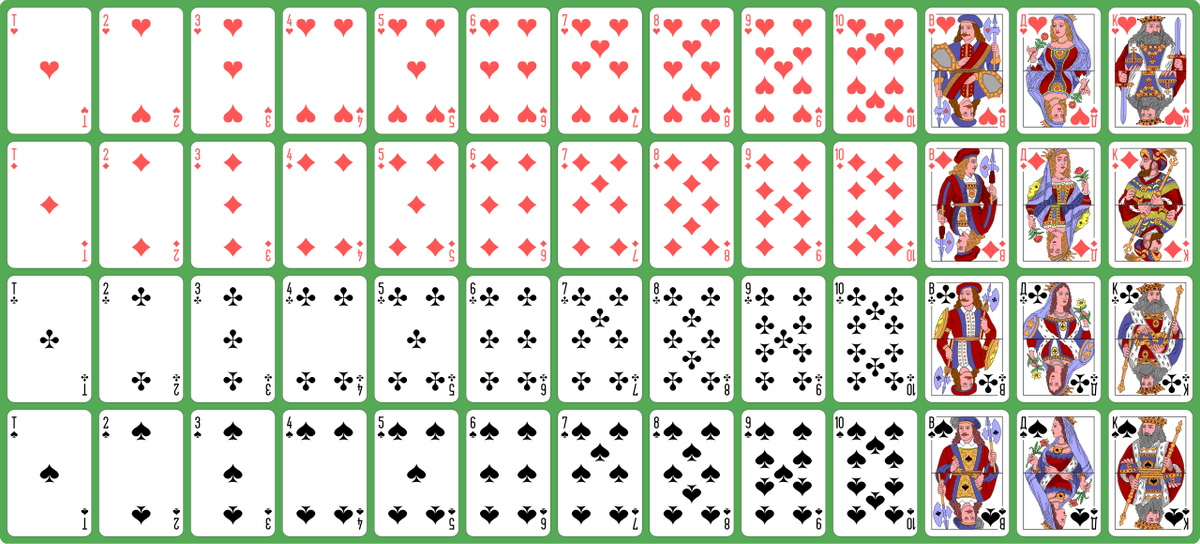
One standard 52-card French-suited deck, reshuffled between hands, commonly by an automatic shuffling machine at a live table. Standard poker hand rankings apply, from high card up to the royal flush, and suits carry no relative rank.
Objective
Form a better five-card poker hand than the dealer, using your 2 hole cards combined with the 5 shared community cards, while risking as little as possible on hands unlikely to win. Beating a qualifying dealer hand wins both the Ante, paid according to a fixed paytable, and the Call bet at even money; beating a dealer hand that fails to qualify still wins the Call bet, with the Ante simply returned.
Setup and Deal
- Each player places an Ante bet in the marked betting circle; an optional AA Bonus side bet may also be placed, paid independently of the dealer's hand.
- The dealer deals 2 face-down hole cards to each player and 2 face-down hole cards to themselves.
- The dealer immediately turns 3 community cards face up in the center of the table, known as the flop.
- Players may look at their own 2 hole cards at any point; the dealer's 2 cards stay hidden until the showdown.
Gameplay
- Decision point: after seeing the flop, each player must either fold, forfeiting the Ante and any AA Bonus bet, or call by placing a Call bet equal to exactly twice the Ante. There is only 1 decision per hand, unlike multi-stage variants such as Ultimate Texas Hold'em.
- Turn and river: once every player has folded or called, the dealer reveals the fourth and fifth community cards together, completing the five-card board.
- Showdown: the dealer turns over their own 2 hole cards and reveals their best five-card hand. The dealer's hand must contain at least a pair of 4s or better to qualify.
- Each remaining player's best five-card hand, built from their 2 hole cards and the five-card board, is then compared against the dealer's qualifying or non-qualifying hand.
Scoring
- If the dealer's hand does not qualify, the Call bet pushes regardless of the outcome, and the Ante pays according to the ante paytable only if the player's hand beats the dealer's; if the player's hand loses to a non-qualifying dealer hand, the Ante is still collected.
- Ante paytable (standard): royal flush 100 to 1; straight flush 20 to 1; four of a kind 10 to 1; full house 3 to 1; flush 2 to 1; straight or a lesser winning hand 1 to 1.
- If the dealer's hand qualifies and beats the player's hand, both the Ante and Call bets are collected. If the player's hand beats a qualifying dealer hand, the Call bet pays 1 to 1 and the Ante pays according to the paytable above. An exact tie pushes every bet still in play.
- AA Bonus side bet (optional): paid independently of the dealer's hand, using the player's best five-card hand from their 2 hole cards plus the three-card flop. A common paytable: a pair of aces through a straight pays 7 to 1; flush 20 to 1; full house 30 to 1; four of a kind 40 to 1; straight flush 50 to 1; royal flush 100 to 1.
Winning
There is no cumulative match winner; each hand is settled independently between a player and the dealer. A player wins a given round whenever their best five-card hand beats a qualifying dealer hand, collecting the Ante per the paytable plus 1 to 1 on the Call bet, or whenever their hand simply beats the dealer's cards while the dealer fails to qualify, which returns the Ante as a push while the Call bet still pays 1 to 1. Folding after the flop always loses the Ante and any AA Bonus bet immediately, with no further cards seen.
Common Variations
- Caribbean Hold'em: a widely used alternate name for the same game in many casinos and online platforms, sometimes paired with a paytable where the Ante pays even money only when the dealer fails to qualify, rather than the fuller ante paytable used in standard Casino Hold'em.
- Progressive AA Bonus: some casinos link the AA Bonus side bet to a shared jackpot, typically paying the full jackpot for a royal flush and fixed odds for lesser qualifying hands.
- Live dealer online versions: streamed casino platforms deal the identical Ante, Call, and AA Bonus structure through a live croupier, letting remote players fold or call on the same timer used at a physical table.
- Short-deck tables: a small number of casinos remove the 2s through 5s for a 36-card game, which changes hand-rank priorities, such as a flush outranking a full house, without altering the core Ante and Call structure.
Tips and Strategy
- Correct strategy calls roughly 8 hands out of every 10 dealt; folding is the exception, not the norm, since the dealer fails to qualify a meaningful share of the time.
- Always call with any pocket pair, since a pair alone frequently beats a dealer hand that fails to qualify and still keeps reasonable equity against one that does.
- Call whenever both of your hole cards individually outrank the highest card on the flop, commonly called holding 2 overcards, since these hands retain enough equity to profitably see the turn and river.
- Fold only hands with 2 low, disconnected hole cards that show little realistic chance of a straight or flush and no pair or overcard advantage against the flop already on the table.
Tips & Strategy
Correct basic strategy calls roughly 8 out of every 10 hands dealt, so treat folding as the exception rather than the default choice. Always call with any pocket pair, since even a small pair frequently beats a dealer hand that fails to qualify and keeps reasonable equity against one that does. Call as well whenever both hole cards individually outrank the highest card on the flop, a hand commonly described as holding 2 overcards, since these hands retain enough equity through the turn and river to profitably call. Reserve folding for hands with 2 low, disconnected hole cards that show little realistic path to a straight or flush and no pair or overcard edge against the cards already on the board.
Because Casino Hold'em offers only a single decision point, right after the flop, optimal strategy is far closer to a fixed rule of thumb than the multi-stage sizing decisions found in Ultimate Texas Hold'em or Three Card Poker. The Call bet is fixed at exactly twice the Ante, so the profitability of calling depends almost entirely on how a hand's equity compares to the dealer's realistic range once 3 of the 5 community cards are already known. Pocket pairs and hands with 2 overcards to the flop clear that bar comfortably, which is why correct play calls in roughly 82 percent of dealt hands rather than folding defensively. The dealer's qualifying requirement of a pair of 4s or better further tilts the math toward calling, since a meaningful share of dealer hands fail to qualify and return the Ante as a push even when the player's hand does not win outright, softening the cost of marginal calls that end up losing only the Call bet.
Trivia & Fun Facts
Casino Hold'em's roughly 2.16 percent house edge under standard pay tables and optimal play sits close to blackjack's, unusually low for a proprietary table game, which helped it spread to hundreds of online casinos running platforms from major software providers. Because the dealer only needs a pair of 4s or better to qualify, and fails to do so a substantial share of the time, correct strategy calls far more often than it folds, closer to 82 percent of hands by most published strategy charts. The game is also sold under the name Caribbean Hold'em in many markets, with only a small paytable difference between the two names rather than any change to the core rules.
-
01What minimum hand must the dealer hold for the game to be considered qualified, fully paying a winning player's Ante?Answer A pair of 4s or better; a dealer hand weaker than a pair of 4s fails to qualify, which pushes the Call bet and pays the Ante only according to a winning player's own hand.
-
02At what single point in the hand does a Casino Hold'em player decide to fold or call, and how does that differ from Ultimate Texas Hold'em?Answer Immediately after the flop's 3 community cards are revealed; Ultimate Texas Hold'em instead offers up to 3 separate decision points, before the flop, after the flop, and after the turn and river, for the same single Play bet.
History & Culture
Casino Hold'em was created by Stephen Au-Yeung in the late 1990s, originally as a training tool to help newcomers understand Texas Hold'em's structure, before it was reworked into a house-banked table game and launched commercially in 2000. The game first appeared as a live casino offering in Egypt, Russia, and South Africa, then was licensed for play in the United Kingdom in 2007, part of a broader wave of player-versus-dealer poker variants that followed the televised poker boom of the early 2000s. It predates later designs such as Ultimate Texas Hold'em, and its single post-flop decision, rather than multiple staged bets, made it one of the simplest Hold'em-based table games for casinos to teach dealers and patrons alike.
Casino Hold'em helped prove that the televised Texas Hold'em boom of the early 2000s could be repackaged as a house-banked table game without a poker room's rake or player pool, a template later refined by Ultimate Texas Hold'em and other player-versus-dealer designs. Its spread from early adopters in Egypt, Russia, and South Africa to a 2007 UK license and now hundreds of online casinos worldwide illustrates how quickly a simple, single-decision poker variant can travel once it is proven at a physical table. Marketed interchangeably as Casino Hold'em and Caribbean Hold'em depending on the region and software provider, it remains a common entry point for players who enjoy Texas Hold'em's structure but prefer a fixed house edge and a single fast decision over the deeper strategy of ring-game or tournament poker.
Variations & House Rules
Caribbean Hold'em is the most common rebranding of the same game, differing mainly in how the Ante is paid when the dealer's hand does not qualify: some Caribbean Hold'em tables pay the Ante at even money only in that situation rather than following the fuller ante paytable used in standard Casino Hold'em. A Progressive AA Bonus links the optional side bet to a shared jackpot, typically paying it out in full for a royal flush among the player's 2 hole cards and the 3-card flop. Live dealer online versions stream a real croupier dealing the identical Ante, Call, and AA Bonus structure to remote players. A smaller number of casinos deal a 36-card, short-deck style table that removes the 2s through 5s and adjusts hand-rank priorities, most notably ranking a flush above a full house, while keeping the same single post-flop decision.
For a home version, agree on a fixed Ante unit before dealing and use a separate stack or marker for the Call bet so it is never confused with the initial Ante once a hand is underway. Skip the AA Bonus side bet for simpler social play, since it adds a second paytable to track without changing the core fold-or-call decision that defines the game. Rotate the dealer position each hand, or nominate 1 player to always deal and represent the house, mirroring the role a live casino dealer plays and keeping the game balanced when the group has no actual banker. Groups that want a longer game night can deal several hands in a row per dealer rotation instead of switching every single hand, since each round finishes quickly once the fold-or-call decision is made.


