
How to Play
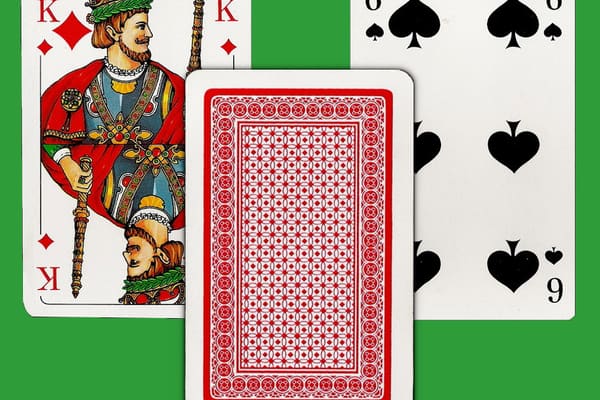
Acey Deucey (In-Between, Between the Sheets, Yablon, Red Dog) is a gambling card game of pure chance for 2 or more players. Each turn an active player is dealt two face-up 'posts' and bets that a third card will rank strictly between them; between pays from the pot, outside pays in, and an exact match pays double.
Acey Deucey (also In-Between, Between the Sheets, Sheets, Yablon, or Red Dog in a casino form) is a gambling card game of pure chance for 2 or more players. On each turn a single active player is dealt two face-up cards; they then bet a portion of a shared pot that a third card drawn next will rank strictly between the two. Getting a card between pays the bet from the pot; a card outside pays it into the pot; an exact match of either card (a post) pays double into the pot. A session lasts until the pot is empty or the players agree to stop.
Quick Reference
- Every player antes into a shared pot at the start and whenever the pot empties.
- Choose a dealer; the first active player is the one to the dealer's left.
- Dealer places two face-up posts in front of the active player; if either is an Ace, the active player announces high or low (an Ace in the second position is always high).
- Active player bets between the minimum and the pot size, or passes in some houses.
- Dealer draws a third card: between the posts wins the bet from the pot; outside pays into the pot; an exact match (post) pays double into the pot (quadruple for Ace-Ace).
- Play passes clockwise.
- Wins 1:1, losses 1:1 into the pot, post matches 2x (4x Ace), pair-post triple-match 3x.
- Session ends by agreement; highest chip total wins.
Players
2 or more players; 4 to 8 is practical. Every player plays individually against the pot (no partnerships). A dealer is chosen by any agreed method; some houses rotate the dealer between hands while others use a single 'house' dealer for the session.
Card Deck
One standard 52-card deck, no jokers. Ranks within each suit run 2 (low), 3, 4, 5, 6, 7, 8, 9, 10, Jack, Queen, King, Ace (high by default) for the purpose of deciding which cards fall between which. Suits are irrelevant. Aces have special flexibility (see Setup and Deal): when dealt as the first of the two posts, the player may choose Ace-high or Ace-low; when dealt as the second, it is always Ace-high.
Objective
On your turn, accurately judge the gap (the 'spread') between two face-up cards and bet the right amount: a very wide spread favours betting the pot; a one-rank spread is nearly unwinnable. Over the course of the session, finish with more chips than you started; the player who ends with the most chips wins.
Setup and Deal
- Agree on an ante per player and a minimum/maximum per-turn bet (often minimum 1 chip, maximum capped at pot size).
- Every player places their ante into a central pot. The pot is the common bank that all bets pay from or into.
- Choose a dealer; the first active player is the one to the dealer's left.
- On the active player's turn, the dealer places two face-up cards (the posts) in front of them.
- Ace handling (first post): If either of the two posts is an Ace, the active player announces high or low for the Ace before the next step. (By convention an Ace dealt as the second post is always high.) Announce clearly so the spread is unambiguous.
- Spread: The spread is the number of ranks strictly between the two posts. Example: posts 5 and 10 have a spread of 4 (6, 7, 8, 9); posts 5 and 6 have a spread of 0 (no rank between them); matching posts (for example two 7s) have a special spread mode (see Gameplay).
Gameplay
- Bet or pass: The active player decides how much of the pot to bet, from a minimum (often 1 chip) up to the current pot size. Some houses allow 'pass' (bet nothing) when the spread is unfavourable; others require a minimum bet on every turn. Announce the bet out loud.
- Draw the third card: The dealer draws the next card from the stock and places it face-up between the two posts.
- Between (win): If the third card's rank lies strictly between the two posts, the active player wins their bet from the pot; the pot decreases by the bet amount and the active player gains that many chips.
- Outside (lose): If the third card's rank is outside the two posts (higher than the higher or lower than the lower), the active player loses their bet into the pot; the pot increases by the bet amount.
- Post (exact match): If the third card exactly matches either of the two posts (for example posts 5 and 10 with a third card of 5 or 10), this is a post; the active player loses double their bet (paid into the pot).
- Ace post: If one post was an Ace and the third card is an Ace, the payout is quadruple the bet (four times the stake into the pot). This is because Aces have higher variance.
- Pair posts (matching two): If the first two cards are the same rank (for example two 7s), the active player bets whether the next card will be higher or lower than this rank. If the third card matches the rank again (a third 7), the active player pays triple their bet into the pot.
- Consecutive or touching posts: If the two posts are consecutive (spread = 0, e.g., 7 and 8), no rank falls between them and the active player is usually allowed to pass with no bet. Some houses require a minimum ante regardless.
- Replenishing the pot: When the pot is empty (all chips paid out), everyone antes again to restart. Sessions usually continue until players agree to stop.
- Next turn: Play proceeds clockwise to the next active player, regardless of win or loss on the current turn.
Scoring
- Per-turn settlement: Wins and losses happen instantly at the end of each turn by moving chips between the pot and the active player. No cumulative scoring is kept beyond chip totals.
- Session scoring: Chip totals at the end of the session are the final scores. The player with the most chips wins; anyone with negative net chips has lost.
- Payout multipliers by outcome: Win (between) pays 1:1 (pot pays bet). Loss (outside) pays 1:1 into the pot. Post (exact match) pays 2x into the pot. Ace post pays 4x into the pot. Pair-posts hitting a third match pays 3x into the pot.
Winning
- Session winner: Highest chip total at the end of play.
- No fixed-length sessions: Play continues at the players' agreement or until the pot is empty and no one wants to re-ante.
- Ties: If two players tie on chip totals, play one extra turn each to resolve; higher net wins.
- Breaking the pot: When a player wins the last chip in the pot, the hand ends; players re-ante to continue.
Common Variations
- Blind Pot: The third card is drawn face-down and revealed only after the bet; prevents peeking.
- AutoPot: Posts of A-2 (or 2-A) force the active player to bet the full pot; a lucky break but rare.
- Satan 6s: Three 6s (6-6 posts plus a 6 third card) require the active player to pay 6 times their bet.
- Post Bet: Side bet on whether the third card will be a post; pays 10:1 if correct.
- No-double-penalty: Drop the post-rule; match pays the same as any other outside card. More forgiving for beginners.
- Red Dog (casino): A simplified version in which the dealer plays the bank and pays set odds; the math changes but the core mechanism is the same.
Tips and Strategy
- Spread math is the whole game. Count the ranks strictly between the two posts: the probability of the next card being between is (spread × 4 pairs) / (remaining cards). With an Ace-2 spread (all ranks in between, 11 × 4 = 44 cards), odds exceed 90%; with a 7-9 spread (one rank between, 4 cards), odds are under 10%.
- Never bet heavy on a spread of 3 or less; the post risk (double-penalty) pushes expected value negative.
- Aces dealt as the first post: choose the Ace direction (high or low) that maximises the spread. If the other post is a 7, call Ace-low for a 6-rank spread (2 to 6 remaining plus 8 through Queen if you call high); plugin the numbers before deciding.
- Avoid the full-pot 'brave' bet. Betting the whole pot on a 50% chance of winning returns zero expected value but exposes you to busting out.
- When the pot is nearly empty, small bets let you chase recovery without needing a re-ante; keep minimum bets reserved for these situations.
Glossary
- Post: One of the two face-up cards dealt at the start of a turn; also the name for an exact-match third card that pays double.
- Spread: The number of ranks strictly between the two posts.
- Ante: The compulsory chip contribution to the pot at the start of a session or after the pot empties.
- Pot: The central pool of chips that bets pay from (on wins) or to (on losses).
- Between / outside: The two winning/losing outcomes: between = third card ranks between the posts (win); outside = third card's rank is above or below both posts (lose).
- Ace-high / Ace-low: The choice available to the active player when an Ace is dealt as the first post; determines whether Ace ranks as 1 or as 14 for the spread calculation.
- Post-matched: An exact match between the third card and either post; pays double (or quadruple for Ace-Ace).
Tips & Strategy
Spread math is the whole game: count the ranks strictly between the two posts. A spread of 3 or less is nearly always a losing bet once you account for the post (double-penalty) risk; bet heavy only on spreads of 7 or more.
Ace handling is a tactical lever: when an Ace is dealt as the first post, choose high or low to maximise the spread. Never bet the full pot on a 50-50 spread; expected value is zero and you expose yourself to busting out.
Trivia & Fun Facts
With a perfect Ace-low-through-King spread (12-rank gap) the odds of winning exceed 90 percent, but the rare 8 percent losing outcome (plus post risk) keeps the pot dynamic.
-
01What happens in Acey Deucey if the third card exactly matches one of the two face-up posts?Answer It is a post: the bettor loses double their bet into the pot (or quadruple if an Ace matches an Ace).
History & Culture
Acey Deucey has been a popular American military and college gambling game since the mid-20th century, valued for its simplicity and the excitement of the growing pot; it survives today in casino form as Red Dog.
A long-standing favourite in American military barracks, college dormitories, and casino floors; the subject of folk card-game lore and a regular topic in gambling-strategy guides.
Variations & House Rules
Blind Pot draws the third card face-down before the bet; AutoPot forces a full-pot bet on A-2 posts; Satan 6s require 6x payment on three 6s; Post Bet is a side bet on match-third-card. Red Dog is the casino simplification.
Cap bets at half the pot for a more conservative session; drop the post (match) double-penalty for beginners. For a competitive evening, use a posted minimum bet to force aggressive play.


