
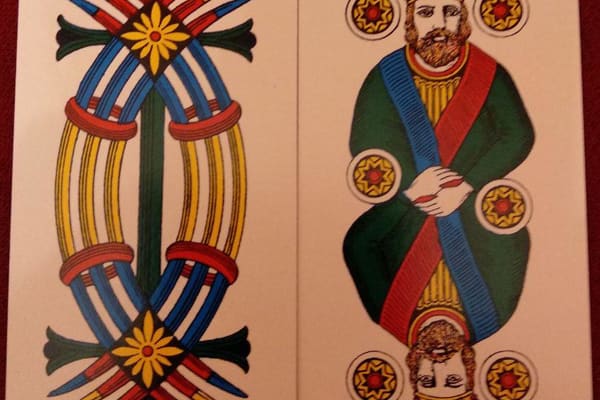
How to Play
Italy's iconic Christmas banking card game: draw cards from a 40-card deck to reach as close to 7.5 as possible without busting. Face cards count half, the matta is wild, and a two-card 7.5 (reale) pays double and transfers the bank.
Sette e Mezzo ('Seven and a Half') is the traditional Italian banking card game that, together with French Trente-et-Un, is considered the direct ancestor of Blackjack. It is played with a 40-card Italian deck (number cards 1 through 7 plus Knave, Knight, and King in four suits, either Italian-suited bastoni/spade/coppe/denari or a French-suited 52-card pack with 8s, 9s, and 10s removed). Players compete individually against a banker, aiming to draw cards until their hand totals as close as possible to exactly 7.5 without going over. Number cards are worth their pip value (Ace = 1, 2 = 2, ..., 7 = 7) and face cards are each worth 0.5. One card, the matta (wild, traditionally the King of Coins / King of Diamonds in French-suited packs), counts as any value the holder chooses. A two-card hand totalling exactly 7.5 is a reale and pays double. The game is especially associated with the Italian Christmas and New Year holidays, where it is played around the family table for small stakes.
Quick Reference
- Use a 40-card deck (Italian or standard deck with 8s, 9s, 10s removed).
- Choose a banker; players place individual bets.
- Deal one face-down card to each player.
- Examine your face-down card privately.
- Draw additional face-up cards one at a time, or stand.
- Matta (wild King) counts as any value. Bust if you exceed 7.5.
- Banker draws last; may stand at any total.
- Number cards = face value; face cards = 0.5 each.
- Closer to 7.5 than banker wins 1:1. Ties go to the banker.
- Two-card 7.5 (reale) pays 2:1 and transfers the bank.
Players
Typically 3 to 8 players including the banker, though any number from 2 to 12 can play. Each player competes individually against the banker; non-banker players never affect each other's outcomes. The banker role rotates: in the standard rule, any player who makes a two-card 7.5 (reale) takes over the bank on the next deal, otherwise the bank holds for at least one complete round.
Card Deck
A 40-card deck: either a true Italian deck (coins/denari, cups/coppe, swords/spade, clubs/bastoni with Ace-2-3-4-5-6-7-Knave-Knight-King = 10 ranks per suit), or a French-suited 52-card deck with all 8s, 9s, and 10s removed. Card values: Ace = 1, 2 through 7 = pip value, face cards (J/Q/K or Knave/Knight/King) = 0.5 each. The matta is the King of Coins in Italian packs or the King of Diamonds in French-suited packs; it is wild and counts as any value the holder names (traditionally set at the draw, not after).
Objective
Beat the banker by holding a hand closer to 7.5 than the banker, without exceeding 7.5. You bust the moment your total goes over 7.5, forfeiting your bet immediately. A two-card exact 7.5 (reale) wins automatically and pays double.
Setup and Deal
- Agree who is the first banker. The banker holds the bank until someone else makes a reale (or until the group agrees to rotate).
- Each non-banker player places their bet in front of them. The banker's stake is the sum of all player bets (the bank covers each bet individually).
- Shuffle the 40-card deck. The banker deals one card face-down to each player (including themselves), going anticlockwise.
- Each player privately examines their face-down card before deciding whether to draw.
Gameplay
- Player turns (anticlockwise starting from the banker's right): On your turn, look at your face-down card privately, then either stand or ask for a card. Each additional card is dealt face-up; they remain on the table for all to see.
- Matta rule: If you hold (or draw) the matta, you may declare its value at the moment you need to compute your total. Most houses require the value to be declared when the hand is revealed, not mid-draw.
- Standing: When you are satisfied, say 'sto' ('I stand'). Play passes to the next player. Your face-down card remains hidden until the banker's showdown.
- Busting: If your running total exceeds 7.5, you immediately reveal all your cards and forfeit your bet to the banker. A busted player does not continue.
- After all players have acted, the banker's turn: The banker reveals their face-down card and draws until they either stand or bust, following the same rules. The banker may stand at any total from 0 to 7.5.
- Showdown: Each remaining player reveals their hand. Each player's total is compared individually to the banker's total.
Scoring
- Banker busts: Every non-busted player wins 1:1 (even money) on their bet.
- Neither busts, player total > banker: Player wins 1:1.
- Neither busts, banker total >= player total: Banker wins; player loses their bet. (Ties go to the banker.)
- Player reale (two-card 7.5): Pays 2:1 (double) from the banker. This is declared immediately when the player reveals their initial two-card 7.5.
- Banker reale: Every player pays double their bet to the banker. Essentially a banker blackjack.
- Player busts: Bet lost immediately, no matter what the banker does later.
Winning
Sette e Mezzo is played hand by hand for stakes rather than to a target score. Each deal is a self-contained wager. The bank-transfer rule gives long-term strategic depth: making a reale (two-card 7.5) not only pays double but also transfers the bank to you, letting you play against everyone else for the rest of the session. The player who holds the bank at the end of the evening usually ends up ahead, which is why banking is prized.
Common Variations
- Rotating dealer (standard): Any player who makes a two-card reale takes over the bank on the next deal. If multiple players make reales in the same deal, the one seated closest anticlockwise of the current banker takes over.
- Fixed banker: The banker keeps the bank for an agreed number of deals (e.g. 5) before rotating.
- No matta: Some groups drop the wild King for a purer probability game; removes the skill element of choosing wild value.
- Three-card bonus: Many houses add a bonus for a three-card 7.5 (e.g. 1.5× payout), as achieving it with three cards is much harder than with two.
- Sette e Mezzo Reale: A variant where all face cards are worth 1 point (not 0.5), changing the probabilities and making 7.5 easier to hit exactly.
Tips and Strategy
- Stand on 5.5 and up: From 5.5, drawing any card above 2 busts you. Even a ½-point face card brings you to 6, and another draw has high bust odds.
- Watch the table: Face-up cards on the table tell you what has already been drawn. If you have seen many face cards (low-risk draws for yourself), the deck is richer in higher cards and busts become more likely.
- Matta is gold: If you hold the matta, you almost always have a safe hand: call it the value that makes your total exactly 7.5 at the showdown, no matter what else you have drawn.
- Banker's advantage: The banker acts last and sees every player's decision before drawing. As banker, stand on any total of 4 or higher when most players have stood; only push when many players made strong bets and stood high.
- Chase the reale for the bank: A reale not only pays double but also transfers the bank to you. On a 7-card hand total of 7, drawing one more card for the matta play is usually worth the risk if you are close to the bank anyway.
Glossary
- Reale: A two-card hand totalling exactly 7.5, paid 2:1 and (by default) transfers the bank to its holder.
- Matta: The wild card (King of Coins or King of Diamonds); counts as any value the holder names.
- Sto: 'I stand' - the call to stop drawing.
- Carta: 'Card' - the call asking for another card.
- Busted: Total over 7.5; immediate loss.
- Banker / Mazziere: The player holding the bank; covers every other player's wager.
- 40-card deck: A standard Italian deck or a stripped French deck missing 8s, 9s, and 10s.
Tips & Strategy
Stand on 5.5 or higher since the deck is rich in bust cards. As banker, stand on 4 or 5 when players have already stood because you only need to beat or match their totals. Treat the matta as an automatic winning complement to round your hand to exactly 7.5.
The half-point face cards create finer probability gradations than Blackjack. At totals of 3 to 5, drawing another card is almost always correct because two-thirds of the 40-card deck are 'safe'. At 5.5 and above, the math flips: most draws bust you. The matta is the single most valuable card in the game, worth more than any specific natural total.
Trivia & Fun Facts
Sette e Mezzo is the most popular card game in Italian households on Christmas Eve and New Year's Eve; tradition holds that playing for small coins brings good luck for the coming year. Some households keep a dedicated 'Christmas deck' that only comes out during the holiday season.
-
01In traditional Sette e Mezzo, which specific card serves as the matta (wild card) that can represent any value the holder chooses?Answer The King of Coins (Re di Denari) in an Italian deck, or the King of Diamonds [K♦] when using a stripped 40-card French-suited deck.
History & Culture
Sette e Mezzo dates back to at least the 16th century in Italy and is one of the two main ancestors of 20th-century Blackjack (the other being French Trente-et-Un). References to the game appear in the 1570s in Venetian card-game treatises, and it has been the emblematic Italian Christmas family game for at least four centuries. Generations of Italian children have learned it at the kitchen table during the holiday season.
Sette e Mezzo is the single strongest marker of Italian family holiday life. During the Christmas-New Year week, it is played around dining tables and in cafes across Italy, with nonnas teaching grandchildren the rules and small bets made in leftover coins from the Christmas dinner. The game features in Italian films, holiday novels, and Christmas advertising as shorthand for intergenerational family time.
Variations & House Rules
The rotating-dealer form is most common: making a reale takes the bank from the current banker. No-matta variants drop the wild King for pure probability play. Three-card bonus rules reward harder-to-hit three-card 7.5s. Sette e Mezzo Reale treats face cards as worth 1 point, simplifying arithmetic.
Play with dried beans, chocolate coins, or tokens for family-friendly stakes. Introduce a bonus rule where three consecutive face cards automatically wins regardless of total. For large groups, split into two tables, each with its own banker, and combine winnings at the end.


