
How to Play
A family matching card game in which players ask named opponents for named cards to collect quartets (four of a rank or themed family). Direct ancestor of Go Fish and the Victorian Happy Families tradition.
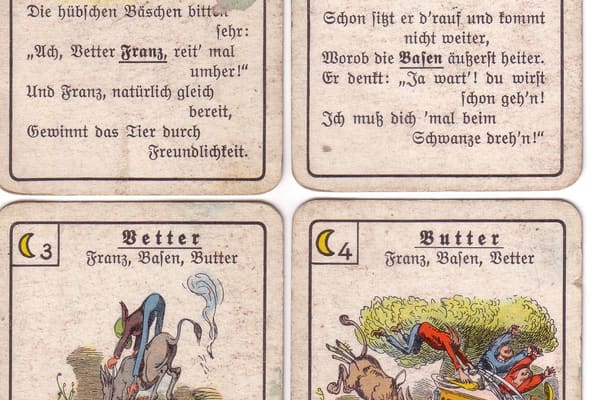
Quartets is a family of matching card games in which each player's goal is to collect complete sets (quartets) of four related cards by asking opponents for specific cards by name. It is the international generic form of Happy Families, the 1851 John Jaques and Son game that first formalised the mechanic in Victorian England. Quartets can be played with a purpose-printed pack (typically 32 to 48 cards arranged in 8 to 12 themed families of 4) or with a standard 52-card deck, in which case each rank (Aces, Kings, Queens, and so on) forms one quartet of 4 cards. Play passes clockwise and every answer is truthful: when you ask a named opponent for a specific named card, they must hand it over if they hold it, and otherwise say so, which ends your turn and passes play to them. A player may only ask for a card whose quartet they are already holding at least one card from. When all 13 quartets in a 52-card deck (or all printed families in a custom pack) have been laid down, whoever has collected the most sets wins the match. Quartets is the ancestor of Go Fish and the British Happy Families tradition, and the mechanic underpins modern family learning decks sold in Germany, France, and the Netherlands as Quartett or Jeu des 7 Familles.
Quick Reference
- 3 to 6 players. Use a 52-card deck (13 quartets) or a themed Happy Families pack.
- Shuffle and deal all cards evenly. No draw pile.
- Ask a named opponent for a named card; you must already hold one card of that quartet.
- If they have it they must hand it over and you go again.
- If not, turn passes to them and they become the next asker.
- Lay down completed quartets face up in front of you.
- 1 point per quartet. Most quartets when the deck is exhausted wins.
Players
3 to 6 players, best at 4 or 5. No partnerships; every player is for themselves. Deal rotates clockwise after each completed match. Typical match takes 15 to 25 minutes with a 52-card deck or 10 to 15 minutes with a themed 32 to 48 card set.
Card Deck
Two options. (1) Standard 52-card pack: each rank (A, K, Q, J, 10, 9, 8, 7, 6, 5, 4, 3, 2) forms a 4-card quartet, giving 13 quartets in total. (2) Purpose-printed Quartets or Happy Families deck: 8 to 12 themed families of 4 cards each (e.g. Mr Bun the Baker, Mrs Bun, Master Bun, Miss Bun), typically 32 to 48 cards total. With a custom pack, each family is a quartet. Suits do not matter in either form; only the rank or family name is tracked.
Objective
Collect more complete quartets than any other player. A quartet is all 4 cards of one rank (with a 52-card pack) or all 4 members of one printed family (with a themed pack). When every quartet in the deck has been completed and laid face up in front of its owner, whoever holds the most quartets wins.
Setup and Deal
- Shuffle the pack thoroughly.
- Deal the cards one at a time clockwise until the deck is exhausted. Players may receive unequal hands if the deck does not divide evenly; this is normal and no draw pile is used.
- Players sort their hands privately by rank or family. The player to the dealer's left takes the first turn.
- Any player who is dealt a complete quartet at the start may lay it face up immediately before play begins (optional; some groups require the player to wait and capture it during play).
Gameplay
- Asking: On your turn, choose one named opponent and one named card by rank or family (e.g. 'Sam, do you have the King of Spades?' or 'Sam, may I have Master Bun?'). You must already hold at least one card of that quartet in your own hand to be allowed to ask for it.
- Truthful answer: The asked player must answer honestly. If they hold the named card, they hand it over face up to the asker and the asker takes another turn. If they do not, they say so and the turn passes to them (they become the next asker).
- Laying down a quartet: As soon as you hold all 4 cards of a single quartet, place them face up in a row in front of you. Those cards are out of play and count as 1 point toward your score.
- Running out of cards: If your hand empties mid-game and at least one quartet is still out there, draw 1 card from any still-holding opponent (or, in variants, skip your turn) and continue. Some groups simply pass to the next asker when an empty-handed player's turn comes.
- End of match: The match ends when all quartets in the deck have been collected. If a player holds partial quartets that no one can complete because the remaining cards are in other hands, the round still continues until every card is accounted for.
Scoring
- 1 point per complete quartet laid down during the match. No partial credit for 2 or 3 cards of a rank or family.
- Match winner: Player with the most quartets at the end. Ties are shared or broken by an extra quick deal.
- Session score: For longer sessions, add up quartets across several matches and declare the session winner at an agreed threshold (e.g. first to 10 quartets across matches).
Winning
Winning a single match is collecting the most quartets once the deck is exhausted. A complete 52-card match awards up to 13 quartets distributed among the players; a Happy Families 44-card match awards 11. There are no lives or elimination; when the deck is done, the tally decides the winner.
Common Variations
- Happy Families (John Jaques, 1851): The original themed version; 11 families of 4 cards each (Mr, Mrs, Master, Miss) built around comic Victorian occupations. Same asking rules, same winning condition; the themed pack is the distinguishing feature.
- Go Fish: Close cousin. Instead of turn passing when the asked player does not have the card, the asker draws one card from a central stock. A player who draws the exact card they asked for takes another turn.
- Authors (educational variant): Quartets with author-themed cards; each family is four works of one author.
- Jeu des Sept Familles (France): Seven families of 6 members (grandfather, grandmother, father, mother, son, daughter); sextets rather than quartets, but otherwise identical rules.
- Quartett (Germany): Themed educational packs (cars, dinosaurs, cities) using the same mechanic; often with additional 'top trumps' style comparison scoring when the quartet is laid down.
- Strict Happy Families: The 1851 rulebook says a player who forgets to ask for a card on their turn loses it to the opponent who spotted the mistake. Played by Victorian children as a memory and etiquette drill.
Tips and Strategy
- Listen closely to every ask. When Sam asks Alex for the 7 of Clubs, you learn Sam holds at least one 7 and Alex probably does not have the 7 of Clubs; both facts narrow your choices later.
- Save your most obvious asks for the end of your turn. If your first ask exposes a quartet you are chasing, subsequent asks across the table will try to starve you.
- Do not ask blindly. The 'you must hold one card of the quartet' rule is real, and some strict groups penalise an illegal ask (typically the offender loses a card to the player they tried to ask).
- In themed packs, ask early for members of families you already hold two of. The later the match runs, the easier it is for opponents to remember which family you are chasing.
- If you run out of cards mid-match, agree with the group in advance whether your turn is skipped or whether you may draw one card from a still-holding opponent.
Glossary
- Quartet: A complete set of 4 cards of one rank (in a 52-card deck) or one family (in a themed pack). Worth 1 point.
- Family: A themed-pack quartet, e.g. the Buns (Baker family) in Happy Families.
- Ask: The turn action of naming one opponent and one specific card you want. Requires holding at least one card of that quartet.
- Lay down: Placing a completed 4-card quartet face up in front of you. The cards are locked out of further play.
- Happy Families: The 1851 John Jaques and Son named themed variant; the original marketed form of Quartets.
- Strict ask rule: A house rule that penalises asking for a card you do not already hold a member of.
Tips & Strategy
Track every ask. Each question reveals which quartets the asker is chasing and which cards the asked player does not hold. Save your obvious asks until near the end of your turn so you do not hand away free information before you have collected what you need. Only ask for a card whose quartet you already hold one member of; the rule is easily forgotten but strict groups penalise violations.
Quartets is a limited-information deduction game, not a luck game. Every public ask narrows the probability map for every player paying attention. Skilled players memorise which quartets each opponent has asked about and which cards each asked opponent denied holding; across 10 to 20 turns, this information is usually enough to identify the exact location of the last missing card in any quartet. The game rewards memory rather than card manipulation.
Trivia & Fun Facts
Happy Families' illustrations of sour-faced Victorian professionals are collector's items, and modern reprints of the original John Jaques deck are still in print 175 years after first publication. Go Fish is essentially Quartets with a draw-pile twist, demonstrating how a single rule change (draw a fish card on failed ask) spawned an entirely separate game tradition. The Jeu des Sept Familles adjustment from quartets to sextets makes matches longer and more strategic because any given family represents a larger fraction of the deck.
-
01In what year and by which publisher was Happy Families (the first standardised Quartets pack) released?Answer 1851, by John Jaques and Son in London.
-
02Under the standard Quartets rule, may a player ask for a card from an opponent if the asker does not already hold at least one card of that quartet?Answer No. The asker must already hold at least one card of the quartet they are asking about; asking without holding any is illegal and is penalised in strict rule sets.
History & Culture
Quartets as a formal card game was standardised by John Jaques and Son in 1851 under the name Happy Families, with 11 families of 4 Victorian-era occupations (Mr Bun the Baker, Mr Chip the Carpenter, and so on). The mechanic predates that publication; similar ask-and-collect games had circulated in 18th-century England and France. Happy Families was one of the first commercially successful children's card games and cemented the 4-card-family format that continues in modern educational decks worldwide. Quartets spread across Europe as Quartett (German) and Jeu des Sept Familles (French, with sextets rather than quartets), and the Authors variant became an American educational classic in the late 19th century.
Quartets and Happy Families are foundational children's card games across Europe and North America. Happy Families gave countless Victorian children their first structured card-game experience, and its decks are standard teaching tools for learning turn-taking, truthful answering, and polite asking. Jeu des Sept Familles plays a similar foundational role in French childhood gaming, and Quartett is a ubiquitous souvenir-shop purchase in German-speaking Europe.
Variations & House Rules
Happy Families is the 1851 themed original. Go Fish adds a draw pile and becomes a faster children's game. Authors is the educational variant. Jeu des Sept Familles uses sextets of 6 cards. Quartett is the German themed-deck family with optional top-trumps comparison scoring. Strict Happy Families enforces memory penalties for forgotten asks.
For young children, allow the 'strict ask' rule to be relaxed so illegal asks simply forfeit the turn rather than a card. For strategy-focused groups, use the 1851 forgetfulness penalty (a forgotten ask forfeits a card). For mixed-age play, hand each child one printed family card as a reminder of who they are chasing.


